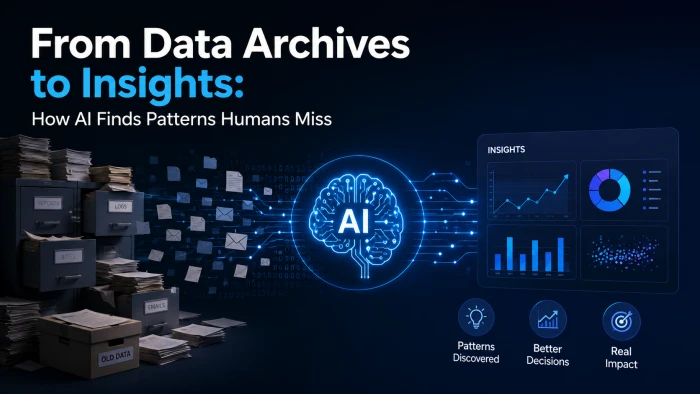
Somewhere inside every large company sits a room nobody visits. Not always a physical room. Sometimes it is a server, a decade of scanned invoices, a folder of customer support transcripts nobody has reopened, or a warehouse of paperwork nobody has scanned yet. Analysts estimate that more than half of all enterprise data falls into this category: collected and stored, then never looked at again.
Splunk's own research group has tracked this shadow inventory across enterprise clients for years and reports the same finding project after project: most organizations know less about their own archives than they assume.
Data scientists call this dark data. Storage vendors call it a line item on a cloud bill. For a business, it behaves more like a locked room in a house you already own, one you keep paying rent on without knowing whether it holds old tax paperwork or something worth real money. What sits inside rarely matters as much as the fact that almost nobody opens the door. Sorting a warehouse of scanned files or years of transaction logs by hand takes a team nobody can spare and months nobody wants to lose.
This is where the maths changes. A machine can read that entire room in a matter of hours and hand back a short list of what actually mattered. This piece walks through why the human eye struggles with that job first. Then it traces four real discoveries AI has pulled out of archives like this one, before ending with the five practical steps for opening your own.
The Archive Nobody Opens
Dark data is not junk. It is often the most detailed record a company owns of what actually happened: old customer emails, warehouse sensor logs, scanned contracts, call transcripts, security footage sitting on an unlabeled drive in a closet. It shows up in aging log files nobody reads until something breaks, in customer support transcripts and emails, in scanned paperwork and old contracts, and in sensor or camera feeds nobody assigned anyone to review.
The volume grows every quarter, and the archive gets harder to search with each passing year. Adoption of tools built to manage this problem is growing too. Metadata management software adoption alone grew by 44 percent between 2024 and 2025, as more companies tried to get a handle on backlogs they had been ignoring for years.
| Source | Typical Owner | Why It Gets Ignored |
|---|---|---|
| IT and system logs | Engineering | Too large to read by hand, checked only after a failure |
| Support tickets and emails | Customer service | Filed away by date, almost never reread |
| Legacy contracts and paperwork | Legal or finance | Scanned once, never indexed |
| Sensor and video feeds | Operations | Recorded for compliance, never analyzed |
Left alone, none of this is neutral. Global spending on storing data nobody uses is on pace to cross 500 billion dollars a year by 2028 if the trend holds. That is the storage problem. The harder one sits a level up, in the human brain assigned to make sense of what is inside.
Why the Human Eye Stops Seeing
A person can hold a handful of variables in working memory at once and compare them well enough to spot a trend. A spreadsheet with forty columns breaks that ability fast. Forty columns produce 780 possible pairwise relationships to check by hand, and nobody sits down and checks 780 relationships on a Tuesday afternoon.
Analysts do not fail this test because they are careless. Pattern recognition across data with that many dimensions is not a skill human cognition was built for at scale, and confirmation bias makes the problem worse: once a person expects to find a certain trend, attention narrows toward evidence that confirms it and away from everything else. Machine learning systems carry no such expectation. They hold every combination at once and compare all of it without getting tired on the four hundredth pass.
Data scientists have a name for this: the curse of dimensionality. Add ten more columns to that same spreadsheet and the count of pairwise relationships climbs past 1,225. A human reviewer would need weeks just to glance at each pair once, let alone judge which ones matter.
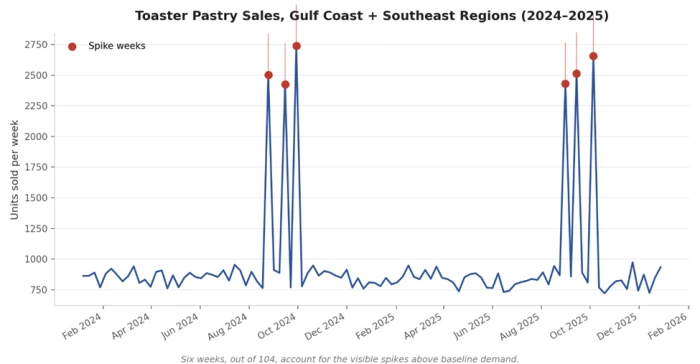
Walmart learned this from a hurricane. Storm season sales data always showed the obvious spike: water, batteries, canned food, and flashlights. Buried inside years of point-of-sale records sat a second pattern nobody on staff had thought to look for, a sharp rise in purchases of strawberry Pop-Tarts in the days before a hurricane made landfall. An AI system combing through the transaction history surfaced the correlation on its own, without anyone asking it to look for snack food. Walmart now ships extra truckloads of the product to stores sitting in a storm's forecast path.
Nobody had missed this out of laziness. Nobody had thought to ask the question in the first place.
This is the exact gap machine learning was built to close, and the mechanics behind it are less mysterious than the marketing around AI tends to suggest.
What's Actually Happening Underneath
Four techniques handle most of this work, and each one suits a different kind of archive.
| Technique | What It Reads | What It Finds |
|---|---|---|
| Anomaly detection | Transactions, sensor data, financial logs | Outliers that break an expected pattern, like a fraudulent charge or a failing part |
| Natural language processing | Emails, tickets, contracts, call transcripts | Repeated complaints, buried contract clauses, early churn signals, and shifts in sentiment |
| Computer vision | Scanned documents, medical images, camera feeds | Visual defects, diagnostic markers, packaging errors, and details a tired eye scans past |
| Generative AI interface | All of the above, combined | Plain-language answers to questions typed in ordinary sentences |
The fourth row matters most for people who never touched a query language before. A category manager does not need to write SQL anymore. As of 2026, tools like Claude and ChatGPT let someone upload a spreadsheet and ask, in a normal sentence, what changed in returns last quarter, then get an answer back instead of a blank cursor.
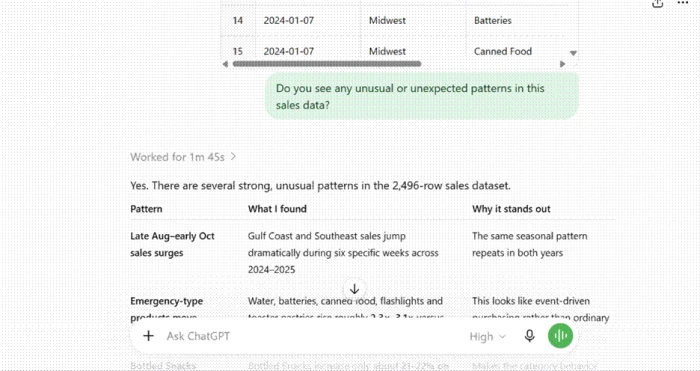
Techniques on a page are one thing. What happens once this gets pointed at a real archive, in a real industry? Four examples make the answer concrete.
Four Archives, Four Discoveries
Retail
The Pop-Tarts correlation from the section above is the example everyone quotes, and it earns the attention. It is also one line inside a much longer list Walmart's system now tracks automatically every storm season, catching seasonal and regional buying shifts a regional manager would never have time to compile by hand.
Medicine
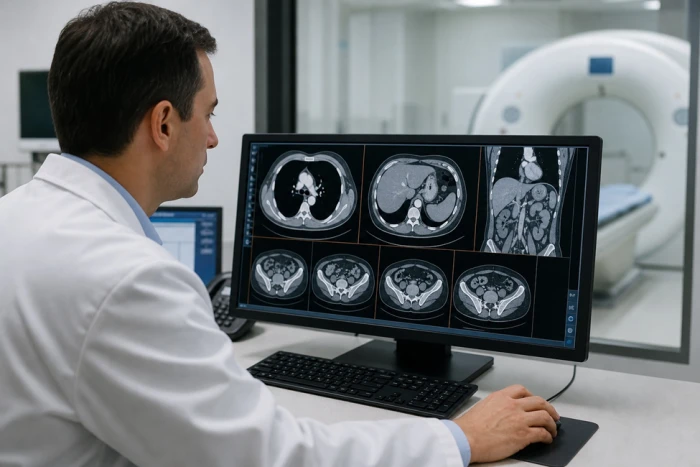
Radiologists read thousands of scans across a career and develop sharp instincts for catching what they were trained to look for. Deep learning models trained on medical imaging now match or exceed specialist accuracy on specific conditions, including certain cancers and diabetic retinopathy, a diabetes complication that can cause blindness if it goes undetected. The model is not smarter than the doctor reading the scan. It has simply reviewed more images than any one person could see across ten careers, and it never gets tired on the four hundredth scan of the day.
The Laboratory and the Night Sky
In October 2025, researchers at Oxford and Google Cloud tested a general-purpose AI system on a problem astronomers have wrestled with for over a decade: telling a genuine cosmic event, an exploding star or a black hole shredding a passing star, from a false signal buried in telescope data. A panel of twelve astronomers reviewed the results. They rated both the AI's classifications and its written reasoning behind each one as coherent and useful.
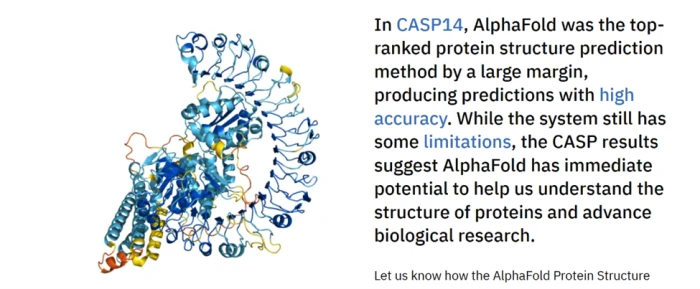
The same wave of pattern-finding AI reaches into biology. Evo 2, a genetic model trained on 9 trillion base pairs spanning the tree of life, predicts how a single DNA mutation changes protein function, a task that used to require a wet lab and months on the calendar. AlphaFold, the protein-folding system built by the same research culture, has been used by more than three million researchers across 190 countries to predict shapes that once took years of lab work to pin down.

The Factory Floor
Quality control used to mean a person standing at the end of a line, checking a sample of units by eye. Computer vision systems now inspect every unit at full production speed, catching surface defects and assembly errors a tired inspector on the fourth hour of a shift might miss entirely.

These four stories share a detail most articles about AI leave out: none of them worked on the first attempt, and none of them run today without a person checking the output.
Where the Machine Still Gets It Wrong
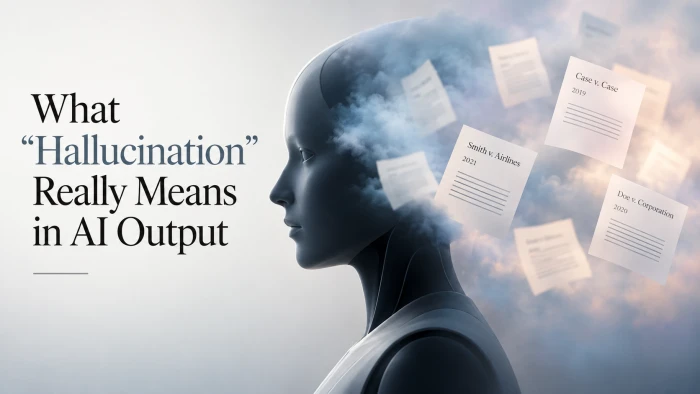
In 2024, Air Canada's customer service chatbot told a grieving passenger about a bereavement fare discount. The policy did not exist. The airline argued in a tribunal that the chatbot counted as a separate entity responsible for its own words. The tribunal disagreed and held the company liable for what its own system had said.
The system had not lied in any human sense. It generated a confident, plausible answer built from patterns in its training data, and none of those patterns happened to point at the truth.
Confidence and accuracy are not the same measurement. AI systems are better at projecting the first than guaranteeing the second.
Pattern-finding cuts both ways. A system built to catch subtle correlations catches real ones and imagined ones with the same confidence, and nothing in its output flags which is which. A retailer chasing every statistical link an algorithm surfaces will eventually staff a truck run for a correlation that was pure coincidence, the algorithmic equivalent of a coin landing heads six times running.
A 2026 study on AI-assisted scientific peer review found the same gap from a different angle. Researchers compared AI reviewers against human reviewers across a large batch of paper submissions and catalogued what each side caught that the other missed. In over a third of the cases studied, human reviewers correctly diagnosed a statistical or methodological problem that every AI system in the study failed to flag. Statistical judgment, the kind that asks whether a result actually means what a paper claims it means, still leans on a kind of training AI has not fully absorbed.
None of this erases the archive-to-insight case made across the rest of this piece. It draws a clear line around where a person still has to stand in the loop.
Turning Your Own Archive Into Insight
The path from a locked archive to a usable answer follows roughly the same five steps, whatever the industry or team size.
1. Audit what actually sits in storage before opening any AI tool. Most teams underestimate the volume and overestimate how organized it already is.
2. Classify and tag the highest-value slices first instead of attempting the whole archive in one pass. Machine learning can screen as little as 1 percent of a dataset and flag which parts deserve full attention from a person.
3. Match the technique to the data type, using the table from earlier in this piece: anomaly detection for transaction and sensor logs, natural language processing for text, computer vision for images and scans, and a generative AI interface to ask questions across all of it in plain language.
4. Have a person validate the output before it drives a real decision, especially anywhere a wrong answer carries a real cost, such as a diagnosis, a legal filing, a large purchase order, or a public statement.
5. Fold the validated insight into an actual workflow. A pattern sitting in a report nobody reads accomplishes nothing beyond the dark data it came from.
None of this happens over a single weekend. A first pass through one archive, done properly with a person validating results at every stage, realistically takes four to six weeks for a mid-sized team, not the same-day turnaround that vendor demos tend to promise.
The payoff for finishing this cycle shows up in the numbers. Organizations that put their dark data to work report a 20 to 25 percent gain in operational efficiency, and those that keep dark data under 30 percent of total storage move through decision cycles 1.8 times faster than peers still sitting on a mostly-dark archive.
Where to Start
Go back to the locked room from the start of this piece. Everything inside it already belongs to you. The invoices, the call transcripts, the maintenance logs, the years of transaction records sit there whether or not anyone reads them. The only real variable is whether that inventory stays a line on a storage bill or becomes the thing that tells you which customer is about to leave or which machine part fails next.
Pull one drawer open first, not the whole room.
Pick the archive that costs the most to ignore right now, whichever team owns it, and run the five steps above against a slice small enough to finish inside a month. The Pop-Tarts pattern only became a company-wide habit because someone checked one hurricane's worth of data first, not ten years of it at once.
The room has been open the whole time. Someone just has to walk in.


Comments 0
Join the discussion and share your perspective.
Sign in to post a comment and reply to other readers.
No comments yet
Be the first to share your perspective on this article.