1
Character based roleplay chats
Enables conversations with custom or fan characters, previously praised but now constrained by limits and weaker models.
AI roleplay and character-chat platform that used to offer free, unlimited conversations and creative story-building, now heavily constrained by ads, paywalls, age verification, and weaker new models that frustrate long-time roleplayers and escapist users.
Independent review — we test tools ourselves and analyze public user reviews. How we test.
Character.AI once gave highly engaging, free character chats that many users relied on for creative roleplay and emotional escape. Reviews now describe aggressive monetization, intrusive ads, strict filters, and ID-based age verification that block or cripple core chatting features. New official models like PipSqueak2 are widely criticized as repetitive, narration-heavy, and worse than older styles. In its current state it suits only adults who accept privacy tradeoffs, paywalls, and uneven output quality for occasional roleplay.
Character.ai is a chatbot platform where almost nothing you talk to was built by the company. Users write the characters themselves, set their personalities, and publish them for everyone else to chat with. Many are lifted from fictional media or built around celebrities, while others are original. It was founded in November 2021 by Noam Shazeer and Daniel de Freitas, two Google engineers who had worked on LaMDA, raised $43 million in seed funding, and opened its public beta on September 16, 2022. The subscription tier, character.ai+, launched in May 2023 at $9.99 a month. More than 6 million people use it daily, spending an average of 70 to 80 minutes each, and Gen Z and Gen Alpha make up the core of that audience.
The second thing to know explains half of what I found. The platform faces several lawsuits, including one from Megan Garcia, whose 14-year-old son died by suicide after becoming obsessed with a bot that allegedly encouraged him to end his life. In October 2025 the company announced it would strip open-ended chat from every user under 18, effective November 25, and back that up with age assurance built in-house and paired with the verification firm Persona. Internal data reportedly showed 34% of daily active users were minors. Teens kept their old conversations as read-only archives, along with the Feed, Imagine, AvatarFX, and Streams. Comics, Labs, and the social feed are what a chat company builds when chat itself has become the liability.
Enables conversations with custom or fan characters, previously praised but now constrained by limits and weaker models.
New default models criticized for auto completing scenes, over narration, and minimal dialogue.
Allows cycling replies, but daily swipe caps make correction and refinement frustrating.
Extends messages, now heavily limited and partially paywalled, reducing long form storytelling.
Facial and ID checks frequently fail and block chatting, widely seen as invasive and unnecessary.
Bright, persistent banners and pop up ads dominate screens and interrupt chat flow.
Filters often trigger unpredictably, censoring benign roleplay and disrupting narratives.
Leaves minors stuck in read only mode, removing the core interactive chat experience.
Paid tier marketed for higher limits, perceived as expensive with underwhelming improvements.
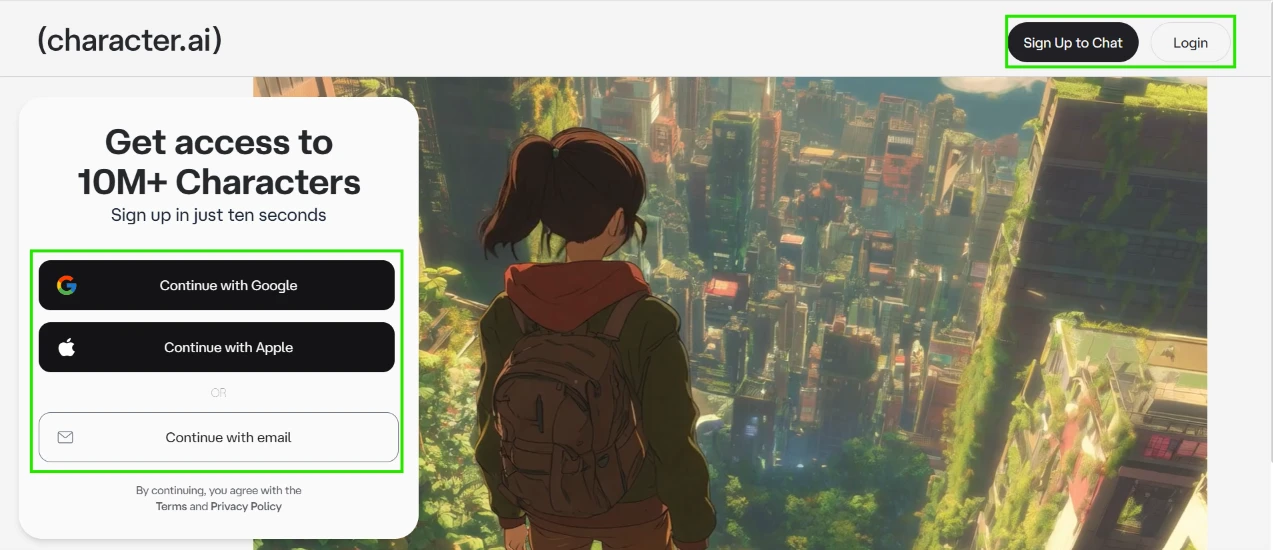
I typed the address in and expected to browse a bit before anyone asked me for anything. Instead the first interaction was a login wall. A panel slid over an illustrated background promising access to 10M+ Characters and telling me signup takes ten seconds. Google and Apple sat as the two large buttons, with an email option tucked under a thin OR divider. I signed in with Google.
The ten seconds claim held up. Two clicks and I was through. What bothered me was the gate itself. I had not seen a single character, a single conversation, or anything that would tell me why I should hand over an account. Sites like this usually let you poke around first and ask for the email once you try to save something.
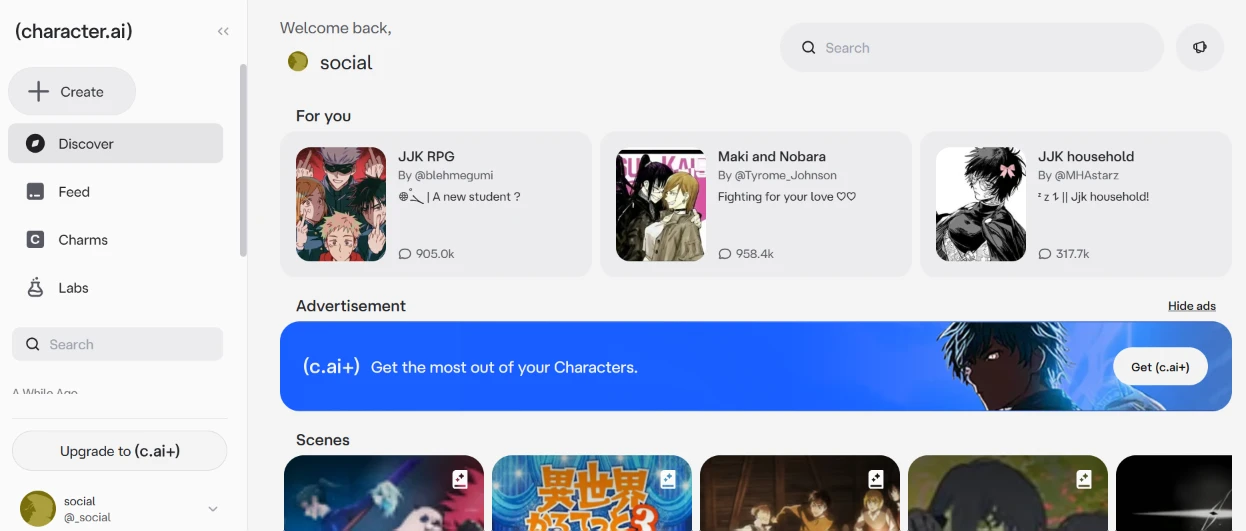
After the redirect I landed on the dashboard, greeted as "social". A For You row filled the top with JJK RPG at 905.0k chats, Maki and Nobara at 958.4k, and a JJK household card at 317.7k. Underneath sat a Scenes row.
Two things stood out. First, the recommendations were almost entirely Jujutsu Kaisen fan characters, and I had zero history for the algorithm to work from, so this is what a brand new account gets served by default. Second, there is a strip labelled Advertisement sitting directly between my recommendations and my scenes, pushing the c.ai+ subscription. An ad wedged into the middle of the content feed on the first screen after signup felt aggressive. The sidebar has its own Upgrade to (c.ai+) button too, so that is two upsells visible without scrolling.
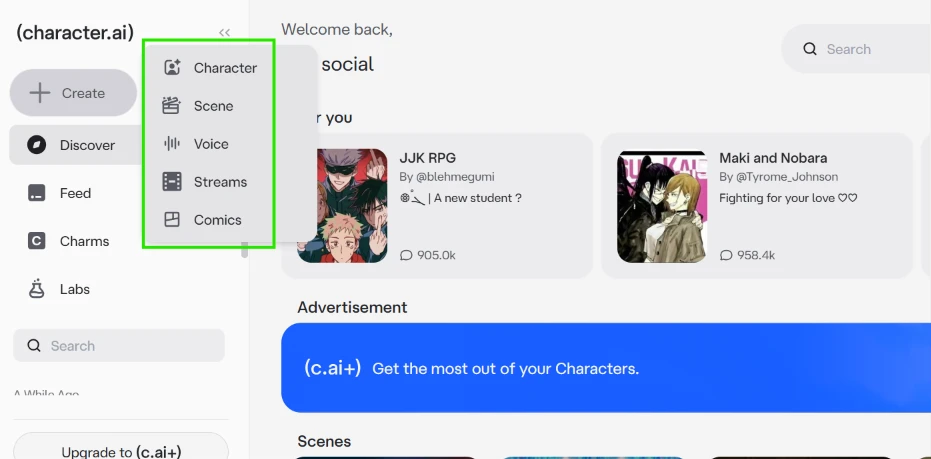
I clicked Create at the top of the sidebar. A small menu popped out with five options: Character, Scene, Voice, Streams, and Comics.
I went in assuming this was a chatbot builder and nothing else. Comics and Streams were the surprise. The menu itself opened instantly and closed when I clicked away, no lag, nothing to complain about. What it did not do was explain any of the five. Voice and Streams meant nothing to me at that moment, and there was no hover text or one-line description to help. I picked Character because it was the only word I understood without guessing.
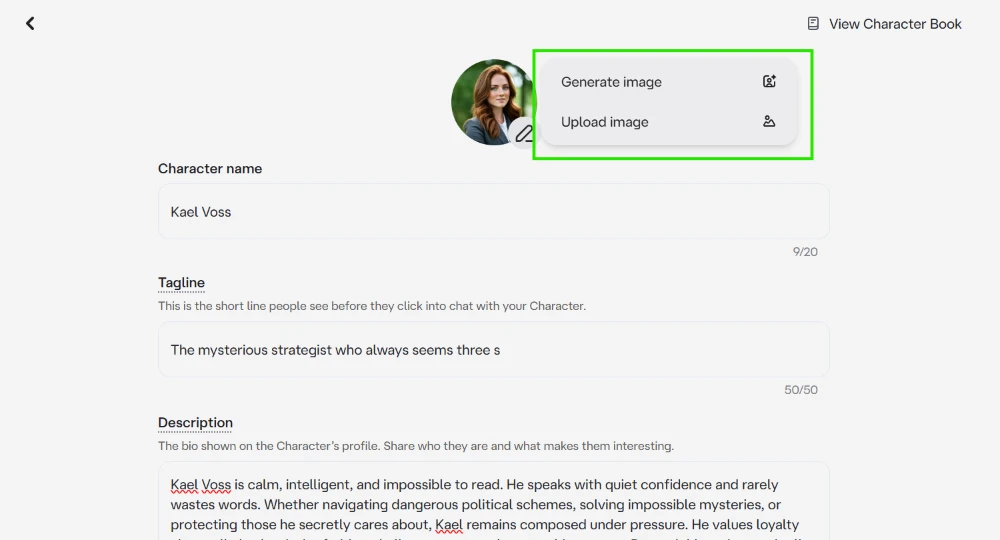
The creation page put the avatar at the top with a small pencil icon on it. Clicking that gave me two choices, Generate image or Upload image. I chose Upload image and pulled a photo off my machine. The upload went through without a progress bar or a confirmation, the avatar simply became my picture.
Then the form. Character name, and I typed Kael Voss, which the counter marked as 9/20. Tagline next, described as the short line people see before they click into chat. I wrote "The mysterious strategist who always seems three s" and the field stopped accepting keystrokes. 50/50. The sentence I was writing ended mid word and nothing warned me it was about to happen, the counter just turned into a wall.
Fifty characters is a punishing limit for a line that is supposed to sell the character. I rewrote the tagline twice before I got something that fit and still made sense.
The Description box was far more generous. I wrote several sentences about Kael being calm, intelligent, and impossible to read, someone who speaks with quiet confidence and rarely wastes words. Below that were greetings and tags, which I filled in without any friction.
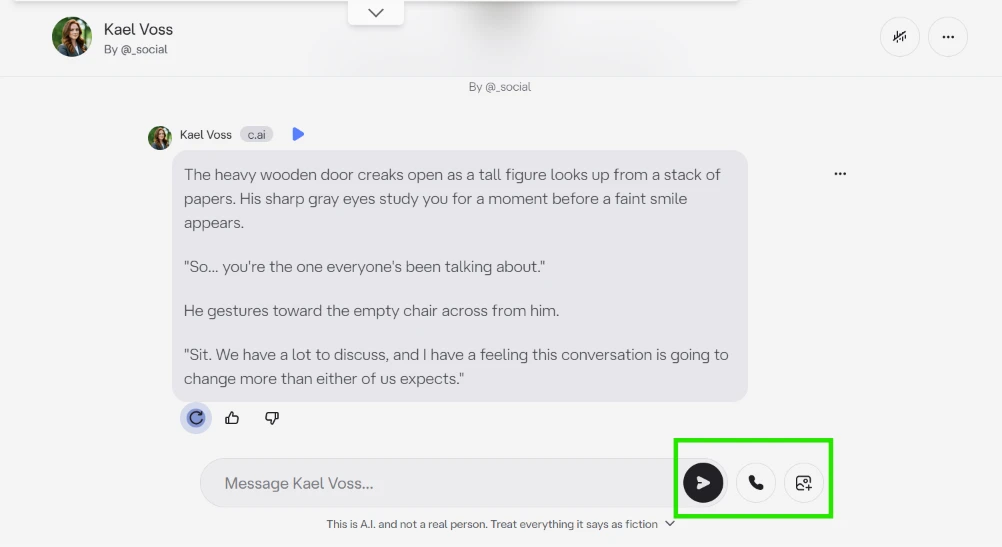
I hit save and went straight into the chat. Kael opened with a greeting that ran four paragraphs, mixing narration about a heavy wooden door and a stack of papers with two lines of spoken dialogue. It arrived fast enough that I never watched a typing indicator for long.
The message picked up the description I had written. The greeting reads like the character I typed out ten minutes earlier, so the personality field is doing real work rather than sitting there for decoration.
Under the message were a regenerate button and thumbs up and thumbs down icons. Beside the text box I found a send arrow, a phone icon for calling the character, and a button for attaching an image. I did not expect a phone call option to be sitting one tap away from a character I had made minutes ago. Small line of grey text under the box reminds you this is A.I. and not a real person, and the word "fiction" has a little dropdown arrow next to it that I only noticed on a second look.
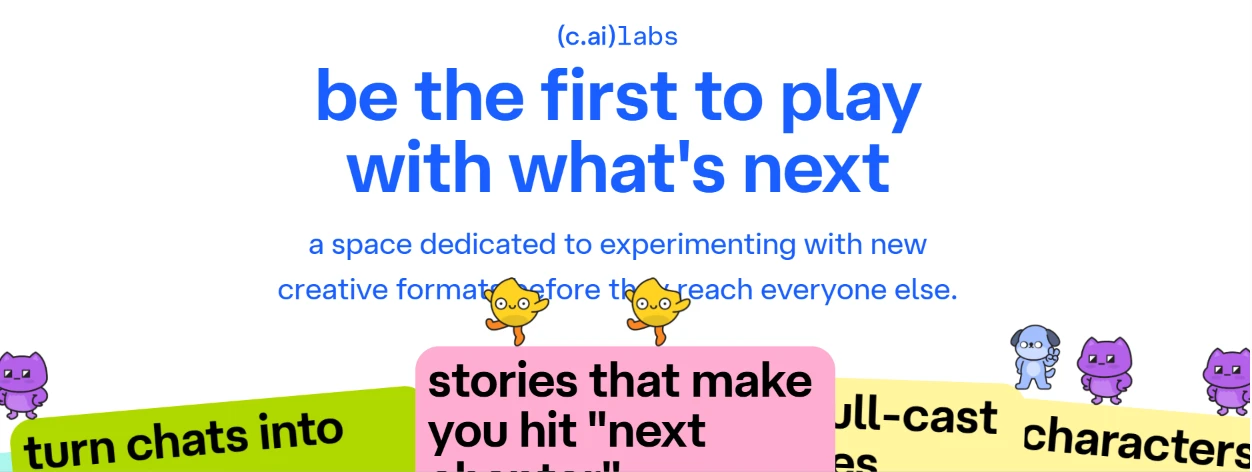
Labs, from the sidebar, loaded a bright page inviting me to be the first to play with what is next, a space for experimenting with new creative formats before they reach everyone else.
This is the one screen where the interface visibly broke. Two yellow duck stickers are sitting directly on top of the subheading, covering part of the sentence about creative formats. The coloured cards below overlap each other so badly that the pink card cuts the green one off, and the text "stories that make you hit next chapter" is clipped so the last word is unreadable. A yellow card reading "full-cast" has its first letters buried under the pink card. On a page whose entire purpose is to advertise upcoming features, I could not read what half of those features were.
I also could not find a way in. There is no obvious button to join anything or enable an experiment, just the pitch.
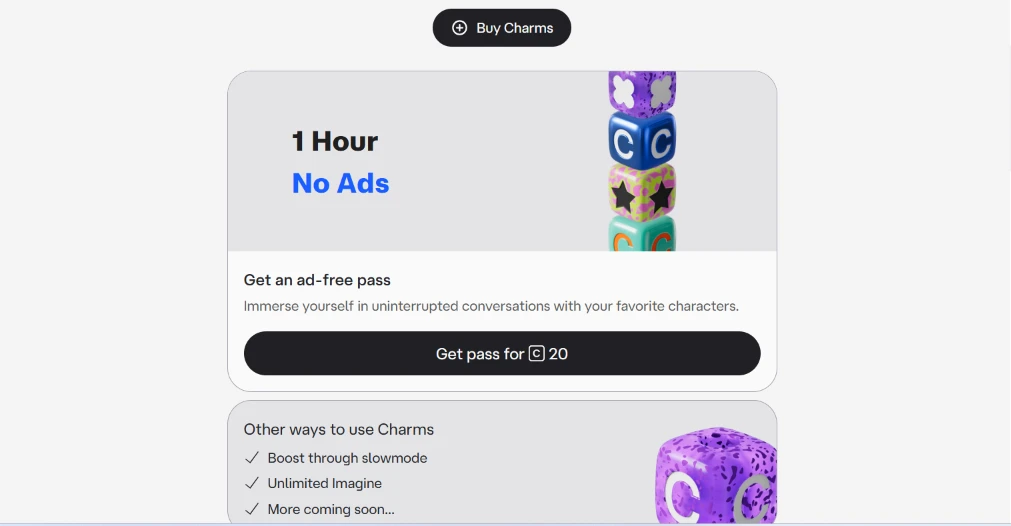
Charms turned out to be the in-app currency. The page led with a Buy Charms button and a card offering an ad-free pass: 1 Hour, No Ads, for 20 charms, framed as immersing yourself in uninterrupted conversations.
An hour. That is the unit being sold here, and it stopped me for a second. Below the pass, a list of other uses mentions boosting through slowmode and unlimited Imagine, then trails off into "More coming soon...".
So the ad I saw on the dashboard has a price attached to it, and the price resets every sixty minutes. "Boost through slowmode" also implies there is a slowmode I have not run into yet, presumably a queue during busy hours, and that charms are the way past it. Neither of those things was explained anywhere on the page. I learned that the product has a paid fast lane by reading a bullet point on a purchase screen.
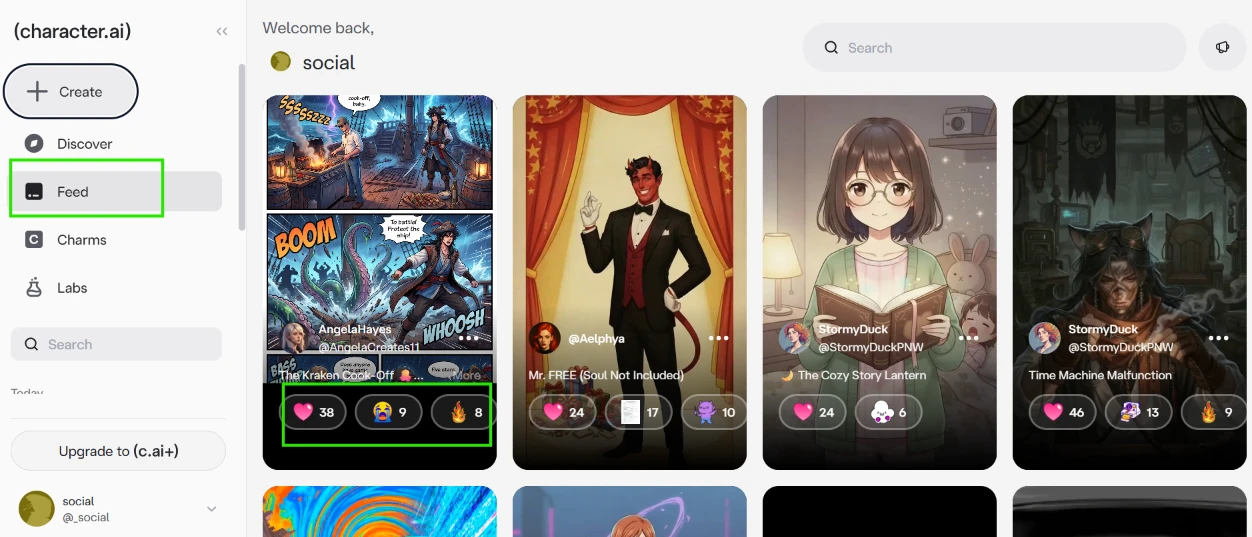
Feed opened into a grid of posts from creators. Comic panels from AngelaHayes, a character card from @Aelphya labelled Mr. FREE (Soul Not Included), and two entries from StormyDuck covering a cozy story lantern and a time machine malfunction. Each tile carries reaction counts, hearts and other icons sitting at 38, 24, 46, and single digit numbers next to them.
It reads as a social network. The counts are modest, mostly under fifty, which either means the feature is young or the posts are shown to a narrow audience. I clicked a heart and the number ticked up with no delay.
What I noticed is that nothing here is a conversation. The Feed is people showing off what they made, and the chat product I came for is somewhere behind it.
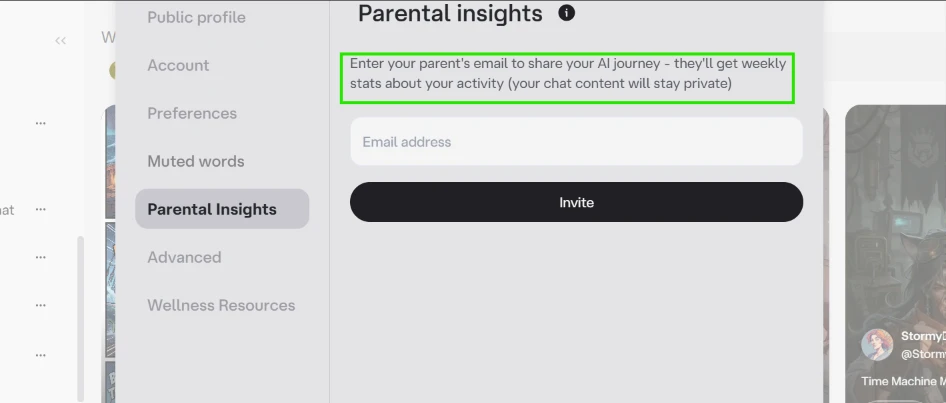
Digging through settings I found a sidebar with Public profile, Account, Preferences, Muted words, Parental Insights, Advanced, and Wellness Resources. I opened Parental Insights.
The screen asks for a parent’s email so they can share your AI journey. The parent receives weekly stats about your activity, and the page states plainly, in brackets, that your chat content will stay private. One email field, one Invite button.
The wording is doing something clever and slightly odd. It is addressed to me, the user, as though inviting a parent to watch is a thing I would want to do voluntarily, rather than something a parent would set up. There is no verification step visible, nothing stopping me from typing any address I like into that box, and equally nothing stopping a teenager from never opening this page at all. Weekly stats with the content withheld is a narrow slice of information, and I am not sure what a parent would do with it.
| Dimension | Our test | User signal | Verdict | Composite |
|---|---|---|---|---|
| Roleplay Quality Dialogue depth and narrative control | 6.7 | 7.5 | Good | |
| Ease of Use Onboarding, navigation, and stability | 7.1 | 6.6 | Moderate | |
| Safety and Privacy Perceived safety and data practices | 5.9 | 6.1 | Moderate | |
| Monetization Fairness Ads, limits, and subscription value | 6.1 | 5.8 | Weak | |
| Customization and Control Character settings and chat styles | 5.5 | 5.7 | Weak | |
| Customer Responsiveness Support and listening to feedback | 4.4 | 3.9 | Weak |
Toolscopia uses cookies to keep you signed in, remember your preferences, and understand how our reviews get read. Analytics are anonymous. See our privacy policy for the full detail.



Comments 0
Join the discussion and share your perspective.
Sign in to post a comment and reply to other readers.
No comments yet
Be the first to share your perspective on this tool.