
Type "a fox reading a newspaper in a sunlit cafe" into the right tool today and a usable image lands in about eight seconds, for free.
Type the same prompt into the wrong one and you spend your daily allowance on three soft, misshapen attempts before a paywall slides up with a watermark stamped across your work.
That gap is the whole story of free AI image generation in 2026.
The models got good this year. The free tiers got complicated. This guide runs six generators through the same hands-on test, pins down what each one actually gives a free user before asking for money, and shows where the invisible ceiling sits. Every price and limit below was checked against the company's own pricing page rather than a third-party tracker, because this is the one subject where a six-month-old number sends you down the wrong path.
We open with the test method and a scorecard so you can see the shape of the field. Then we go tool by tool, in a rough order from easiest to most specialist, before closing with a plain recommendation for different kinds of work.
Six tools made the cut because they clear one bar: a free user can produce something worth keeping, today, with no trial clock ticking down.
How we tested
Claims are easy, so every tool ran the same prompt on its free tier, with default settings, in November 2026. The prompt was:
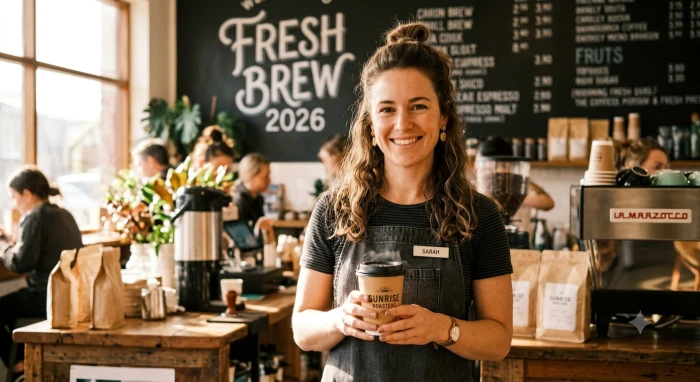
A photorealistic portrait of a woman barista in her early 30s holding a takeaway coffee cup with both hands in a sunlit cafe, with a chalkboard sign behind her that clearly reads "FRESH BREW 2026". Warm morning light, shallow depth of field.
One prompt, chosen to stress four things at once: a human face, both hands wrapped around a cup, warm directional light, and a chalkboard that had to read "FRESH BREW 2026". Text inside an image is where most generators break, so that sign doubles as the hardest part of the test. Each tool's actual free-tier result sits in its section below, untouched.
First, what "free" even means now
One distinction decides which tool fits you, because "free" splits into two camps in 2026.
Some tools refill on a clock. Leonardo tops up tokens every 24 hours and Firefly resets its free generations daily, so you return tomorrow and keep working. Others hand you a monthly pool or a loose "fair use" allowance that quietly shrinks when demand spikes, which is how Google runs Gemini now. A daily refill suits a hobbyist who dips in often. A monthly pool suits someone doing one big batch and then stepping away.
Watermarks and commercial rights are the second fault line.
A free image you are allowed to sell is worth more than ten you cannot. That single point reshuffles the ranking for anyone doing paid work, and it returns in the Firefly section and again in the verdict.
The 2026 free AI image generator scorecard, at a glance
Read the table as a map rather than a verdict. It shows who is generous and who is stingy. It cannot show how a tool handled the test or the catch each free tier hides, which is what the sections after it are for.
| Tool | Best for (free) | Free allowance | Refill | Model behind it |
|---|---|---|---|---|
| Google Gemini | Top image quality | Varies, set by demand | Demand-based | Nano Banana 2 |
| Microsoft Copilot | Easy DALL-E access | Fast boosts, then slower unlimited | Boost-based | DALL-E 3 / MAI-Image |
| Adobe Firefly | Commercial-safe work | Free daily generations | Daily | Firefly + partners |
| Leonardo AI | Control and tweaking | 150 fast tokens/day | Daily | Phoenix / FLUX |
| Ideogram | Text inside images | Weekly slow credits | Weekly | Ideogram 3.0 |
| Canva | Design in one place | Monthly AI allowance | Monthly | Canva AI / Magic Media |
The numbers rank generosity, not quality. "Best" depends on the job, so the tool with the most free images is not automatically the one you should open. The next six sections fill in what the table leaves out, each with its actual test image, and we return to these rows in the final verdict.
1. Google Gemini (Nano Banana): the quality leader everyone chased
If one tool defined the year, it was this one. "Nano banana" went from a mystery codename to one of the most searched AI terms of 2026. A free Google account generates with Nano Banana 2, Google's standard image model, inside the Gemini app at no cost, while the sharper Nano Banana 2.1 and the "Redo with Pro" step sit behind a paid plan.
• Free model: Nano Banana 2, inside the Gemini app
• Upgrade: Google AI Pro at $19.99/month or Google AI Ultra at $99.99/month
• Free limit: Google states that limits apply and change with demand
Where it does well
The test made the quality gap plain. The chalkboard headline "FRESH BREW 2026" came out crisp and correctly spelled. The barista's face and both hands looked photographic under warm morning light, and the scene carried more real depth than anything else on this list, which is why it tops the quality ranking.
Where it falls short
Push past the headline and the cracks show. Every smaller line on the menu board behind her was invented gibberish, so dense or multi-line text is still a weakness. The free allowance is the second catch, since Google trimmed its limits more than once this year, which makes the ceiling a moving target. Set that against the fixed daily refill of Leonardo, which we reach shortly.
2. Microsoft Copilot (Bing Image Creator): the easiest free door to DALL-E
Microsoft took the opposite route to credits. It keeps image generation free for anyone with a Microsoft account and simply slows you down once your fast "boosts" are used, so you never slam into a hard paywall for ordinary use. The engine is OpenAI's DALL-E 3, now joined by Microsoft's own MAI-Image model, reached at bing.com/create or inside Copilot.
• Cost: free with a Microsoft account
• Engine: DALL-E 3 plus Microsoft's MAI-Image
• Speed: fast boosts, then slower unlimited generation
• Commercial use: personal only on the free tool

Where it does well
It handled the brief with no fuss. The "FRESH BREW 2026" sign and a second "GOOD COFFEE" line both came out legible. The face and hands held up, and the image arrived in seconds with nothing more than a Microsoft account, which makes it the lowest-friction way to reach DALL-E quality.
Where it falls short
The look leaned slightly toward stock photography rather than the depth Gemini produced, and the commercial limit is the real ceiling. Microsoft's terms keep free output to personal use, so the result is fine for a social post but off-limits for a product you sell. Anyone selling the image should read the Firefly section next.
3. Adobe Firefly: the free image you can actually sell
Here commercial rights flip the whole decision. Firefly's free plan also changed quietly in 2026, since its pricing page no longer advertises the old fixed "25 credits" figure. Instead it offers free daily generations that reset each day across image, video, design and audio, with the paid ladder below starting lower than most people expect.
• Standard: $9.99/month, 2,000 generative credits
• Pro: $19.99/month, 4,000 generative credits
• Pro Plus: $49.99/month, 10,000 generative credits
• Premium: $199.99/month, 50,000 generative credits

Where it does well
The scene itself was convincing. The skin and fabric looked real under a natural backlight, and the commercial backing behind Firefly means this is output you can actually sell. Adobe trained the model on licensed and Adobe Stock material, so that legal comfort is rare on a free tier.
Where it falls short
Text tripped it up. The sign rendered "FRESH" as "FRE SH" with a stray mark between the words, so the headline needed a second attempt to clean up. The free daily pool is also thinner than Leonardo's, and credits reset with no rollover, so an unused day is gone. The trade is worth it only when commercial safety outranks perfect text.
4. Leonardo AI: the creator's control room
Leonardo is the flagship of the daily-refill camp from earlier. A free account gets 150 fast tokens every day, and at roughly two to eight tokens per image that works out to about 30 to 75 images before the counter resets at midnight UTC.
• Free: 150 fast tokens/day, Auto model only, public gallery, basic quality
• Essential: $12/month, 8,500 tokens/month, 80+ models, private generation
• Premium: $30/month, 25,000 tokens/month
• Ultimate: $60/month, 60,000 tokens/month

Where it does well
This was the quiet all-rounder. The sign read "FRESH BREW 2026" cleanly and the hands around the cup were among the best in the whole test. The daily 150-token refill then lets you keep iterating tomorrow, and the interface gives you real dials to shape a result instead of a single prompt box.
Where it falls short
The free tier keeps you on the Auto model at basic quality. Every creation posts to a public gallery, and the deeper 80-plus model library stays behind a paid plan. Someone who wants one quick image with no setup is better served by Copilot above.
5. Ideogram: when the words inside the image have to be right
Every generator above can draw a storefront. Ask most of them to print a full slogan on the sign and the spelling falls apart. Ideogram built its name on fixing that exact failure.
• Free: weekly slow credits, images public by default
• Plus: $15/month, 1,000 priority credits and private generation
• Pro: $42/month, 3,500 priority credits/month
• Team: $20/user/month, billed annually

Where it does well
This is where the specialist showed off. Ideogram did not stop at "FRESH BREW 2026". It rendered extra lines of menu text below the headline, most of them legible, which no other tool in the test even attempted. For posters and signage where words carry the design, it is the clear pick.
Where it falls short
The lowest menu lines blurred into near-nonsense, so even the text champion has a limit once the lines pile up. The free allowance is the stingiest here too, a small weekly batch of slow credits with every image public by default. Treat it as a specialist you open for one job rather than a daily driver.
6. Canva: image generation where you already work
The last tool reframes the question. Most people do not want an image sitting alone in a folder. They want it inside a social post, a slide, a flyer or a resume they are already building. Canva drops generation straight onto the canvas through its Canva AI and Magic Media features, and Canva Free costs nothing while including a monthly AI allowance before it nudges you to upgrade.
• Free: a monthly AI allowance, with generation built into the editor
• Paid: Pro Lite, Pro, Business and Enterprise tiers raise the allowance and unlock premium content

Where it does well
For a tool built around design rather than raw generation, it held its own. "FRESH BREW 2026" came out clean and the portrait was believable, and because the image lives on the Canva canvas you can turn it into a finished post without leaving the page.
Where it falls short
Realism trailed Gemini and Firefly, and a small secondary sign in the background came out garbled. The monthly AI allowance also drains faster on the heavier tools, so Canva stays a finishing tool first and an image engine second.
What the test and the fine print reveal
One finding held across all six. Every tool nailed the short headline "FRESH BREW 2026", so the real split showed up elsewhere: in small or stacked text, in raw realism, and in who is allowed to sell the result.
A second pattern runs underneath the free tiers. Name it before the verdict. Every free tier is a funnel built to convert you.
The refill tools, Leonardo and Firefly among them, reset something each day and bet you will want privacy or more output enough to upgrade. The allowance tools, Gemini and Canva among them, bet you will hit the wall in the middle of a project. Copilot bets that one day you will need commercial rights its free tool withholds.
One name you will not find above earns a quick mention. xAI pulled free image generation from Grok during 2026, so despite the search interest it now sits behind a paid X or SuperGrok subscription, which is why it is absent from a list of free tools.
None of that makes any of them a bad deal. Match the funnel to your own habit before you grow attached. A student making a few images a week pays no one, ever. A freelancer shipping client work every week will pay somebody within a month, so the clever move is deciding whose paid tier you would least resent later. The reference table below shows where each paid ladder begins for the tools that publish a clear monthly price.
| Tool | Cheapest paid tier | Price (USD/mo) | What it adds |
|---|---|---|---|
| Adobe Firefly | Standard | $9.99 | 2,000 credits/month |
| Leonardo AI | Essential | $12 | 80+ models, private generation |
| Ideogram | Plus | $15 | Private generation, 1,000 credits/month |
| Google Gemini | Google AI Pro | $19.99 | Nano Banana 2.1, higher limits |
| Microsoft Copilot | Copilot Pro | Optional | Priority and more fast boosts |
| Canva | Pro | Paid upgrade | Higher AI allowance, premium content |
The final verdict: which free generator should you open?
No single tool swept every round of the test, so the honest answer is a matched set rather than one winner.
- Choose Google Gemini (Nano Banana 2) when image quality matters most and your volume stays low.
- Choose Microsoft Copilot when you want the simplest free route to DALL-E quality for personal images.
- Choose Adobe Firefly when the result will be sold or handed to a client and commercial safety comes first.
- Choose Leonardo when you generate every day and want the most free output with real controls.
- Choose Ideogram when the image has to carry more than a few words of correct text.
- Choose Canva when you want the finished post rather than the raw image on its own.
Open the one that matches your most common job first. Testing costs nothing, so the only price of a wrong first pick is one wasted afternoon, and you now know where every ceiling sits before you reach it.


Comments 0
Join the discussion and share your perspective.
Sign in to post a comment and reply to other readers.
No comments yet
Be the first to share your perspective on this article.