Introduction
When UPS deployed ORION, its machine learning routing system, the company cut roughly 100 million miles from its delivery routes every year and saved an estimated $300 to $400 million annually. That is what machine learning-driven decision-making looks like at enterprise scale.
Modern enterprises generate unprecedented volumes of data from customer interactions, operational systems, connected devices, financial transactions, supply chains, and digital platforms. Yet possessing data alone does not create competitive advantage. The organizations outperforming their competitors are those capable of transforming raw information into timely, accurate, and actionable decisions. Machine learning (ML) has become the technological foundation enabling this transformation.
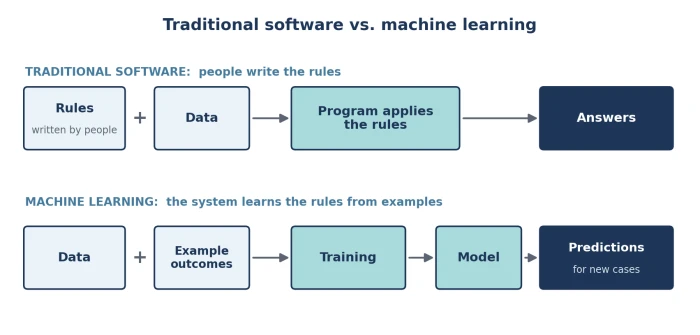
Unlike traditional software that follows predefined rules, machine learning models continuously identify patterns, relationships, and anomalies within large datasets. These models enable organizations to forecast demand, identify operational risks, optimize pricing, detect fraud, personalize customer experiences, improve healthcare outcomes, and automate thousands of routine decisions with a level of speed and precision that manual analysis cannot achieve.
The shift is now measurable across the global economy. McKinsey's most recent State of AI survey, published in November 2025, found that 88% of organizations use AI in at least one business function, up from 78% just a year earlier. PwC, meanwhile, estimates that AI could contribute up to $15.7 trillion to the global economy by 2030.
This article explores how companies leverage machine learning models to improve strategic, operational, and tactical decision-making, the models most commonly deployed, industry applications, implementation challenges, and best practices for building trustworthy AI systems.
Understanding Machine Learning Models
A machine learning model is a mathematical representation trained on historical data to recognize patterns and generate predictions or recommendations without explicit programming for every possible scenario.
Instead of relying solely on fixed business rules, machine learning systems learn from examples:
- Walmart predicts next month's product demand across thousands of stores.
- Banks such as JPMorgan estimate the probability of loan default before approving credit.
- Johns Hopkins Hospital forecasts which patients are at risk of deterioration hours before symptoms escalate.
- Amazon recommends products based on each customer's browsing and purchase history.
- UPS optimizes delivery routes for tens of thousands of drivers every day.
As more relevant data becomes available, properly maintained models can improve accuracy through retraining.
Why Traditional Decision-Making Is No Longer Enough
Many organizations still rely on:
- Static reports
- Historical dashboards
- Human intuition
- Rule-based workflows
- Spreadsheet analysis
These approaches become increasingly ineffective when businesses process millions of transactions every day.
Modern enterprises face challenges such as:
- Rapidly changing customer behavior
- Volatile supply chains
- Dynamic pricing
- Cybersecurity threats
- Increasing fraud sophistication
- Complex global operations
Machine learning addresses these challenges by identifying hidden relationships across thousands, or even millions, of variables simultaneously.
| Traditional BI and reports | Machine learning | |
|---|---|---|
| Question answered | What happened? | What will happen, and what should we do? |
| Speed | Days or weeks | Milliseconds to minutes |
| Variables considered | A handful, chosen by an analyst | Hundreds to millions, weighted automatically |
| Adaptability | Static until manually rebuilt | Improves with retraining on new data |
Instead of asking, "What happened?", companies increasingly ask:
- What is likely to happen next?
- What action should we take?
- Which option produces the best outcome?
- How confident is the prediction?
These questions define predictive and prescriptive decision-making.
The Decision-Making Pipeline Powered by Machine Learning
Enterprise machine learning typically follows a structured workflow:
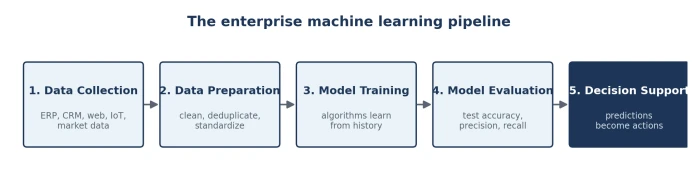
1. Data Collection
Organizations gather information from:
- ERP systems
- CRM platforms
- Websites
- Mobile applications
- IoT devices
- Financial records
- Customer support systems
- Manufacturing sensors
- External market data
Example: A telecom company gathers two years of billing history, usage data, and support tickets to predict which subscribers might cancel.
2. Data Preparation
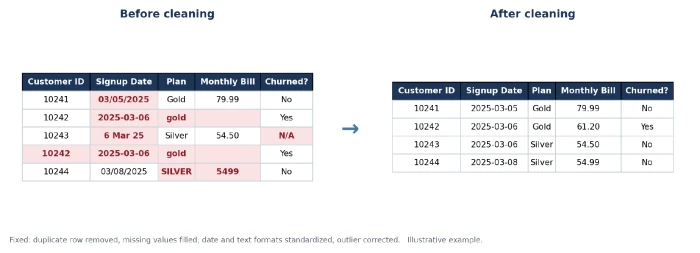
Raw business data contains:
- Missing values
- Duplicate records
- Inconsistent formatting
- Noisy observations
- Outliers
Data engineers clean and transform this information before training begins. The workload here is substantial: Anaconda's State of Data Science survey found that data scientists spend roughly 45% of their time just loading and cleaning data before any modeling can begin.
Example: The telecom's engineers remove duplicate accounts, fill missing billing values, and standardize date formats before training begins.
3. Model Training
Algorithms learn patterns from historical examples. Common algorithms include:
- Linear Regression
- Logistic Regression
- Decision Trees
- Random Forest
- Gradient Boosting
- XGBoost
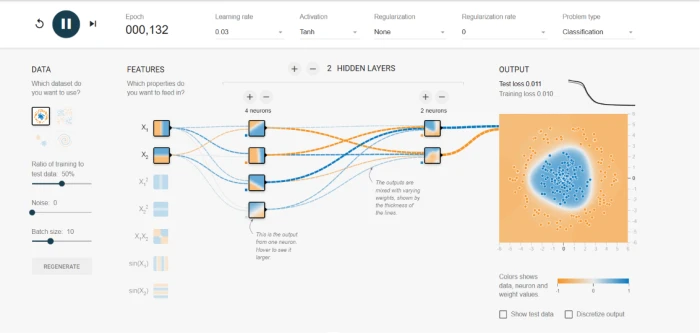
- Neural Networks
- Support Vector Machines
- Clustering algorithms
Example: The telecom trains a gradient boosting model on its historical churn data.
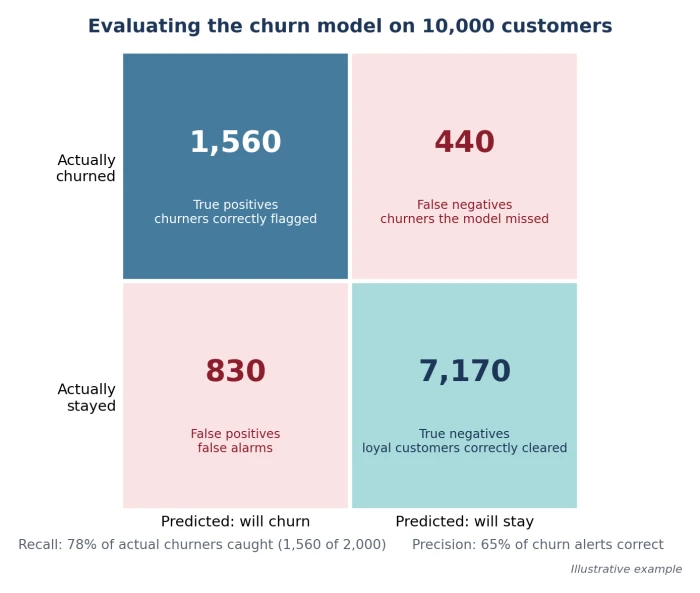
4. Model Evaluation
Performance metrics include:
- Accuracy
- Precision
- Recall
- F1 Score
- ROC-AUC
- Mean Absolute Error (MAE)
- Root Mean Square Error (RMSE)
Selecting the appropriate metric depends on the business problem. For example, in fraud detection, minimizing false negatives may be more important than maximizing overall accuracy.
Example: The telecom optimizes for recall, catching as many true churners as possible, because a missed churner costs far more than a false alarm.
5. Decision Support
Predictions become business actions:
- Approve or reject loans
- Reorder inventory
- Prioritize maintenance
- Recommend products
- Flag suspicious transactions
- Allocate marketing budgets
Example: Subscribers flagged as high churn risk automatically receive a retention offer within 24 hours.
Types of Machine Learning Models Used in Business Decision-Making
Regression Models
Regression estimates continuous numerical outcomes. Examples include:
- Revenue forecasting
- Electricity demand
- Housing prices
- Customer lifetime value
Zillow's Zestimate, for example, uses machine learning models built on regression techniques to estimate prices for more than 100 million U.S. homes.
Business impact: Executives can build more reliable financial forecasts and improve resource planning.
Classification Models
Classification predicts categories. Examples:
- Fraudulent or legitimate transaction
- Customer churn or retention
- Spam or genuine email
- High-risk or low-risk borrower
PayPal, for instance, uses classification models to screen millions of transactions per day for fraud in real time.
Business impact: These models automate high-volume decisions while maintaining consistency.
Clustering Models
Clustering groups similar observations without predefined labels. Businesses use clustering for:
- Customer segmentation
- Product grouping
- Behavioral analysis
- Market research
Marketing teams can create highly targeted campaigns for each segment. Netflix reportedly groups its viewers into more than 2,000 "taste communities," a clustering approach that shapes what every member sees on their homepage.
Recommendation Models
Recommendation engines estimate user preferences. Applications include:
- Streaming platforms
- Online retailers
- Music services
- News websites
The business impact is measurable. Netflix has stated that its recommendation system influences about 80% of the hours streamed on the platform and is worth an estimated $1 billion per year, while McKinsey has estimated that roughly 35% of what customers buy on Amazon comes from its recommendation engine.
Time-Series Forecasting Models
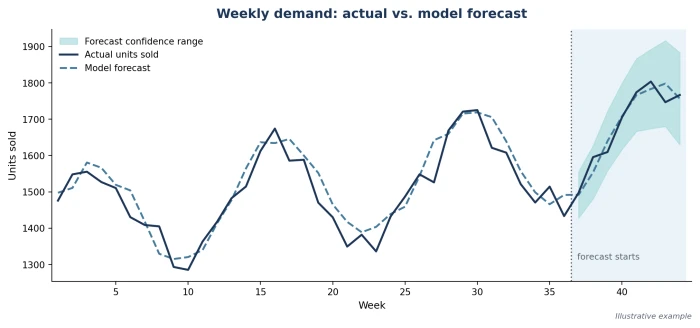
Time-series models predict future values using historical trends. Applications:
- Sales forecasting
- Inventory planning
- Workforce scheduling
- Energy consumption
Better forecasting reduces both stockouts and excess inventory. Walmart, for example, generates weekly demand forecasts for millions of item and store combinations to decide exactly how much of each product to replenish.
Deep Learning Models
Deep learning handles highly complex data such as:
- Images
- Speech
- Videos
- Natural language
- Medical imaging
In one landmark example, Google researchers trained a deep learning model to detect diabetic retinopathy in retinal photographs with accuracy comparable to that of board-certified ophthalmologists (JAMA, 2016).
The table below summarizes the model families covered in this section:
| Model type | What it predicts | Example business use | Common algorithms |
|---|---|---|---|
| Regression | A number | Revenue forecast, home price | Linear regression, XGBoost |
| Classification | A category | Fraud vs. legitimate, churn vs. stay | Logistic regression, random forest |
| Clustering | Natural groupings | Customer segments | K-means, DBSCAN |
| Recommendation | Preferences | "You may also like" suggestions | Collaborative filtering |
| Time-series | Future values over time | Demand, energy load | ARIMA, Prophet, LSTM |
| Deep learning | Complex patterns | Image, speech, text | Neural networks |
Industry Applications
Financial Services
Financial institutions process billions of transactions annually. Machine learning improves decisions involving:
- Credit risk assessment
- Fraud detection
- Anti-money laundering
- Investment analysis
- Insurance underwriting
Modern fraud detection models evaluate hundreds of transaction features within milliseconds, enabling real-time intervention before financial losses escalate.
The stakes are enormous. Visa has reported that its AI systems helped prevent an estimated $25 billion in fraud in a single year. JPMorgan's COiN platform, meanwhile, automated the review of commercial loan agreements, work that previously consumed roughly 360,000 lawyer-hours annually.
Healthcare
Hospitals use machine learning to support clinical decision-making. Applications include:
- Disease prediction
- Diagnostic imaging
- Patient risk stratification
- Treatment recommendations
- Hospital resource planning
Rather than replacing clinicians, these systems augment decision-making by highlighting patterns that may not be immediately apparent. At Johns Hopkins, the TREWS early-warning system for sepsis was associated with roughly 20% lower mortality among patients whose alerts clinicians acted on quickly (Nature Medicine, 2022).
Retail
Retailers optimize:
- Inventory
- Pricing
- Promotions
- Customer recommendations
- Demand forecasting
Machine learning helps balance inventory levels across thousands of products, reducing lost sales while lowering storage costs.
Manufacturing
Manufacturers deploy predictive models for:
- Predictive maintenance
- Defect detection
- Production optimization
- Quality control
Predictive maintenance can identify equipment failures before they occur, reducing costly downtime. The same optimization logic applies beyond the factory floor: Google DeepMind applied similar techniques to Google's own data centers and cut cooling energy consumption by 40%.
Supply Chain
Supply chain optimization includes:
- Route planning
- Warehouse optimization
- Demand prediction
- Supplier risk assessment
- Inventory allocation
Machine learning continuously adjusts forecasts as market conditions evolve. This is where UPS's ORION system, mentioned in the introduction, operates, continuously re-optimizing routes for tens of thousands of drivers as traffic, weather, and package volumes change.
Human Resources
HR departments increasingly use machine learning for:
- Workforce planning
- Employee retention prediction
- Recruitment screening
- Skill-gap analysis
Responsible deployment requires careful governance to prevent discriminatory outcomes.
Real Business Decisions Enhanced by Machine Learning
Machine learning improves decisions such as:
| Decision | Model type | Data it uses |
|---|---|---|
| Which subscribers are likely to cancel? | Classification | Usage history, support tickets, billing |
| Which products need replenishment tomorrow? | Time-series forecasting | Sales history, seasonality, promotions |
| Which transactions are fraudulent? | Classification | Amount, location, device, merchant, velocity |
| Which machines need servicing this week? | Predictive maintenance | Sensor vibration, temperature, runtime |
| Which customers should get premium support? | Regression (lifetime value) | Purchase history, engagement, tenure |
| Which insurance claims need manual investigation? | Anomaly detection | Claim details, history, provider patterns |
| Which applicants qualify for financing? | Classification | Credit history, income, utilization |
| Which marketing campaign gets more budget? | Uplift and regression modeling | Channel performance, audience response |
Rather than replacing executives, these models provide probabilistic recommendations that improve consistency and speed.
Benefits of Machine Learning in Enterprise Decision-Making
Faster Decisions
Automated predictions reduce decision times from days to seconds. Card networks, for example, score a transaction for fraud in a fraction of a second, a judgment no human team could deliver at thousands of transactions per second.
Improved Accuracy
Models weigh vastly more variables than any analyst can hold in mind at once. A credit model can consider hundreds of signals on every application and apply them identically every single time.
Better Risk Management
Organizations spot operational, financial, and cybersecurity risks earlier. Predictive maintenance models flag failing equipment days or weeks in advance, turning unplanned downtime into scheduled service.
Cost Reduction
UPS's routing savings and DeepMind's 40% cooling reduction are, at their core, cost-reduction stories. The most common targets include:
- Inventory efficiency
- Workforce utilization
- Logistics planning
- Marketing spend
Personalization
Machine learning delivers individualized experiences at a scale no marketing team could match manually, tailoring offers, content, and recommendations to millions of customers simultaneously rather than a handful of broad segments.
Continuous Learning
Unlike static business rules, models improve as new data arrives. A fraud model retrained monthly keeps pace with attack patterns that a fixed rulebook would miss entirely.
Challenges Companies Must Address
Machine learning is powerful, but success depends on more than selecting an algorithm.
Poor Data Quality
Incomplete or inaccurate data leads to unreliable predictions. The principle remains: better data produces better models.
Model Bias
Historical data can encode societal or organizational biases. Without careful evaluation, models may unfairly disadvantage certain groups.
This is not hypothetical. Amazon scrapped an internal ML recruiting tool after discovering it systematically downgraded resumes containing the word "women's", a bias learned from a decade of male-dominated hiring data (Reuters, 2018). Responsible AI practices require fairness testing, bias audits, and ongoing monitoring.
Explainability
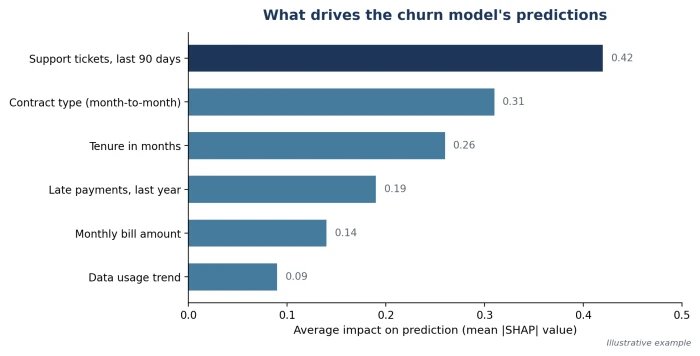
Executives often require transparent reasoning behind AI-generated recommendations. Explainable AI techniques help organizations understand:
- Feature importance
- Prediction confidence
- Decision pathways
Transparency is particularly important in regulated industries. Techniques such as SHAP and LIME quantify how much each input contributed to a given prediction. In U.S. lending, for example, the Equal Credit Opportunity Act requires lenders to give applicants specific reasons for a denial. "The model said no" is not a legally acceptable answer.
Model Drift
Customer behavior, economic conditions, and markets evolve. As patterns change, model accuracy may decline. Continuous monitoring and retraining are essential for maintaining performance.
The COVID-19 pandemic provided a dramatic demonstration. Instacart reported that its inventory-prediction accuracy fell from about 93% to 61% almost overnight as shopping behavior changed (MIT Technology Review, 2020).
Regulatory Compliance
Organizations must comply with a fast-growing body of rules, including the EU AI Act (in force since August 2024, with transparency rules applying from August 2026 and obligations for high-risk systems phasing in through 2027 and 2028), the NIST AI Risk Management Framework in the United States, GDPR, and sector-specific requirements in finance and healthcare.
Governance should include:
- Documentation
- Audit trails
- Version control
- Human oversight
- Risk assessments
Best Practices for Enterprise Adoption
Successful organizations typically follow these principles:
- Begin with a clearly defined business problem. Projects that start with "let's use AI" rather than a measurable question rarely reach production.
- Prioritize high-quality data collection, because model quality is capped by data quality.
- Select models for the business objective, not for complexity. A well-tuned gradient boosting model often beats a deep neural network on tabular business data.
- Evaluate multiple performance metrics. Accuracy alone can hide costly failures such as missed fraud.
- Continuously monitor production models. Drift is a matter of when, not if.
- Keep humans in the loop for high-impact decisions. Loans, diagnoses, and hiring should never be fully automated.
- Invest in explainability, because stakeholders and regulators will both ask why.
- Establish AI governance and ethical review. Catching bias before launch is far cheaper than catching it after.
- Retrain models as business conditions evolve, because yesterday's patterns decay.
- Measure success with business KPIs, not just technical metrics. A model with a great AUC score that moves no revenue is a science project.
Emerging Trends
Enterprise machine learning continues to evolve rapidly. Key developments include:
- AutoML: platforms such as Google Vertex AI and H2O automate model selection and tuning, letting small teams ship production-grade models.
- Foundation models: large pretrained models are being wired directly into business workflows, summarizing contracts, drafting responses, and feeding predictions into downstream systems.
- Causal machine learning: moves beyond correlation to estimate what happens if the company acts. It is the difference between predicting churn and knowing which retention offer prevents it.
- Explainable AI: is shifting from best practice to legal expectation as frameworks such as the EU AI Act take effect.
- Edge AI: pushes decisions onto devices themselves, for example quality-control cameras that flag defects on the production line with no round trip to the cloud.
These innovations are expanding machine learning from isolated analytics projects into organization-wide decision systems.
Conclusion
Machine learning has fundamentally changed how organizations make decisions. Instead of relying solely on historical reporting or intuition, companies now use predictive and prescriptive models to analyze vast datasets, uncover hidden patterns, and recommend optimal actions in real time. Across finance, healthcare, retail, manufacturing, logistics, and human resources, machine learning enables faster responses, greater operational efficiency, more accurate forecasting, and improved customer experiences.
However, successful adoption requires more than advanced algorithms. High-quality data, rigorous model evaluation, continuous monitoring, explainability, fairness, and strong governance are essential to building trustworthy AI systems. Organizations that integrate these practices into their decision-making processes are better positioned to respond to changing market conditions, manage risk, and identify new growth opportunities.
As advances in foundation models, automated machine learning, and decision intelligence continue to accelerate, machine learning will become an increasingly integral component of enterprise strategy. Companies that invest in well-governed, transparent machine learning today will be the ones making the fastest, most reliable decisions tomorrow. For a practical next step, see our guide on [add an internal link to a related article on your site].



Comments 0
Join the discussion and share your perspective.
Sign in to post a comment and reply to other readers.
No comments yet
Be the first to share your perspective on this article.