
Any AI music generator can produce something listenable in forty seconds. That stopped being the interesting question a while ago.
The interesting question is what happens on attempt eleven, when the verse is right and the chorus is wrong and you do not want to throw away the part that worked. That is where these two tools stop resembling each other, and it has almost nothing to do with which one sounds better in a first-pass demo.
I spent time inside both products and read both companies' documentation. What follows compares them on generation quality, how much control you get over output, what happens when you iterate, what you can export, what you are allowed to do with the result, and what all of it costs. The pricing section carries a finding I have not seen published anywhere, so it is worth reaching, but it comes late on purpose. Cost per song is meaningless if the tool cannot finish a track.
Where each company sits
Suno reached roughly two million paid subscribers and a valuation in the billions before 2026. That scale funds model training, and it shows up in the sections below.
Musicful is smaller and has chosen a wider footprint instead of a deeper one. Alongside song generation it ships music video generation, lyric videos, a visualizer, a standalone stem splitter, and a public API. Suno does none of those except stems.
Hold onto that difference. Depth against breadth turns out to be the whole comparison.
Generation: v5.5 against V3.0
Musicful's feature list, on all four of its plans, reads "Access to new model (V3.0)." Suno shipped v5.5 in March 2026.
Version numbers do not compare across companies, so ignore the digits and look at what each generation does.
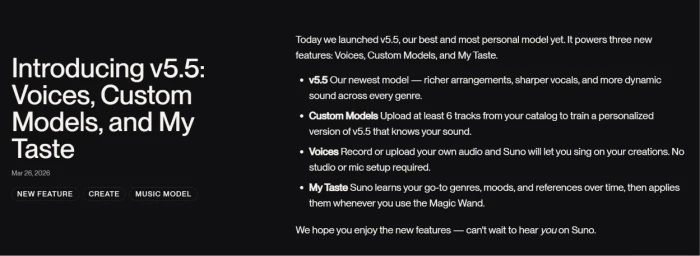
Suno v5.5 added Voices, where you upload a sample of your own singing, pass an identity check, then hear your voice in genres you cannot perform. It added Custom Models trained on six or more of your own tracks so output inherits your production habits. Tracks run past eight minutes.
Musicful V3.0 gives eight-minute songs, custom voices, reference audio analysis, and humming as an input method. Humming is genuinely useful and Suno has no equivalent.
The capability lists are closer than the version gap suggests. What two million subscribers buys is training compute rather than features. Training compute shows up in vocal realism on held notes and in whether a chorus lands where a listener expects. I will hand you a test for that rather than asking you to trust me.
Control: how much can you actually steer?
This is where the gap opens first.
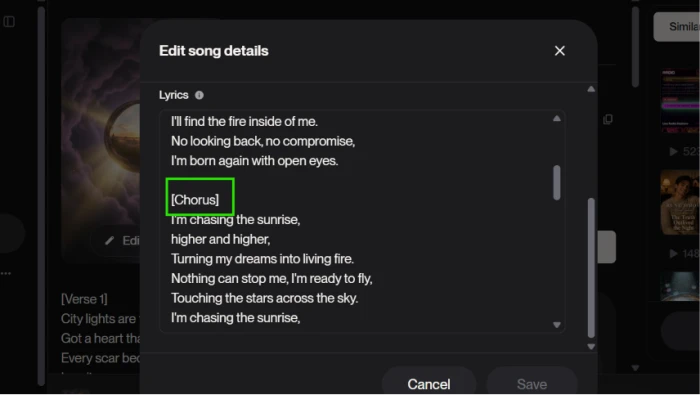
Suno reads structural meta tags inside your lyrics. Write [Verse], [Chorus], [Bridge] or [Instrumental Break] and the model places sections accordingly. Users layer style tags, BPM, mix descriptors and production notes on top of that. There is a prompt enhancement helper that expands a bare genre tag into a fuller description. Two specialized modes matter for anyone recording real audio: Add Vocals takes your instrumental and sings over it, and Add Instrumentals takes your vocal and builds a backing track underneath.
Musicful accepts a style prompt, lyrics, reference audio, or humming. It offers lyric replacement and style optimization. What I could not find is a documented structural tag system.
Suno also carries Personas, saved profiles that capture a song's vocal character and style so you can reuse that identity across future generations. Personas combine with Covers, letting you keep one voice while reinterpreting the melody underneath. Musicful's custom voices cover similar ground, though without the documented layering behaviour.
The practical difference: with Suno you can specify that the bridge arrives after the second chorus. With Musicful you describe the song and hope. For a hobbyist that gap is invisible. For anyone working to a brief, it decides how many generations you burn, and burned generations are the real cost of a subscription.
Worth stating plainly, since it cuts the other way: prompt control is only an advantage if you use it. Someone who types "sad piano song" and takes the first usable result gains nothing from meta tags, and Musicful's simpler surface may get them there with less friction.
Iteration: the verbs are identical, the depth is not
Here is something I did not expect. The two products use nearly the same vocabulary for revision.
Musicful offers five remix actions: Cover, Extend, Reuse, Add Vocal, Add Instrumental.
Suno groups Cover, Extend, Reuse, Adjust Speed, Use Styles and Lyrics, Crop, and Replace Section under Remix.
Three of those words match exactly. Musicful's workflow vocabulary tracks Suno's closely enough that the resemblance is hard to read as coincidence.
Two entries on Suno's list have no Musicful counterpart, and they are the two that matter most on attempt eleven. Crop trims to a region. Replace Section regenerates one part of a finished track while everything around it stays untouched.
That is the difference between fixing a chorus and regenerating a song. On a five-credit generation the waste sounds trivial. Across a month of chasing one release-ready track it is most of your allowance.
Suno also tracks remix lineage. Every version made from a track links back to the original, and you can toggle whether your songs accept remixes at all. Musicful lets you remix other users' published songs where they have enabled it, so the social layer exists on both sides.
Then there is Suno Studio, which sits on the Premier tier. Studio is a timeline. You edit in sections, add new instrument stems to an existing arrangement, record your own audio directly onto the timeline, and export MIDI. Musicful has no timeline editor.
I want to flag a correction here, because I got this wrong when I first looked at these two tools. It is tempting to file Suno Studio under "MIDI export" and conclude that any tool offering MIDI download matches it. That is a category error. Musicful hands you files. Suno hands you an editing environment and then hands you files. If your process is generate, then fix, then fix again, those are not comparable products.
Stems and export
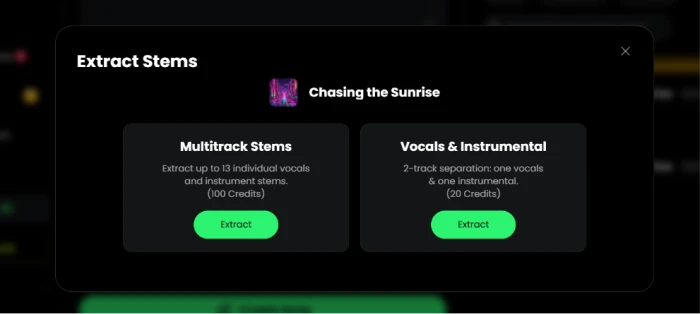
Musicful's stem splitter separates up to 12 parts and runs as a standalone tool, so you can feed it audio you did not generate there. Its own marketing claims cleaner separation with less bleed than competitors. Downloads come as MP3 or WAV, with commercial rights attached to stems.
One inconsistency worth noting: the stem splitter page advertises up to 12 parts while the Pro plan card says up to 13 tracks. Minor, but it is the kind of thing that suggests the marketing pages are not being reconciled against each other.
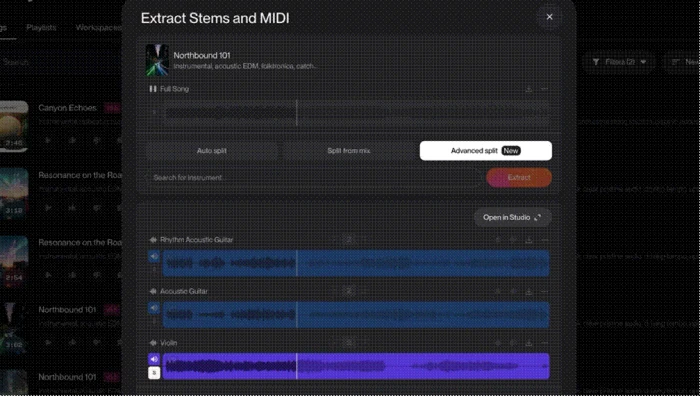
Suno's stem separation draws criticism for being messy. Its Advanced Split lives on Premier.
Count against count, Musicful wins. Thirteen stems that bleed lose to four clean ones, so treat the numbers as unresolved until you split a dense mix in both and listen. This is the second thing on your test list.
What comes out the other end
Musicful's advantage is a whole output category rather than a feature.
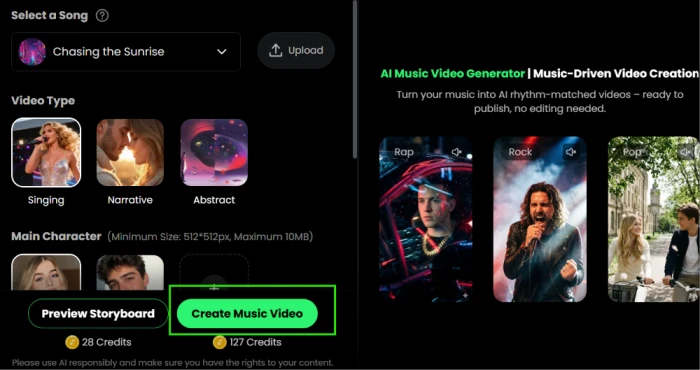
It generates music videos from finished tracks. It makes lyric videos. It has a visualizer alongside a song-to-video tool. Suno's equivalent is uploading a ten-second looping clip, 9:16, under 720px tall, to sit behind a track in your library. Those are not the same product.
For anyone publishing to short-form video, Musicful collapses two subscriptions into one. Verify watermarks during a trial first, because customer reviews have complained about watermarks appearing on paid video exports.
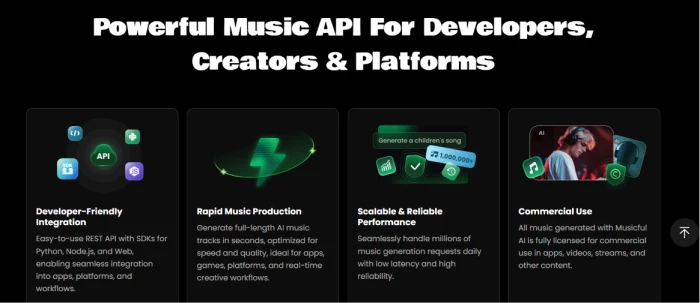
Musicful also runs a public API with its own platform page and self-serve access. If you are building generation into an application, that availability may outrank everything else in this article, and it is the clearest example of the breadth-over-depth pattern from the opening. Musicful ships across web, iOS and Android, with the stem splitter available on all three.
Side by side
| Capability | Suno | Musicful |
|---|---|---|
| Current model | v5.5 | V3.0 |
| Structural meta tags | Yes | Not documented |
| Regenerate one section | Yes (Replace Section) | No |
| Timeline editor | Yes (Studio, Premier) | No |
| MIDI export | Studio, Premier only | Standard and above |
| Stem parts | Advanced Split, Premier | Up to 12 |
| Reusable vocal identity | Voices and Personas | Custom voices |
| Humming input | No | Yes |
| Music video output | 10-second loop upload | Full MV, lyric video, visualizer |
| Public API | Not self-serve | Yes |
| Commercial rights from | Pro | Every paid plan |
Read that table by column rather than by row count. Suno's entries cluster around changing a song that already exists. Musicful's cluster around producing more kinds of output from one. Neither column is longer in a way that settles anything, which is why the choice depends on your process instead of a scorecard.
Two more practical notes. Suno improved generation speed substantially at v4.5 and both tools return tracks in well under a minute, so speed is not a deciding factor. Both run on mobile, and Suno has additionally appeared as a plugin inside Microsoft Copilot, which matters only if that is already where you work.
My scorecard
Every score below comes from documentation, interface behaviour, or arithmetic I could check. The row that matters most to most readers is unscored, and that is deliberate.
| What I scored | Suno | Musicful |
|---|---|---|
| Generation quality | Not scored | Not scored |
| Control over output | 8 | 5 |
| Revision and editing depth | 9 | 4 |
| Stems and export | 6 | 8 |
| Output range | 3 | 9 |
| Value per song | 9 | 5 |
| Pricing transparency | 9 | 3 |
| Rights clarity | 6 | 7 |
| Billing trust | 4 | 4 |
| Free access | 9 | 6 |
| Total | 63 / 90 | 51 / 90 |
Generation quality carries no number because I cannot listen for you, and neither can anyone reviewing these tools from a browser. It is the heaviest factor in the decision and the one row a scorecard cannot honestly fill. The test in the section below hands it back to you.
The two widest gaps run in opposite directions. Suno takes revision and editing depth by five points on the strength of Replace Section, Crop and the Studio timeline. Musicful takes output range by six on video generation, the public API, and humming input. Those two rows describe different products serving different jobs.
Billing trust scores 4 for both. Neither company has earned better.
Pricing transparency is the widest single-sided gap. Suno's page audits against itself, with every discount checkable against another figure on the same screen. Musicful's countdown resets per visitor, which makes its reference prices unverifiable.
A total of 63 against 51 is not a recommendation. Read the rows that match your process and ignore the sum.
Rights, and two traps
Suno assigns its rights in the output to paying subscribers on generation. Free-tier songs are non-commercial and do not become commercial retroactively when you upgrade.
First trap. A Suno remix of another creator's song is not monetizable by you, even when that creator enabled remixing. Permission to transform is not permission to sell. The remix button being available is not a licence, and creators have discovered this after release.
Second trap. Suno partnered with Warner Music Group, with licensed models planned during 2026. Warner's announcement stated that current models will be deprecated when the new ones launch. The v5.5 you build a catalogue on has a shelf life.
Musicful grants commercial use on every paid plan including its cheapest, which is more generous than Suno reserving commercial rights for Pro and above. Stems from its splitter carry commercial rights too, though that covers Musicful's processing rather than the copyright in whatever audio you fed it. Splitting a commercial release does not give you rights to the parts.
Now the money
Everything above is why the pricing below matters less than you would think. It still matters.
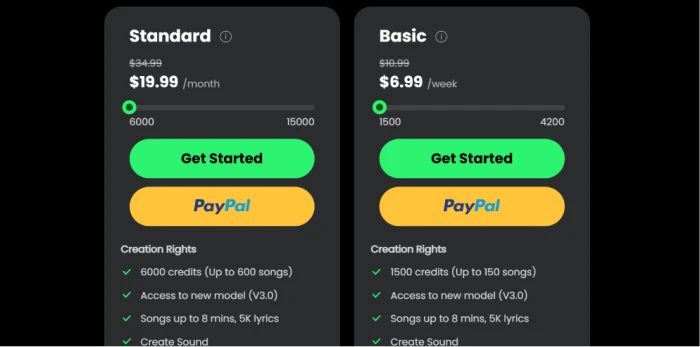
Musicful Standard and Basic plans, captured from musicful.ai/pricing
Basic is $6.99 per week from $10.99, with 1,500 credits for up to 150 songs. Standard is $19.99 per month from $34.99, with 6,000 credits for up to 600 songs.
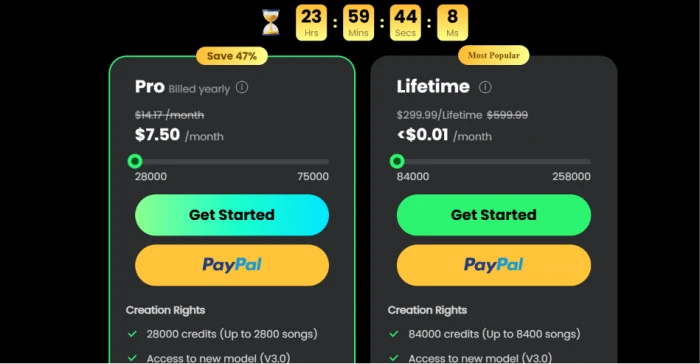
Musicful Pro and Lifetime plans, captured from musicful.ai/pricing
Pro is $7.50 per month billed yearly from $14.17, with 28,000 credits for up to 2,800 songs. Lifetime is $299.99 once from $599.99, with 84,000 credits for up to 8,400 songs, headlined "<$0.01 /month."
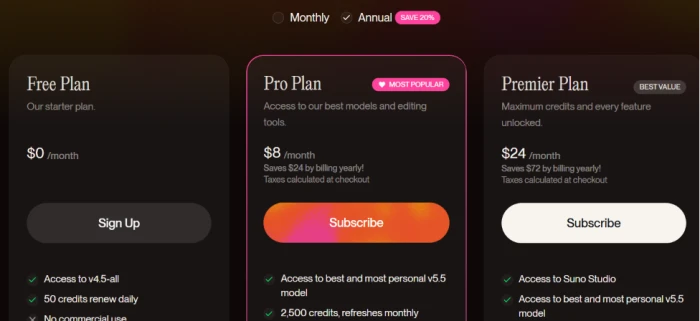
Suno Free, Pro and Premier plans, captured from suno.com/pricing
Suno's free plan runs v4.5-all with 50 credits renewed daily and no commercial use. Pro is $8 monthly billed annually with 2,500 credits and v5.5. Premier is $24 with 10,000 credits plus Studio.
The credit trick
Musicful charges 10 credits per song. The ratio holds across all four plans: 1,500 gives 150 songs, 6,000 gives 600, 28,000 gives 2,800, 84,000 gives 8,400.
Suno charges 5.
So Musicful Standard advertises 6,000 credits against Suno Pro's 2,500, reading as 2.4 times more generous. Converted to songs it is 600 against 500, which is 20 percent more for two and a half times the price. Credit counts across platforms measure nothing.
| Plan | You pay | Songs | Cost per song |
|---|---|---|---|
| Suno Premier (annual) | $288 / yr | 24,000 / yr | $0.012 |
| Suno Pro (annual) | $96 / yr | 6,000 / yr | $0.016 |
| Suno Pro (monthly) | $10 / mo | 500 / mo | $0.020 |
| Musicful Pro (annual) | $90 / yr | 2,800 / yr | $0.032 |
| Musicful Standard | $19.99 / mo | 600 / mo | $0.033 |
| Musicful Lifetime | $299.99 once | 8,400 total | $0.036 |
| Musicful Basic | $6.99 / wk | 150 / wk | $0.047 |
Two plans not to buy
Basic is billed weekly, which makes $6.99 read as pocket change. Fifty-two weeks is $363.48, or $30.29 a month against Standard's $19.99. You pay 52 percent more per month and lose the entire Advanced Features block: no stem splitting, no WAV or MIDI download, no custom voices, no reference audio upload, no remastering.
Lifetime promises "<$0.01 /month." Divide $299.99 by one cent and you get 29,999 months, or 2,500 years. Across three years it is $8.33 a month. The structural problem is bigger: 84,000 credits is 8,400 songs total, not monthly. Lifetime describes access duration rather than volume, and at $0.036 per song it is the second-worst value on its own page. Break-even against Pro arrives at 3.33 years, so it pays off only if the company is still honoring a retired deal in 2029. Read that against the Warner deprecation note above.
The countdown that resets
A timer sits above Musicful's plans. I captured it twice on separate visits: 23 hours 58 minutes on one, 23 hours 59 minutes on the other. Fetching the raw page returns 00:00:00 with "Save 0%" and empty price fields, so those values are written in by JavaScript per visitor. A deadline that reads 23:59 every time you arrive is a deadline that starts when your page loads, which makes $34.99 and $599.99 and $14.17 reference points rather than prices anyone paid.
The page also never says whether Pro's 28,000 credits arrive monthly or annually. At $7.50 a month the two readings differ twelvefold. My table assumes an annual pool, because a monthly reading would make Standard indefensible.
Billing reputations
Suno has documented complaints about hard-to-cancel subscriptions, charges landing after cancellation, credits vanishing at the billing boundary, and slow support. Credits do not roll over.
Musicful has the timer behavior above plus the watermark complaints.
Pay by a method you can stop without asking permission.
What none of this settles
I cannot tell you which one sounds better. Nobody writing about these tools from a browser can.
Cost per song is fiction until you know your retry count. A tool at $0.016 needing forty attempts per keeper costs more in practice than one at $0.036 landing in five. Published credit allowances assume every generation is finished work, and no real process looks like that.
Suno's free tier renews 50 credits daily, ten songs a day, indefinitely. Musicful gives free generations on signup. Test before paying.
Write four prompts in genres you care about. Include one with a sustained vocal line, since held notes break thin models. Run all four through both tools with the same retry budget. Then split a dense mix in both stem splitters, because that comparison is unresolved above.
Listen on the speakers your audience uses. Studio monitors flatter both tools.
Score four things:
• Vocal artifacts on held notes
• Whether the chorus arrives where you expected
• Stem bleed on the dense mix
• Retries needed before something publishable
That last number sets your real cost per song.
Which to choose
Finishing songs, not generating them. Suno Premier at $24 annually. Replace Section, Crop and the Studio timeline are the only tools in this comparison built for revising a track instead of rerolling it.
Publishing on a budget. Suno Pro at $8 annually. Commercial rights, v5.5, structure tags, Personas, and half Musicful's best cost per song.
Music videos. Musicful. Suno does not compete, and a subscription that covers audio plus video beats two subscriptions.
Building on an API. Musicful, on availability.
Standalone stem splitting. Musicful, with 12 parts on audio from anywhere, pending your own bleed test.
Trying it at all. Suno's free tier. Ten songs a day, no card, no commercial rights.
Nobody should buy Musicful Basic. Lifetime needs confidence about 2029 that the Warner note above does not support.



Comments 0
Join the discussion and share your perspective.
Sign in to post a comment and reply to other readers.
No comments yet
Be the first to share your perspective on this article.