A part-time virtual assistant is quoted anywhere from $600 to $3,000 a month. An AI stack that does much of the same work is quoted from $40 to $250. Both sets of numbers are real, and both hide about a third of what you actually pay. Here is the full math, with the parts each side leaves out.
The short version
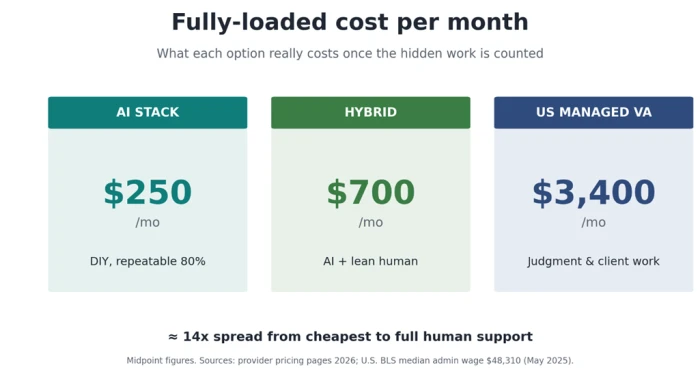
A fully-loaded US managed VA runs about $3,400 a month once you add management time, software and turnover. A DIY AI stack runs about $250 fully loaded. The gap is real, but AI covers roughly 70–80% of routine admin, not the judgment work. Most owners land on a hybrid: an AI stack for the repeatable 80% plus a lean human for the 20%, at roughly $700 a month.
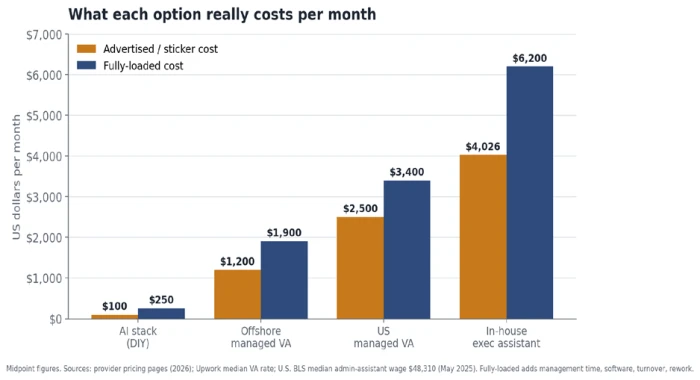
Figure 1. Advertised price versus fully-loaded monthly cost. Fully-loaded figures add management time, software licenses, turnover and rework.
Why every price you have seen is different
Search for this comparison and you get a mess. One page says an AI setup costs $52 a month. Another says $500. One VA agency quotes $699, a premium firm quotes $5,190. None of them are lying. They are describing different products that happen to share a job title.
Cherry Assistant put it well in its 2026 pricing guide: ask five providers what a virtual assistant costs and you get five answers that span an order of magnitude, from $3 an hour on a freelance marketplace to $65 an hour at a premium US service. All five are technically true. They just describe different things wearing the same title.
Pricing model adds another layer of confusion. VAs are sold by the hour, by task, by monthly hour bucket or by dedicated headcount, and each model quotes a different-looking number for the same work. AI tools are sold per seat, per usage tier or per automation run. Comparing an hourly VA rate to a flat monthly AI subscription is where most of the wild ranges come from.
So the first job is to stop comparing headline rates and start comparing like with like. That means two things: naming which version of each option you mean, and loading in the costs that never make the sales page.
How the numbers in this article were built
Every rate here traces to a named source. VA pricing comes from provider pages checked in 2026 and Upwork's published median. Labor cost for an in-house hire is anchored to the US Bureau of Labor Statistics, which put the median wage for secretaries and administrative assistants at $48,310 in May 2025. AI tool prices come from the vendors' own pricing pages. Where a figure is a midpoint or a model, it says so. Nothing here is sold by the author.
What you are actually comparing
A virtual assistant and an AI stack are not two versions of the same thing. One is labor you direct; the other is software you configure. Before the cost comparison makes sense, both need definition.
The four ways to hire a VA
● Freelance marketplace. You hire directly on a platform. Upwork reports a median VA rate near $13 an hour. Cheapest sticker price, most of your own time spent managing.
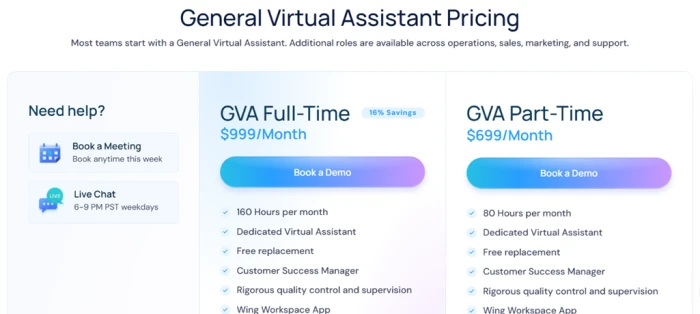
● Offshore managed agency. A vetted assistant in the Philippines, South Africa or Latin America, roughly $4 to $15 an hour, often $800 to $2,000 a month full-time, with the agency handling vetting and cover.
● US-based managed service. $30 to $75 an hour, commonly $1,200 to $3,000 a month part-time. Stronger English and time-zone fit, higher rate.
● In-house executive assistant. A salaried hire. The BLS median wage works out near $4,026 a month before benefits, taxes and overhead push the loaded cost far higher.
What an AI stack actually is
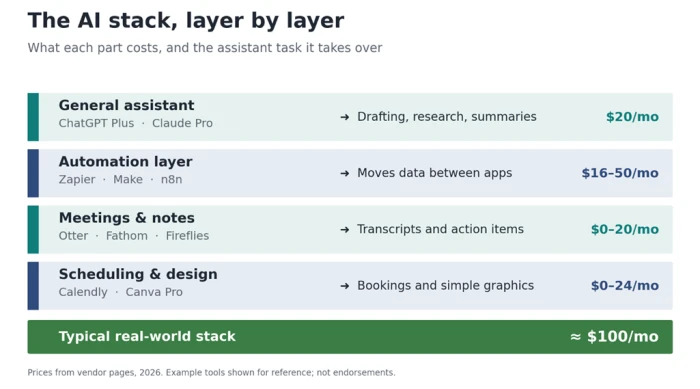
An AI stack is not one $20 chatbot. It is a small set of tools, each covering a slice of what an assistant does. A common 2026 setup:
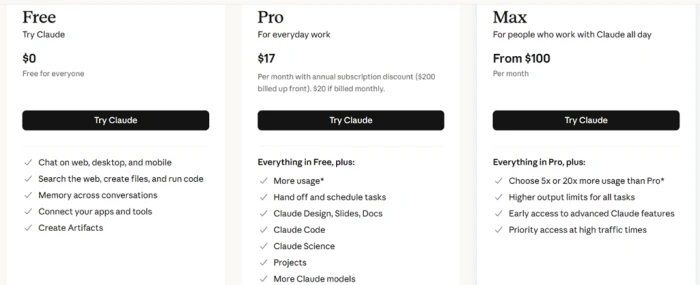
● A general assistant (ChatGPT Plus or Claude Pro, about $20 a month) for drafting, research and summaries.
● An automation layer (Zapier, Make or n8n, roughly $16 to $50) to move data between apps without you touching it.
● A meeting and notes tool (Otter, Fathom or Fireflies, $0 to $20) for transcripts and action items.
● Scheduling and content tools (Calendly, plus Canva Pro near $12) for bookings and simple graphics.
Documented real-world stacks land around $100 a month. One widely shared 2026 breakdown replaced about 85% of a $2,000-a-month VA's workload with ChatGPT Plus, Claude Pro, Zapier, Otter.ai and Canva Pro for $102 a month. That is the sticker price. The next two sections show what sits underneath it.
The real cost of a virtual assistant
The hourly rate is the easy number. The expensive number is everything that comes after you hire: the hours you spend directing the person, the software they need, and what happens when they leave.
The sticker price
| VA model | Typical rate | Monthly (part-time) |
|---|---|---|
| Freelance marketplace | ~$13/hr (Upwork median) | $600 – $1,200 |
| Offshore managed agency | $4 – $15/hr | $640 – $2,400 |
| US managed service | $30 – $75/hr | $1,200 – $3,000 |
| In-house EA (US) | BLS median $48,310/yr | $4,026+ salary alone |
Source: provider pricing pages (2026), Upwork published median, US BLS (May 2025).
The hidden ledger
Three costs rarely appear on a quote, and together they often add 30% or more to the real bill.
● Management time. A well-run VA relationship takes 3 to 5 hours a week of briefing, review and feedback. At a $75 hourly value, five hours a week is about $1,500 a month of your own time, spent managing the person you hired to save time.
● Onboarding and software. SOPs, walkthroughs and tool access take weeks to pay back, and the licenses a VA uses (project management, communication, specialized apps) run $50 to $150 a month.
● Turnover. Replacing an assistant who leaves is commonly estimated at 30% to 50% of annual pay in lost productivity and rehiring, and you rebuild the SOPs from scratch.
Worked example: US managed VA
Sticker $2,500/mo + management time ~$650 (loaded, conservative) + software ~$100 + amortized turnover ~$150 = about $3,400 a month fully loaded. The rate you were quoted was a little over two-thirds of the real cost.
The real cost of an AI stack
AI has its own hidden ledger, and the honest version of this article has to say so. The tools are cheap; the setup, the upkeep and the mistakes are not free.
The sticker price
| Layer | Example tool | Monthly |
|---|---|---|
| General assistant | ChatGPT Plus / Claude Pro | $20 |
| Automation | Zapier / Make / n8n | $16 – $50 |
| Meetings & notes | Otter / Fathom / Fireflies | $0 – $20 |
| Scheduling & design | Calendly + Canva Pro | $0 – $24 |
| Typical total | Documented real stack | ~$100 |
Source: vendor pricing pages (2026); documented $102 five-tool stack.
The hidden ledger
● Setup and integration. Connecting tools, writing prompts and building automations takes real hours up front, and some integrations carry their own fees.
● Maintenance and rework. Automations break when an app changes. Plan on a couple of hours a month keeping things running and correcting output.
● The error you do not see coming. AI can state something false with full confidence. In one documented case, an AI-drafted reply invented a "10% loyalty discount" that did not exist; the client forwarded it to their CFO, and the business faced honoring a fake discount or admitting the email was wrong. A human who knew the real pricing would never have sent it.
Worked example: DIY AI stack
Sticker ~$100/mo + maintenance and rework ~$120 (2 hrs at a loaded rate) + amortized setup ~$30 = about $250 a month fully loaded. Still a fraction of any human option, but not the $52 you saw quoted.
Head to head: the reconciled numbers
With both ledgers filled in, the comparison finally lines up. The table below is the one the vendor blogs never print, because it prices their own hidden costs too.
| Option | Sticker | Fully loaded | Best for |
|---|---|---|---|
| AI stack (DIY) | ~$100 | ~$250 | High-volume, repeatable admin |
| Offshore managed VA | ~$1,200 | ~$1,900 | Ongoing admin on a budget |
| US managed VA | ~$2,500 | ~$3,400 | Judgment work, client contact |
| In-house EA | $4,026+ | ~$6,200 | Full-time, high-trust support |
Figures are midpoints; your numbers move with hours and rates.
The lesson is not "AI is cheaper, pick AI." It is that the right comparison is cost per outcome, not cost per hour. A $250 stack that ships 80% of your admin reliably beats a $3,400 hire for that 80%. For the other 20%, the $3,400 hire is worth every dollar and the stack cannot touch it.
What the gap looks like over a year
A monthly number is easy to wave away. Stretched across a year, the spread is harder to ignore, and it reframes the decision as a budget choice rather than a tool preference.
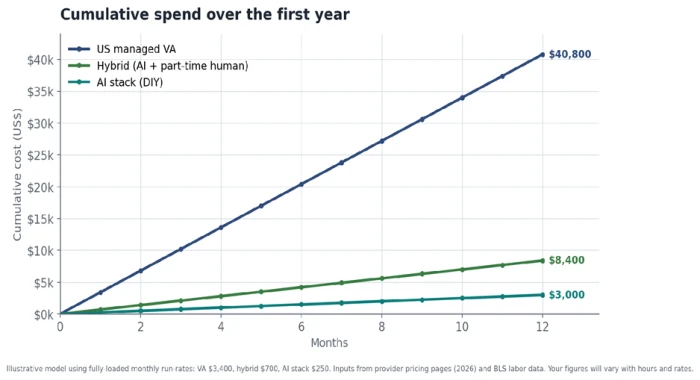
Figure 2. Cumulative first-year cost at fully-loaded run-rates. Illustrative model; inputs shown in the note beneath the chart.
At these run-rates the AI stack costs about $3,000 for the year, the hybrid about $8,400, and the US managed VA about $40,800. The point of the chart is not that one line is lowest. It is that the distance between them is the money you get to redeploy into acquisition, product or simply not spending.
What the math leaves out cuts both ways. AI runs 24/7 and never forgets a follow-up, so a night-owl founder or a multi-timezone team gets value the chart cannot show. A human absorbs ambiguity, reads tone and owns an outcome, which is worth more than its line the moment something goes wrong.
Cost is not capability: what each does well
Price only matters once you know the work will actually get done. This is where the honest answer to "can AI replace a virtual assistant?" lives, and it is neither yes nor no.
What AI handles well today
Across vendor and agency estimates alike, AI reliably covers roughly 70% to 80% of routine administrative work: email triage and drafting, scheduling, task tracking, meeting notes, research summaries and first-pass content. It does this instantly, around the clock, at the same cost whether you use it for two hours or twenty.
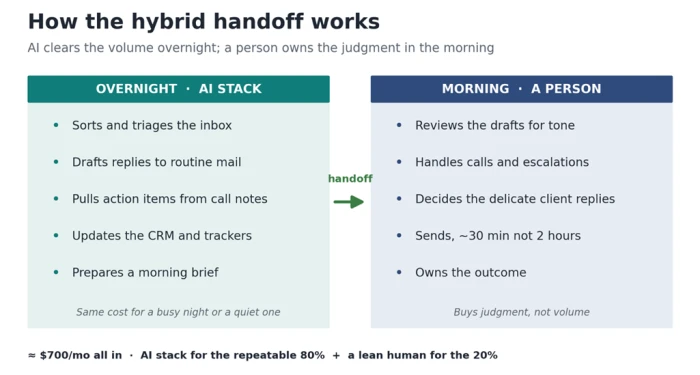
The scaling point matters more than it first looks. A human VA's cost rises in step with the workload, because more work means more hours to buy. An AI stack absorbs a busy week and a quiet one at the same price, which makes it a natural fit for spiky, seasonal or unpredictable demand. A concrete pattern many teams run: overnight, the stack triages the inbox, drafts replies and files action items from yesterday's calls; in the morning a person spends thirty minutes reviewing and sending, instead of two hours starting from a cold inbox.
What still needs a human
● Phone calls, and anything needing a physical or local presence.
● Judgment calls that weigh several soft factors at once.
● Relationship work: reading tone, knowing when to escalate, handling a delicate client.
● Owning an outcome and being accountable when a handoff fails.
The risk column the cost tables skip
A VA needs access to your inbox, calendar and sometimes financial data, which is a real security and privacy exposure. AI shifts that risk rather than removing it: you are trusting tools with the same data, plus you carry the accuracy risk shown by the fake-discount example above. Neither option is risk-free, and the cheaper one is not automatically the safer one.
So which should you pick?
The decision is less about your budget than about the shape of your work. Two questions settle most of it: is the task repeatable, and how much of it is there? The framework below walks the common paths.
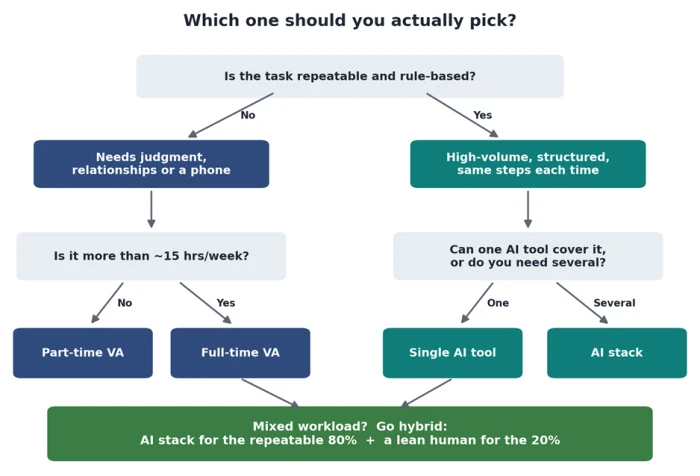
Figure 3. A decision path from task type to the option that fits, ending in the hybrid setup most mixed workloads need.
Read it by business stage
● Solo or pre-revenue: start with an AI stack. It is the cheapest way to buy back hours while cash is tight, and it scales with you.
● Growing, with recurring admin: add a lean human for the judgment work the stack keeps handing back to you.
● Established, with a real ops load: a dedicated VA or EA earns its cost, with AI making that person roughly twice as productive.
The answer most businesses land on
Push the numbers and the capability split together and they point the same way. AI is cheap and tireless but bounded. Humans are expensive but own the hard 20%. The setup that captures both is a hybrid, and it is what a growing share of small businesses now run.
The costed version is straightforward. An AI stack (~$100 fully loaded near $250) handles the daily grind. A part-time human for 8 to 10 hours a month, at $400 to $600, covers calls, escalations and anything sensitive. Total: roughly $700 a month, all in. That is about a fifth of a full US VA, with coverage the VA alone could not give you at 3 a.m.
This is not a fringe idea. Salesforce's 2024 Small & Medium Business Trends report, based on 3,350 SMB leaders, found 91% of AI-using SMBs said the technology boosted revenue, and that growing SMBs were far likelier to have adopted AI (83%) than declining ones (55%). The businesses pairing AI with people are the ones pulling ahead.
How to decide in two weeks
You do not have to guess. Run a short, cheap test and let your own numbers make the call.
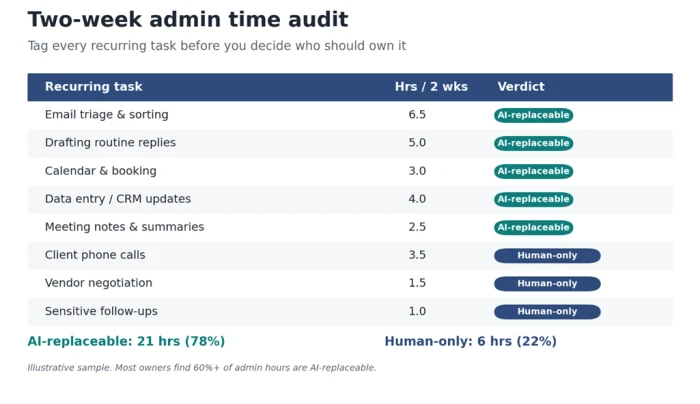
● Log the work first. For two weeks, track where your admin hours actually go. Most owners find 60% or more sits in AI-replaceable tasks like triage, bookings and data entry.
● Pick three tasks. Choose your biggest repeatable time sinks and run an AI tool on them in parallel with how you work now.
● Measure output, not effort. Compare quality and time saved on those three tasks after two weeks.
● Decide from the data. Keep what AI does well, and scope a human, part-time or full, around only what is left.
The number that actually decides it
Strip away the vendor spin and one figure runs the whole decision: the share of your work that is repeatable. If 80% of your admin follows the same steps every time, an AI stack captures most of it for a rounding error, and a lean human covers the rest. If the balance tips the other way, toward judgment, relationships and phone calls, no stack will save you, and a good assistant is worth several times their rate.
So the real comparison was never virtual assistant versus AI stack. It is how much of your work is a pattern, and how much is a person. Answer that honestly and the cost, in whichever direction, takes care of itself.
The Bottom Line
The whole comparison shrinks to one honest question, and it is not about price.
Every number in this article moved once you loaded in what the sales pages leave out. The $52 AI stack became $250. The $2,500 VA became $3,400. The gap between them stayed wide, but the point was never that the cheaper line wins. It was that you were comparing the wrong things: cost per hour, when the number that matters is cost per outcome.
Sort your work into two piles. One is repeatable: triage, bookings, notes, first drafts, the same steps every time. The other is judgment: phone calls, delicate clients, ambiguity, owning the outcome when a handoff fails. An AI stack takes the first pile for a rounding error and never touches the second. A good human takes the second pile and is worth several times their rate for it.
That split is why most owners stop choosing sides. The $700 hybrid is not a compromise. It is the setup that buys the cheap, tireless 80% from software and reserves the expensive, accountable 20% for a person, at about a fifth of a full US VA.
So do not pick a tool. Log two weeks of your own admin, measure how much of it is a pattern, and let that share decide. If your work is mostly repeatable, lean on the stack and staff a human around the edges. If it is mostly judgment, hire well and let AI make that person twice as fast. Either way, the answer was sitting in your own calendar the whole time. The cost just follows it.


Comments 0
Join the discussion and share your perspective.
Sign in to post a comment and reply to other readers.
No comments yet
Be the first to share your perspective on this article.