1
AI app and website builder
Generates functional sites and apps from prompts; praised for speed but criticized when bugs persist.
AI website and app builder aimed at non‑coders and entrepreneurs, combining an AI builder with intensive live training. Delivers quick, attractive results but pricing complexity and billing surprises dominate many real‑world experiences.
Independent review — we test tools ourselves and analyze public user reviews. How we test.
Famous.ai impresses many users with fast app and website generation, polished visuals, and unusually frequent live training sessions that help nontechnical founders get projects off the ground. However, billing complaints are extensive, centering on unclear pricing, per‑prompt and hosting charges, and surprise debits that some only notice on bank statements. Several users also report bugs, unreliable fixes, and slow or unhelpful support when something breaks, though others did receive refunds after escalation. Famous.ai suits patient, well‑informed users who can budget for usage costs, attend onboarding, and treat this as an experimental build platform rather than a low‑risk starter tool.
Famous.ai is an AI-powered app-building platform that promises to turn a plain idea into a working product - its tagline sums it up as "idea to app, instantly," powered by what it calls Synthetic Intelligence. Instead of writing code yourself, you describe what you want and the platform generates it for you, handling the build, the setup, and the hosting behind the scenes. It positions itself as a single place to create across three different worlds: web applications, native mobile apps, and crypto or Web3 projects.
Beyond the core builder, the platform wraps in a few surrounding features. A live community feed showcases projects other creators are building in real time for inspiration, while a directory of independent experts lets you hire freelancers to build on your behalf if you'd rather not do it yourself. There's also an affiliate program for earning referral commissions. Access to the actual builder sits behind a paid subscription, offered across multiple tiers, each bundling build credits, pay-as-you-go usage, and hosting discounts.
Generates functional sites and apps from prompts; praised for speed but criticized when bugs persist.
Frequent sessions with Terry gain strong praise for clarity, energy, and hands‑on demonstrations.
Charges accrue on each build instruction; widely criticized as confusing and easy to overspend.
Hourly hosting model with sleep projects; many report surprise charges on inactive or unfinished apps.
Ongoing training, orientations, and community vibe repeatedly highlighted as motivating and informative.
Mixed feedback, from quick helpful refunds to slow responses and unresolved issues.
Output described as colorful, impressive, and professional when builds succeed.
Service where team builds for clients; suggested as better fit for some users by reviewers.
One user reported serious data exposure and slow response, raising security expectations concerns.
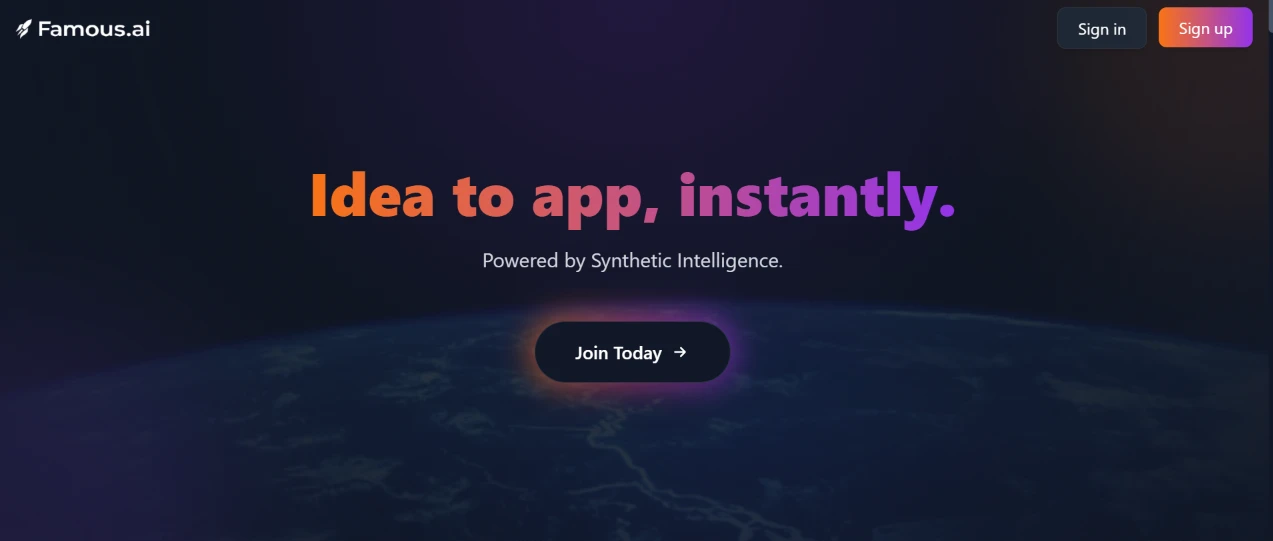
The first thing I hit was the homepage, and honestly there wasn't much to do here beyond read the pitch and click through. The whole screen is built around a single “Join Today” button, with “Idea to app, instantly” front and center and the tagline “Powered by Synthetic Intelligence.” Functionally this page is just the entry point: it decides whether you sign in or sign up, and every button funnels you straight into account creation.
What I noticed while poking around is that there's nothing else to explore from here - no live demo, no “try before you buy,” no sandbox to play in. Within a few seconds my only real move was to create an account and see what sits behind it, so that's exactly what I did.
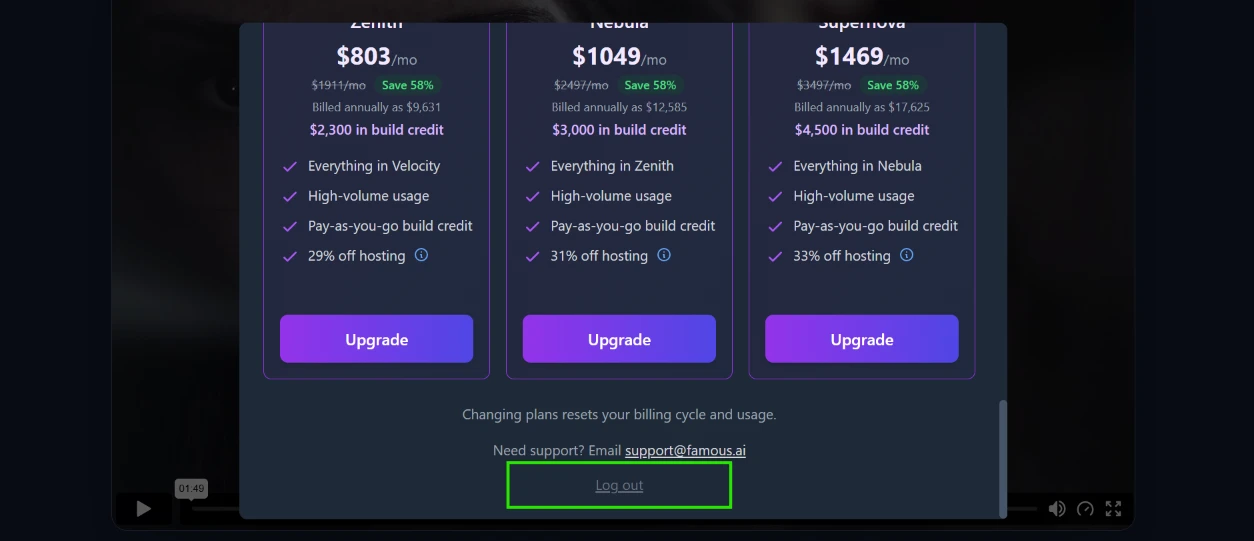
Right after I logged in, this is what greeted me: a full payment wall with no way past it. I went hunting for a “skip,” a free tier, a trial - anything - and there was none. The plans themselves are steep. The three I could see were Zenith at $803/mo, Nebula at $1,049/mo, and Supernova at $1,469/mo, and that's only a slice, because there are twelve plans in total.
Each tier bundles a chunk of “build credit” (the credits you spend generating and building apps), pay-as-you-go credit on top, and a hosting discount that climbs with the tier - 29%, 31%, 33% and upward. The Upgrade buttons drop you onto a plan, with a note that changing plans resets your billing cycle and usage.
The thing that actually stood out - and I've boxed it in green in the screenshot - is that the only escape from this wall without paying is the tiny “Log out” link at the bottom. So my honest observation is that my testing basically stopped at this screen. The product is fully paid, gated hard, and the pricing is high enough that I wasn't about to expense it just to poke around. Everything past this point I could only look at from the public marketing pages, not from inside a live build.
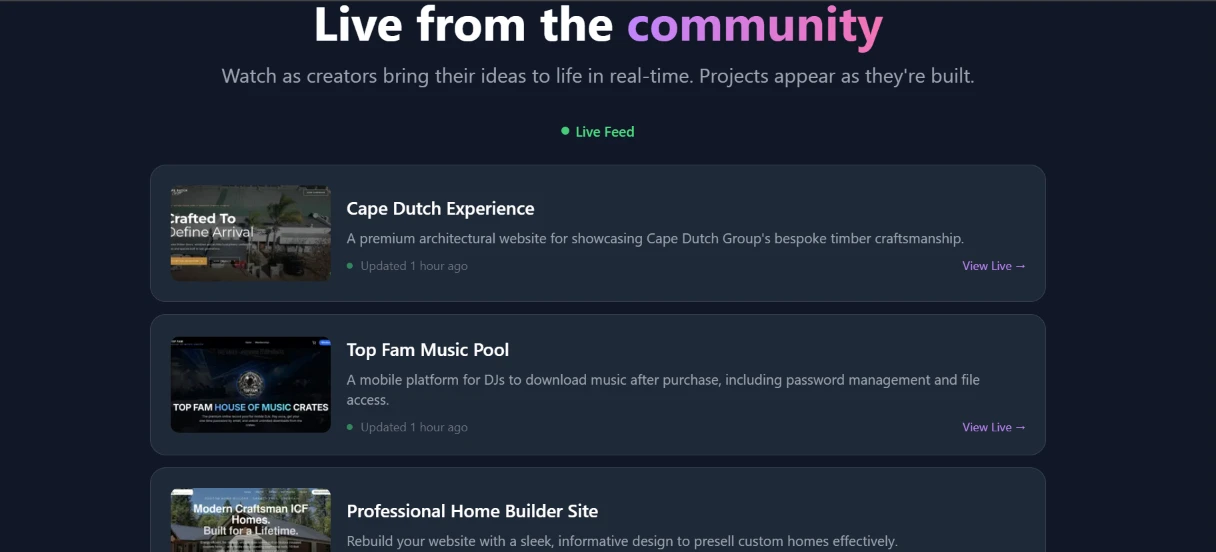
Since I couldn't get into the builder itself, I spent time on the public “Live from the community” feed. This section streams projects other creators are building in real time - there's a “Live Feed” indicator, and each entry (I saw Cape Dutch Experience, Top Fam Music Pool, and a Professional Home Builder site) carries a short description and a “View Live” link that opens the actual generated website.
As a feature it works as social proof plus inspiration: you can click straight into real listed creators' sites and see what the tool is capable of producing before - or instead of - building your own. I liked this more than I expected. It's the one part of the experience that gave me a concrete sense of output quality without a paid account, and the “updated 1 hour ago” timestamps made it feel genuinely live rather than a static gallery.
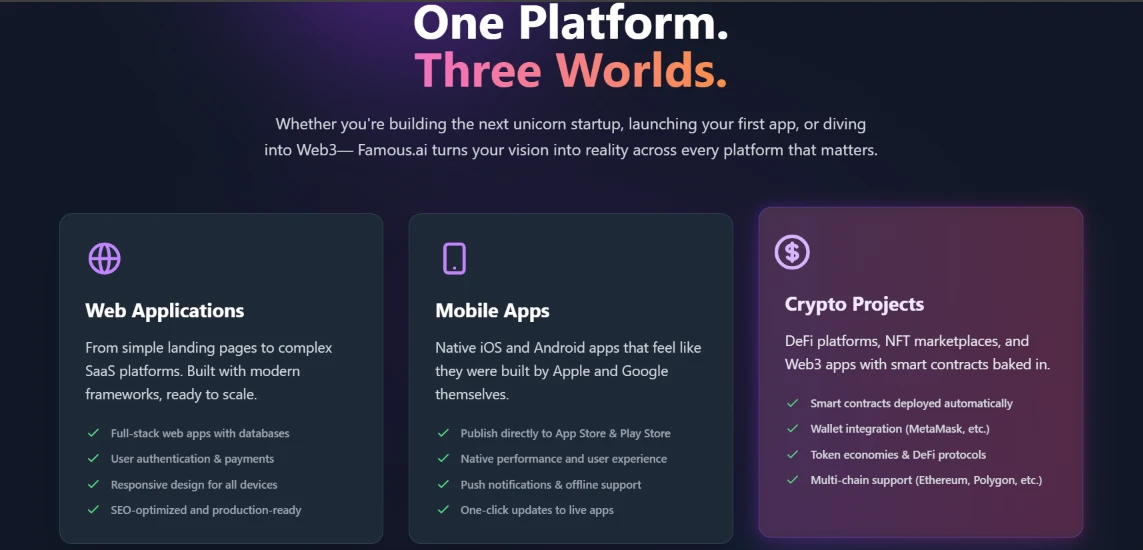
Scrolling further, I landed on the “One Platform. Three Worlds.” section, which lays out the three kinds of things the tool claims to build. Web Applications covers full-stack apps with databases, user auth and payments, responsive design, and SEO-ready output. Mobile Apps covers native iOS and Android with direct App Store / Play Store publishing, push notifications, offline support, and one-click updates to live apps. Crypto Projects covers Web3 - DeFi platforms, NFT marketplaces, smart contracts deployed automatically, wallet integration like MetaMask, and multi-chain support across Ethereum, Polygon, and others.
This is a positioning section rather than anything interactive, so there was nothing to actually operate here beyond reading it - but it does set expectations for scope. My honest take: it's an ambitious spread, and it made me want to test the mobile and crypto claims in particular, which of course I couldn't, thanks to the paywall.
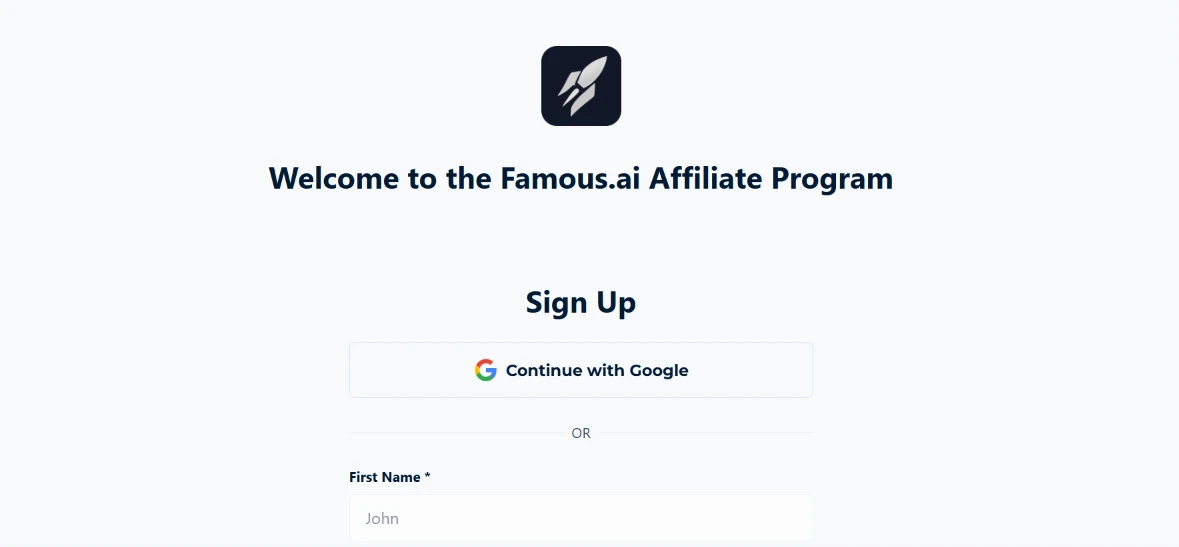
I also came across a separate affiliate program, which has its own sign-up flow - “Welcome to the Famous.ai Affiliate Program” with a “Continue with Google” option or a manual form starting at First Name. This is the referral side of things: the feature lets you register to promote the tool and earn a commission on the people you bring in, entirely separate from your main product account.
There was nothing to test here in terms of the actual builder, but one thing was worth noting - the affiliate onboarding was cleaner and faster to reach than the product itself. I could get all the way into this sign-up without ever hitting a paywall, which was a slightly funny contrast with the main app.
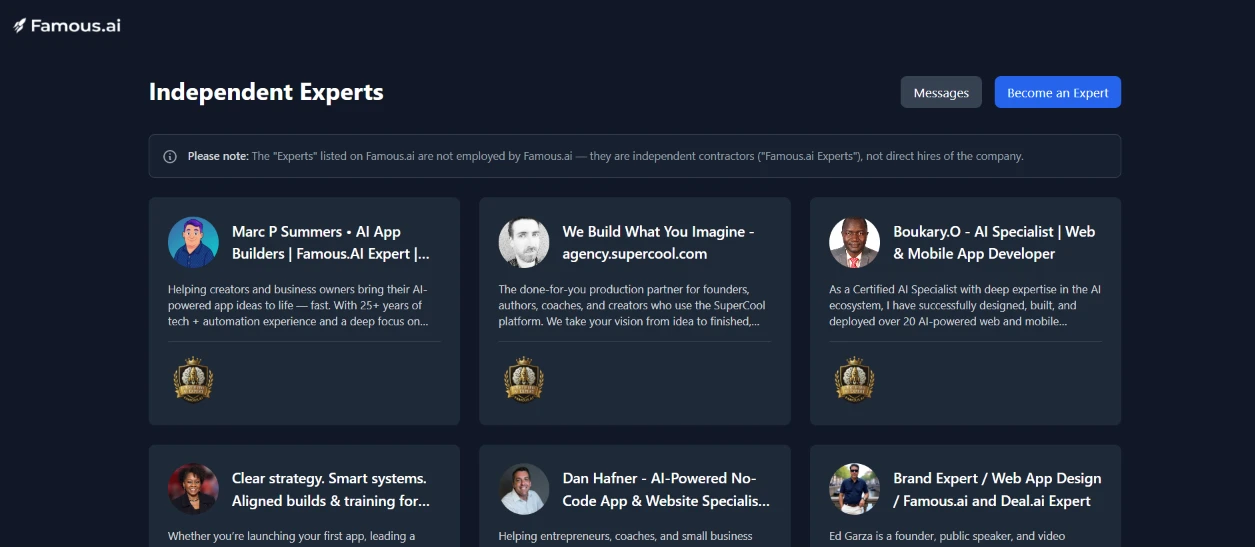
The last area I explored was “Independent Experts.” There's a clear disclaimer up top that these people are independent contractors (“Famous.ai Experts”), not employees of the company. The page is essentially a marketplace/directory: each expert has a profile card describing their background (I saw the likes of Marc P Summers, Boukary.O, Dan Hafner, and a few others advertising app- and web-building services), and you can message them directly or hit “Become an Expert” to list yourself.
As a feature, this is the done-for-you route - if you don't want to build the app yourself, you can hire one of these people to do it on the platform. My observation is that it's a sensible fallback given how gated the self-serve builder is, though it does quietly shift the model from “idea to app instantly” toward “idea to freelancer,” which felt like a slightly different promise than the homepage made.
| Dimension | Our test | User signal | Verdict | Composite |
|---|---|---|---|---|
| Build Quality Functionality and reliability of builds | 6.5 | 7.2 | Moderate | |
| Ease of Use Learning curve and daily usability | 7 | 8 | Good | |
| Billing Transparency Clarity of pricing and charges | 3 | 2.5 | Weak | |
| Customer Support Speed and helpfulness of responses | 4.5 | 4 | Weak | |
| Training Experience Quality of webinars and education | 8.5 | 9 | Excellent | |
| Security and Reliability Data protection and platform stability | 5 | 5.5 | Weak |
Toolscopia uses cookies to keep you signed in, remember your preferences, and understand how our reviews get read. Analytics are anonymous. See our privacy policy for the full detail.



Comments 0
Join the discussion and share your perspective.
Sign in to post a comment and reply to other readers.
No comments yet
Be the first to share your perspective on this tool.