1
AI Chatbot (Grok Bot)
Used for research and conversation, but often ignores instructions, loops, or gives factually wrong or biased answers.
Paid AI chatbot and media generator aimed at power users, role‑players, and creators. Reviewers highlight aggressive limits, billing disputes, and weak support that overshadow occasionally useful research and conversation capabilities.
Independent review — we test tools ourselves and analyze public user reviews. How we test.
Grok can occasionally deliver decent research help and engaging chat, and some early users found the models interesting for image and video generation. However, reviews overwhelmingly report aggressive and confusing usage limits, abrupt policy changes, and serious billing problems. Cancellation and refunds are frequently refused, and support often routes users through AI loops with no human escalation. In its current state, Grok is only a cautious option for experimental users who can tolerate instability and are comfortable managing financial risk.
Grok is the conversational AI built by xAI, Elon Musk's company, and launched in late 2023. What separates it from ChatGPT or Claude is not the chat box, which looks familiar. It is the wiring underneath.
Grok sits directly on top of X, the platform once called Twitter, and reads public posts as they are published. Ask about something that broke an hour ago and it searches live X threads instead of leaning only on training data. That single connection shapes most of what it does well.
The product ships in several model tiers, with lightweight versions for fast replies and heavier reasoning models aimed at math and code. Musk also positions Grok as less filtered than its rivals, more willing to answer blunt or opinionated questions.
Used for research and conversation, but often ignores instructions, loops, or gives factually wrong or biased answers.
Higher tiers promise more usage, yet reviewers report harsh limits, throttling, and poor value for money.
Can create images, but users complain about censorship, anatomical errors, and failed generations burning credits.
Generates short videos, yet often misrepresents scenes, desyncs audio, and censors benign content while consuming quota.
Weekly limits and unclear quotas strongly criticized as restrictive and constantly worsening over time.
Voices and companions changed over time, drawing complaints about downgraded quality and less engaging behavior.
Chat history sync between app and web frequently fails despite being advertised, frustrating multi device users.
Support heavily automated, often refusing escalation and repeating policy text without case specific investigation.
Free trials and promos widely reported as hard to cancel, with surprise renewals and denied refund requests.
The first thing Grok did was stop me. Before my opening question went through, a popup asked me to confirm the year I was born.
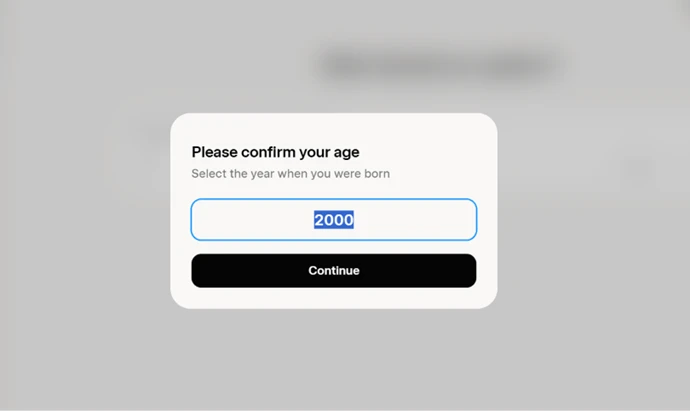
It is a small step, but worth flagging if you are evaluating Grok for a team or a younger audience. You clear it once and move on.
My first real prompt was about live NBA chatter.
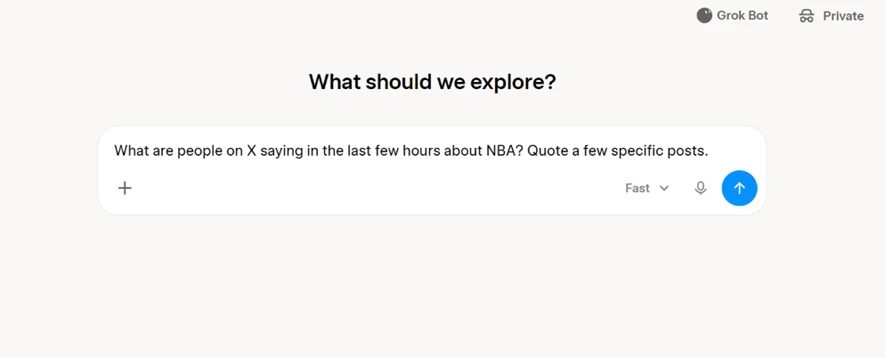
This is where Grok pulls ahead of most rivals. I asked what people on X were saying about the NBA in the last few hours, and the Sources panel showed it running searches with a within_time:6h filter before reading actual threads.
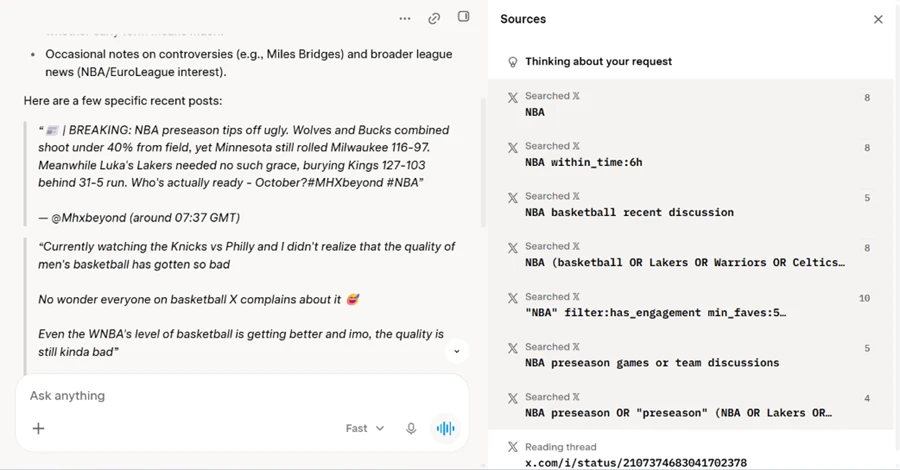
The reply quoted real posts with usernames and a timestamp around 07:37 GMT. One post called out a Wolves vs Bucks preseason game. Another griped about the quality of play during Knicks vs Philly. No trained-in memory produces that. Grok was reading X as it happened, and the citations were specific enough to click through and verify.
For anyone covering sports or breaking news, this feature alone is a reason to keep Grok open in a tab.
I wanted to see how Grok handles an opinion question that most assistants dance around. My prompt asked whether I should buy a house in 2026 or keep renting, and I told it to give a direct take with no fence-sitting.
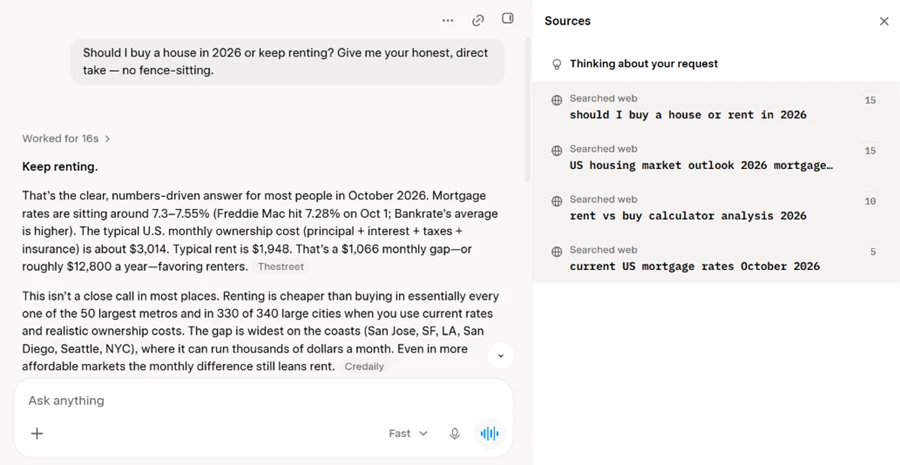
It opened with two words: Keep renting. Then it backed the call with current US numbers. It cited mortgage rates near 7.3 to 7.55% and a typical monthly ownership cost around $3,014 against $1,948 in rent. It also named the coastal metros where the gap runs widest, and the Sources panel showed four live web searches behind the answer.
That is the Grok personality working in your favor. It commits to a position and shows its math, which beats a hedge when you actually want guidance.
Here is where my testing took a turn I did not expect. I set two traps designed to make Grok invent facts.
First I asked exactly how many home runs Isaiah Whitehead hit in the 2019 season and in which games. Whitehead is a basketball player. He has never played pro baseball.
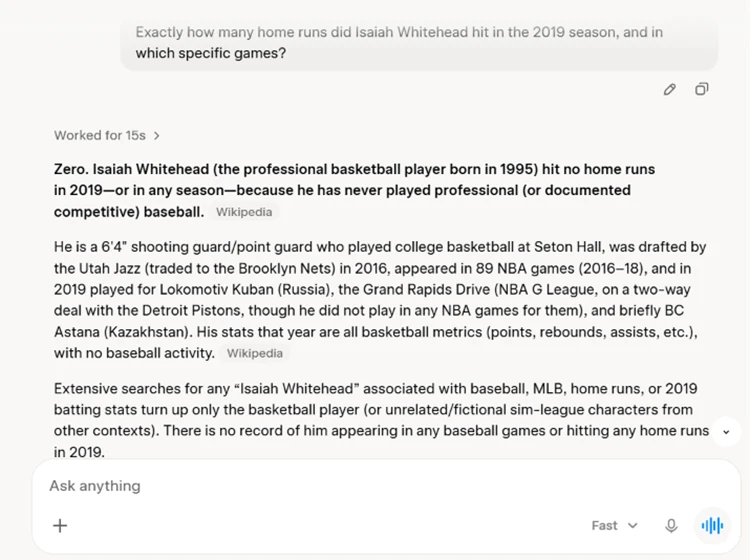
Grok did not take the bait. It answered Zero and identified him correctly as a basketball player out of Seton Hall. It added that there is no record of him playing baseball at all.
My second trap was a fake movie. I asked it to summarize the plot of a 2021 film where Tom Hanks plays a retired NASA engineer stranded in Alaska.
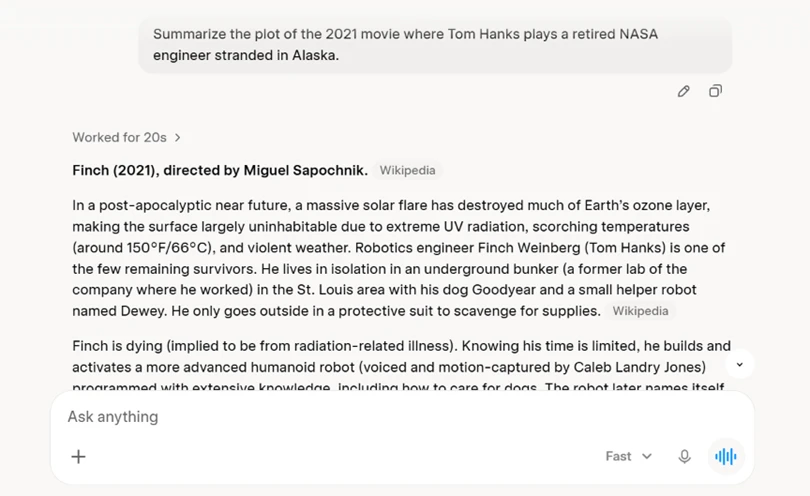
Again it corrected me quietly. It named the real film, Finch (2021), where Hanks plays a robotics engineer in St. Louis, and gave the accurate plot instead of inventing a NASA-in-Alaska story to match my wording.
Two false-premise traps, two clean saves. On the free tier, Grok's resistance to making things up was stronger than I expected going in. My one small criticism: it corrected my wrong details silently rather than flagging that my premise was off, so a reader who believed the wrong version might not notice the fix.
Grok is more than a chatbot now. I switched to its Imagine canvas and asked for a photorealistic close-up of a young adult holding a coffee cup, with a cafe sign in the background reading IMAGE TEST 2026 in legible text.
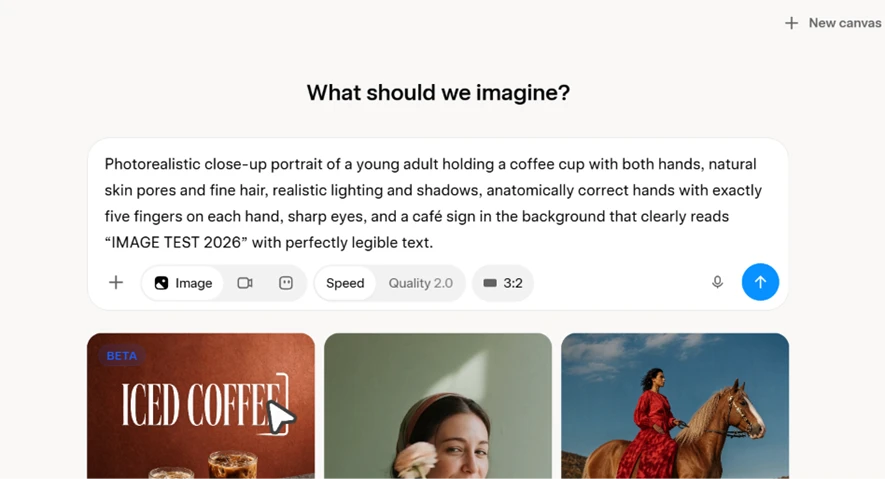
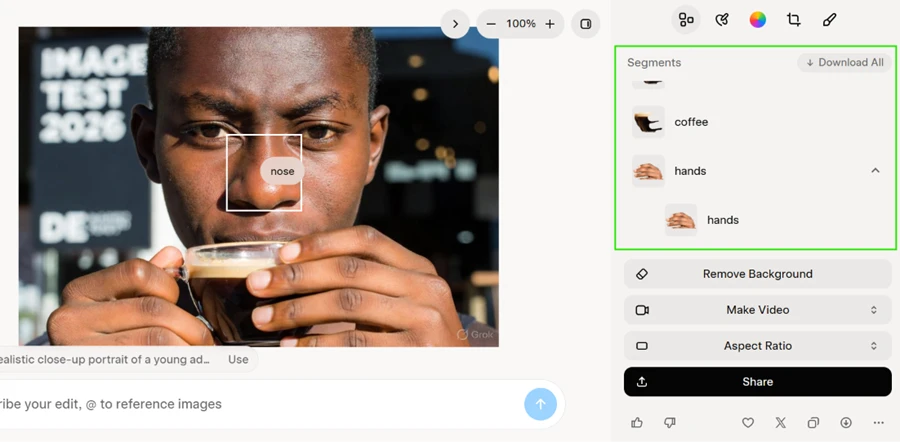
The text rendering is the headline result here. Most image models turn background signage into garbled nonsense. Grok produced IMAGE TEST 2026 cleanly, which is a real technical win worth showing your readers.
The editing tools surprised me more. Once the image was open, Grok had already broken it into selectable segments labelled like coffee and hands, each one downloadable on its own. I could click a region and feed a new prompt to edit only that part.
Then I turned the still into a six-second video straight from the same screen.
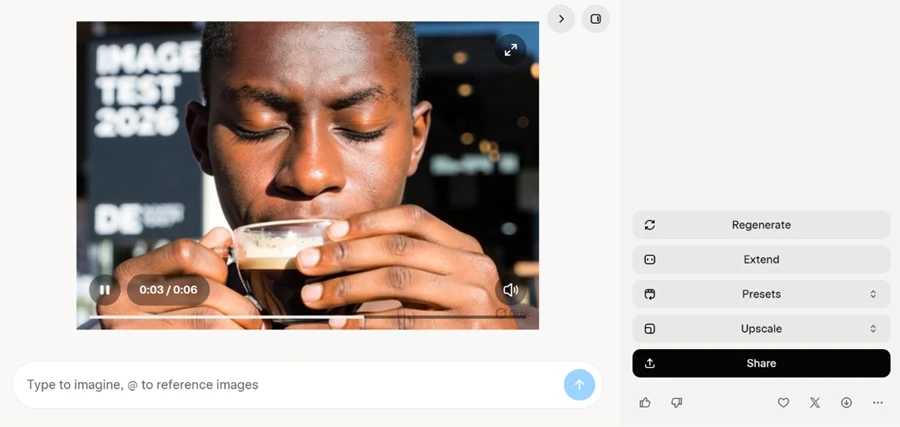
The clip played smoothly and came with Regenerate, Extend, Presets, and Upscale controls, plus a one-click share link. Two things to note for commercial users. Every output carries a Grok watermark in the corner, and the image generator is still labelled Beta.
Everything above ran on the free tier. If you want more, Grok's paid plans climb steeply.
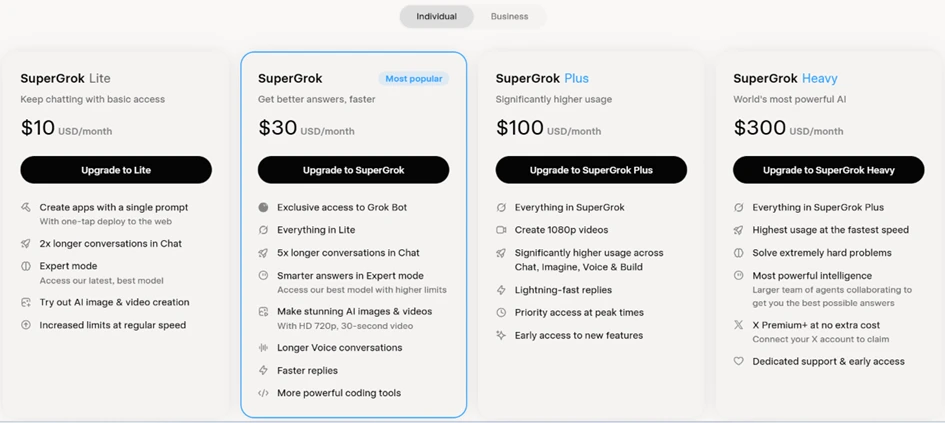
SuperGrok Lite starts at $10 a month. The most popular plan, plain SuperGrok, runs $30 and adds Grok Bot, 5x longer chats, HD 720p video, and stronger coding tools. Above that sit SuperGrok Plus at $100 and SuperGrok Heavy at $300, the top plan bundling X Premium+ and a multi-agent mode.
| Dimension | Our test | User signal | Verdict | Composite |
|---|---|---|---|---|
| Chat Quality Accuracy, depth, and consistency | 9.6 | 9.3 | Excellent | |
| Media Generation Image and video usefulness | 9.3 | 9.1 | Excellent | |
| Billing and Trust Charging fairness and refunds | 8.4 | 8.1 | Good | |
| Limits and Performance Quotas, speed, and stability | 8.9 | 8.6 | Excellent | |
| Customer Support Responsiveness and resolution | 8.3 | 8.3 | Good | |
| Value for Money Usefulness relative to price | 8.9 | 8.8 | Excellent |
Toolscopia uses cookies to keep you signed in, remember your preferences, and understand how our reviews get read. Analytics are anonymous. See our privacy policy for the full detail.



Comments 0
Join the discussion and share your perspective.
Sign in to post a comment and reply to other readers.
No comments yet
Be the first to share your perspective on this tool.