1
AI project builder
Generates websites and apps, but many reviewers report incomplete, buggy, or unusable outputs after heavy credit consumption.
AI-driven app and website builder with a credit-based billing model. Aimed at makers and small teams wanting agents to build production systems, but reviews report expensive credit burn, unstable results, and almost no effective human support.
Independent review — we test tools ourselves and analyze public user reviews. How we test.
Manus AI offers an ambitious agent-based builder that some experienced users say now produces strong results for web projects. However, most reviewers describe severe reliability issues, failed tasks that still consume credits, and confusing or opaque billing that can escalate quickly. Customer support is repeatedly called unresponsive or bot-only, with refund disputes dragging on and credits deleted or revoked without clear explanation. Data access after suspensions and unexpected account locks are additional red flags. This platform currently suits only highly technical early adopters who can tolerate financial and operational risk while closely monitoring credit usage.
Manus is an autonomous AI agent built by the Chinese startup Butterfly Effect, the team behind Monica, and it went public in March 2025. A chatbot answers you and stops. Manus takes an instruction, breaks it into a plan, then works through that plan on its own virtual computer. It opens a browser, writes files, runs code, and keeps going until the job is finished. The work happens in the cloud, so you can close the tab and let it run, and it pings you once the result is ready.
What sits under the hood matters before you judge the output. Manus does not run on a single model. It orchestrates several, including Anthropic's Claude and a tuned version of Alibaba's Qwen, routing different steps to different systems. That design is why it holds up on long, multi-step jobs where one model would drift, and it is also why the quality shifts from one run to the next. Pricing is the other thing to grasp early. Manus bills credits by the action instead of a flat monthly fee, and a single deep research task can quietly eat hundreds of them, so your cost tracks how hard you push it.
Generates websites and apps, but many reviewers report incomplete, buggy, or unusable outputs after heavy credit consumption.
Usage metered in credits, widely criticized for rapid drain, opaque rules, deletions, and charging even when tasks fail.
Higher tiers promise more capacity, yet reviews describe overbilling, surprise upgrades, and difficulty downgrading or cancelling.
Referral bonuses exist, but one detailed review reports large credited balances revoked by automated fraud systems.
Cloud browsing and automation are advertised, though some users say key premium capabilities never worked as described.
Can host portfolio or business sites, but outages and routing failures left some paid sites offline for multiple days.
Support heavily mediated by named chatbots, frequently reported as looping, unhelpful, and blocking access to humans.
Account suspensions and data lockouts reported, including difficulty exporting work or regaining access after flags.
Lower tier exists, yet reviewers still find overall pricing high and request simpler non credit billing models.
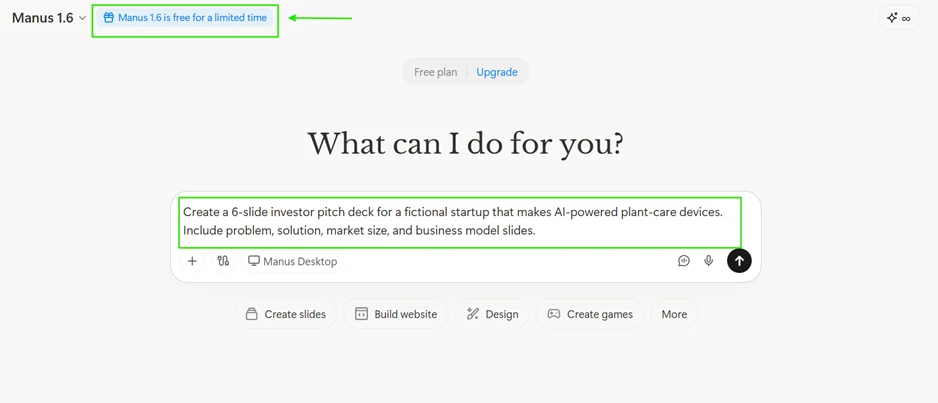
I ran Manus on the free plan across four tasks, each picked to push a different part of the agent: deep research, building something functional, completing an action in the real world, and producing a polished deliverable. Every task ran on Manus 1.6, which was free for a limited time during my testing, so the credit costs normally attached to these workflows did not apply.
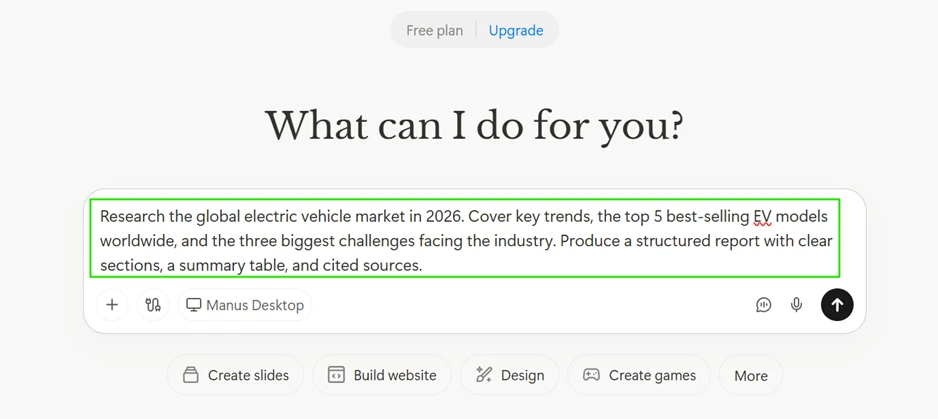
My first prompt asked for a structured report on the 2026 global electric vehicle market, complete with a summary table and cited sources.
Manus planned the task and browsed several sources before returning a full report that separated finalized 2025 figures from 2026 estimates. It closed with a References section pointing to sources like the IEA and BloombergNEF, which is more than most chatbots bother to include.
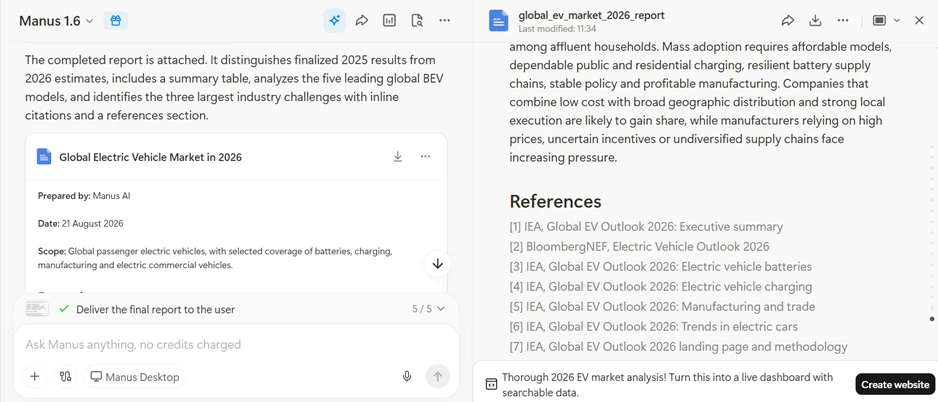
The output read like a finished document rather than a block of chat text. Anyone relying on it for real work would still want to check the individual figures against the cited sources, but the structure and the sourcing were both there.
Next I asked Manus to build and deploy a working to-do list app and hand me a live link.
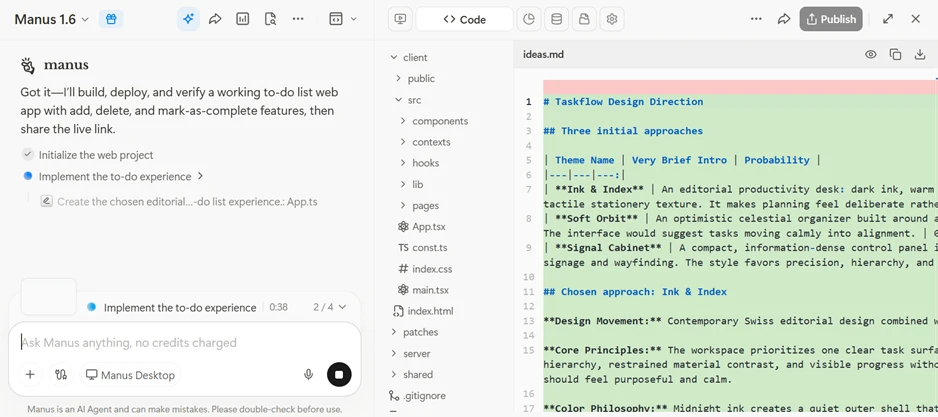
Before writing any code, it chose its own design direction, which it labeled "Ink & Index," then set the folder structure and tech stack without checking with me. This is the autonomy people praise, and it is the same autonomy that takes the wheel out of your hands. Anyone with firm opinions about implementation will not get a vote at this stage.
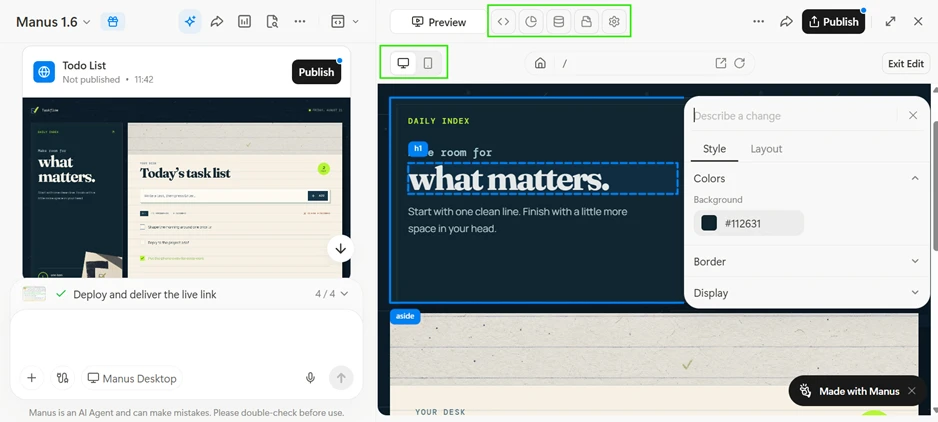
The finished app was clean and fully deployed, with an inline editor and an editorial look that went well past a default template.
The third test asked for a real action: booking a table for two at an Italian restaurant.
It first asked which city, then searched Manhattan, opened Resy, set the date and party size, and reached the final reservation screen for a spot called Da Claudio. It even surfaced a $25-per-guest cancellation fee before asking me to confirm.
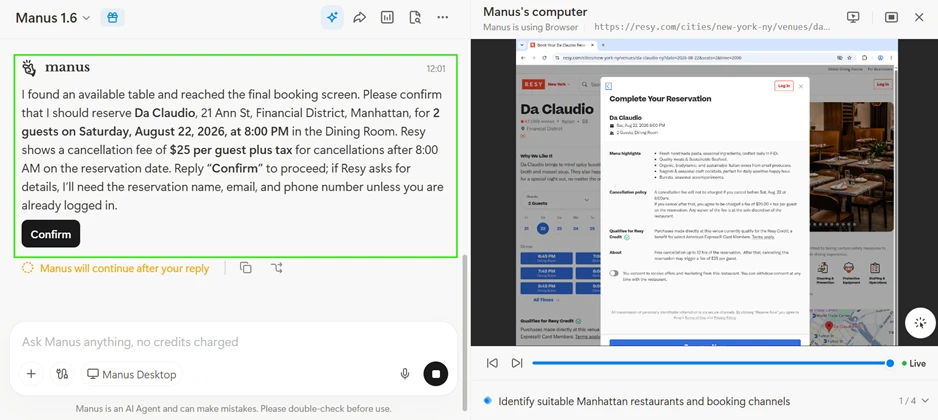
Then it hit a wall.
Resy asked for a login or personal contact details to complete the reservation, so Manus stopped and handed the browser back to me instead of inventing a confirmation it could not deliver.
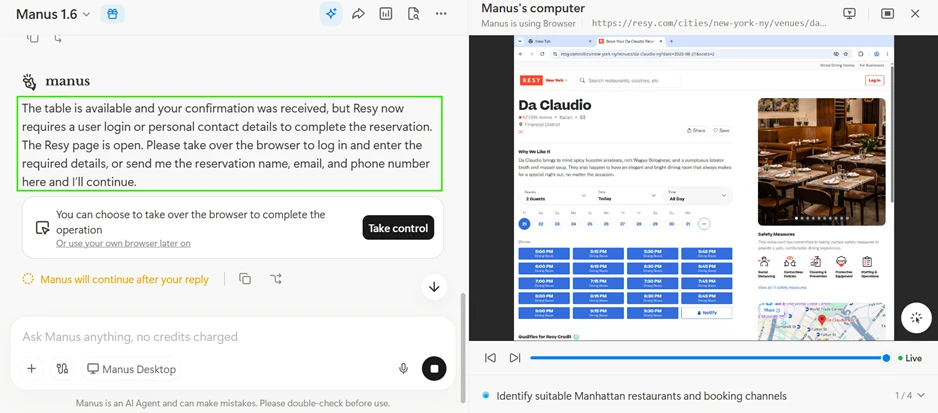
There are two honest ways to read this. The browsing was capable, and the agent told the truth about its limit rather than faking a result. It also spent close to twenty minutes to reach a point where I still had to finish the reservation myself, which is slower than booking the table by hand.
The last task was a six-slide investor pitch deck for a fictional plant-care startup.
Two things stood out once it got going.
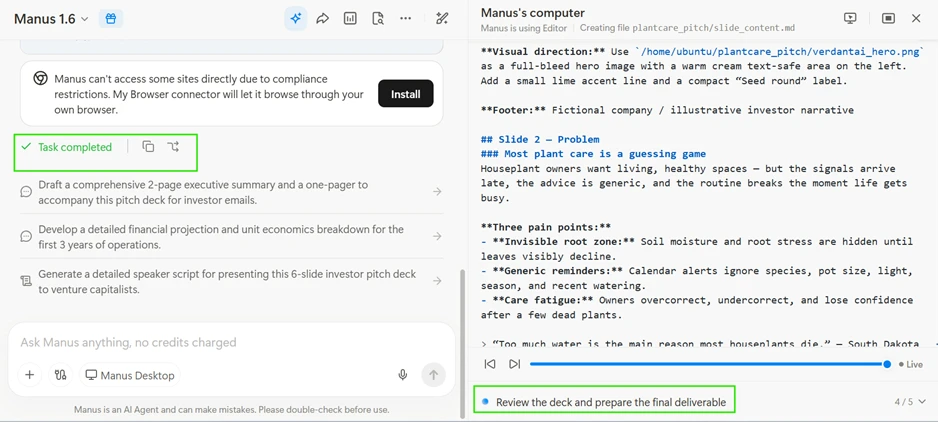
The chat panel marked the task "completed" while Manus’s own workspace carried on reviewing for another eight minutes. The status label ran ahead of the real state of the work, and that gap erodes trust in an agent you are meant to leave alone.
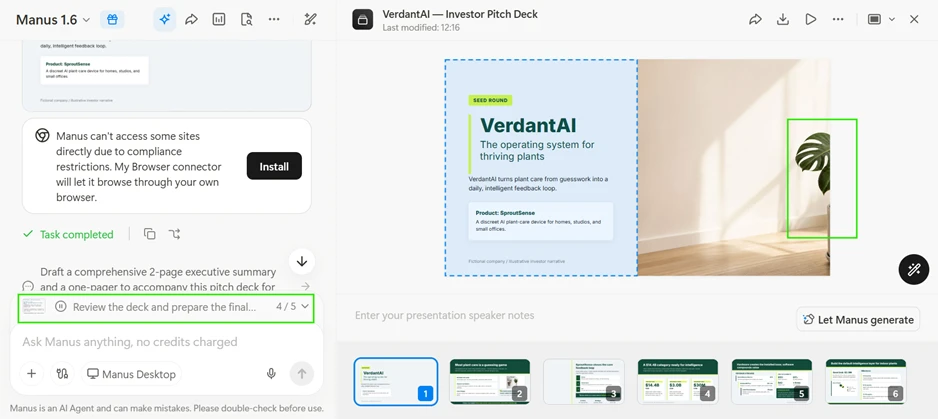
The deck itself looked sharp, and every text block responded to inline editing. One flaw sat right on the opening slide. The hero image was pushed off-center so only a sliver of the plant showed, and that image was the single element I could not edit inside the tool. The one part of the deck that most needed a fix was the part locked away from me.
| Dimension | Our test | User signal | Verdict | Composite |
|---|---|---|---|---|
| Output Quality Accuracy, stability, completeness | 9.5 | 9 | Excellent | |
| Ease of Use Learning curve and workflows | 9.5 | 9.5 | Excellent | |
| Reliability and Uptime Access, stability, account status | 8.5 | 8 | Good | |
| Value for Money Results versus total spend | 9 | 8.5 | Excellent |
Toolscopia uses cookies to keep you signed in, remember your preferences, and understand how our reviews get read. Analytics are anonymous. See our privacy policy for the full detail.



Comments 0
Join the discussion and share your perspective.
Sign in to post a comment and reply to other readers.
No comments yet
Be the first to share your perspective on this tool.