Something strange is happening in software delivery. Machines now write a large share of the code shipping to production, yet the job of proving that code actually works still leans heavily on hand-written scripts and late-night bug hunts. In 2025, industry trackers estimated that more than 40% of new code was generated with AI assistance. Release cycles that once ran in weeks now close in hours. Test suites, meanwhile, keep growing, and every rename of a button can snap dozens of brittle scripts at once.
That mismatch is exactly where AI-assisted testing steps in. Instead of treating quality as a final checkpoint, teams are handing the repetitive parts of testing to models that can draft test cases, run and repair them, and make sense of the results. The payoff is not science fiction. It is measured in engineering hours reclaimed, flaky tests tamed, and coverage that finally keeps pace with the product.
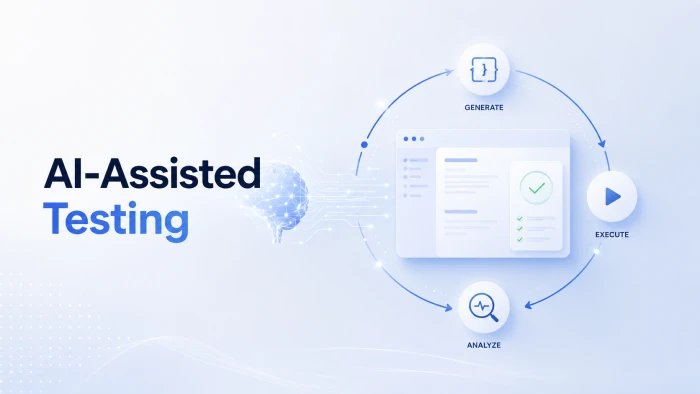
This guide breaks the discipline into its three working parts, generation, execution, and analysis, backed by current market data, adoption figures, and a clear-eyed look at what still trips teams up. A simple framework, the GEA Loop, ties the pieces together.
Key takeaways at a glance
- The AI-powered software testing and QA market is projected to jump from about $12.0 billion in 2026 to $39.4 billion by 2031, a 26.9% compound annual growth rate.
- Roughly 89% of organizations already pilot or deploy generative AI in quality engineering, yet only 15% have scaled it across the enterprise.
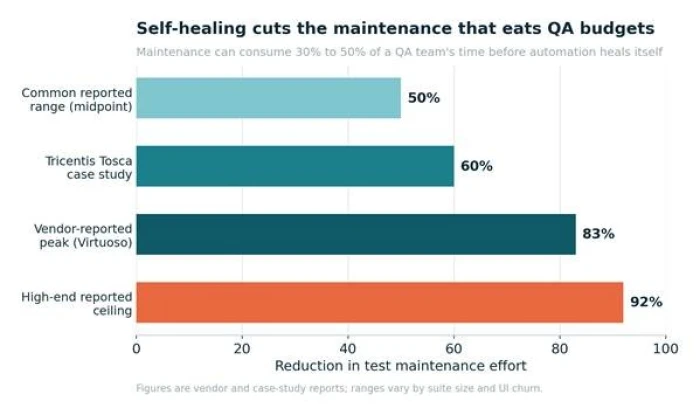
- Self-healing execution can cut test maintenance effort by 40% to 60% in typical reports, with some vendors and case studies claiming reductions above 80%.
- AI adoption in testing starts with generation: about 62% of AI-using teams apply it to test case creation, ahead of test data (58%) and maintenance (57%).
- The top barriers in 2025 turned practical, data privacy (67%), integration complexity (64%), and reliability concerns (60%), not a lack of interest.
- Human oversight remains essential: AI is probabilistic, not deterministic, and generated tests still need review.
What AI-Assisted Testing Actually Means
AI-assisted testing is the use of machine learning, natural language processing, and increasingly autonomous agents to support the software testing lifecycle. That support ranges from gentle autocomplete inside a test editor to systems that plan, write, run, and fix tests with only light human supervision.
The distinction that matters is not the marketing label but the degree of autonomy. Traditional test automation follows fixed scripts and rigid locators; it does exactly what it is told and breaks the moment the application shifts. Record-and-playback tools removed some of the coding but inherited the same fragility. AI-assisted approaches differ because they can interpret intent, adapt to change, and learn from past runs.
One useful way to place any tool on the spectrum is the Three-A Maturity Ladder.
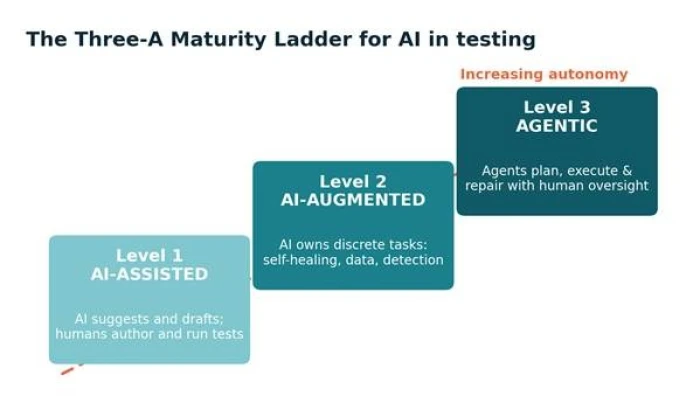
• Level 1, AI-Assisted: models speed up human work by suggesting test steps, generating snippets, and autocompleting scripts. People still author and run the tests.
• Level 2, AI-Augmented: the system owns specific tasks on its own, such as self-healing broken locators, generating realistic test data, and detecting UI elements.
• Level 3, Agentic: goal-driven agents handle the full cycle, reading requirements, generating tests, executing them, and repairing failures, with humans setting objectives and reviewing outcomes.
Most commercial platforms in 2026 sit at Level 1 or Level 2, while a fast-growing group pushes toward Level 3. Notably, Forrester renamed its testing category from Continuous Automation Testing Platforms to Autonomous Testing Platforms in late 2025, a clear signal of where the market believes it is heading.
The State of Play: AI-Assisted Testing by the Numbers
The money follows the momentum. Analysts size the dedicated AI-powered software testing and QA market at roughly $12.0 billion in 2026, on its way to $39.4 billion by 2031.
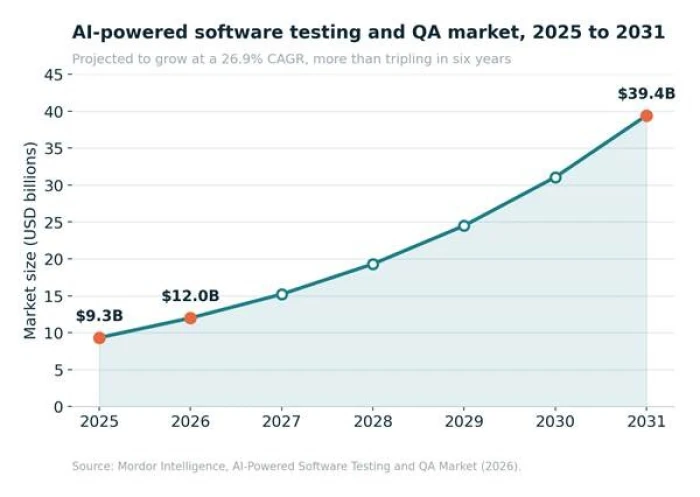
That sits inside a much larger software testing market worth around $54 billion in 2026 by Mordor Intelligence estimates, forecast to approach $100 billion by 2031. The generative AI slice specifically, though small today at tens of millions of dollars, is compounding at more than 20% a year. The exact numbers differ by research firm because each defines the category differently, but the direction is unanimous.
| Market segment | 2026 value | Later forecast | CAGR | Source |
|---|---|---|---|---|
| AI-powered software testing & QA | $12.0B | $39.4B by 2031 | 26.9% | Mordor Intelligence |
| Overall software testing | $54.4B | $99.9B by 2031 | 12.9% | Mordor Intelligence |
| Generative AI in testing | $73M | $440M by 2035 | 22.1% | Precedence Research |
| AI-enabled testing | $1.2B | $4.6B by 2034 | 18.3% | Fortune Business Insights |
Estimates vary by scope and definition across research firms; values reflect 2026 base-year figures where available.
Adoption has moved from curiosity to near-consensus. The World Quality Report 2025, a long-running industry survey from Capgemini, Sogeti, and OpenText, found that about 89% of organizations are piloting or deploying generative AI in their quality engineering practices.
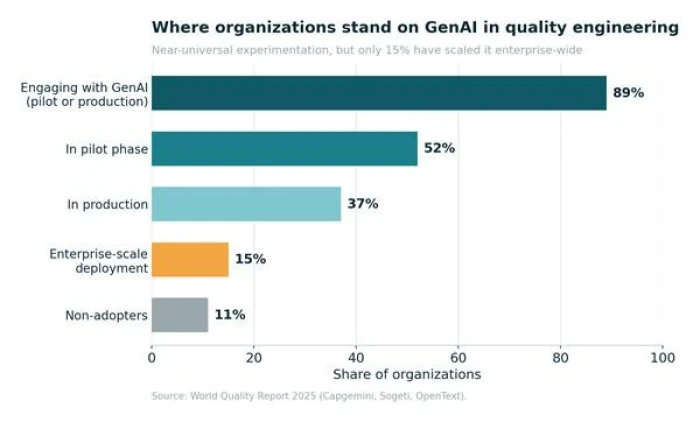
The gap between interest and maturity is the real story. Only 15% have reached enterprise-scale deployment, and the share of outright non-adopters has fallen from 31% in 2023 to just 11% in 2025. Gartner has projected that 80% of enterprises will adopt AI-powered testing tools by 2027, up from roughly 15% in 2023. Put simply, the question has shifted from whether to adopt to how fast and how well.
A Framework for Getting It Right: The GEA Loop
Traditional automation tends to decay. A suite that is 90% green today slowly rots as the application changes and scripts break. AI-assisted testing works best when it is arranged as a loop rather than a line, so that each run improves the next. The GEA Loop captures that idea in three stages, Generation, Execution, and Analysis.
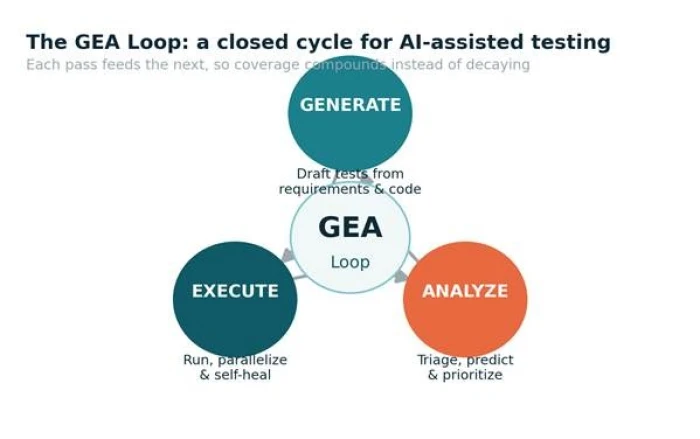
The power is in the feedback. Analysis feeds smarter generation; execution data reveals which tests matter; healed tests strengthen the next run. Coverage compounds instead of eroding. The three sections that follow map directly to the loop.
Pillar 1: Intelligent Test Generation
Test generation is where most teams meet AI first, and for good reason. Writing and maintaining test cases is slow, repetitive work. Modern tools can turn plain-language descriptions, user stories, or acceptance criteria into executable tests in minutes.
The generation toolkit has expanded well beyond simple script suggestions.
• Natural-language to test: a sentence such as log in, add two items to the cart, and check out becomes a runnable scenario, with no selector code required.
• Requirement and story-driven tests: agents read tickets, user stories, or specs and draft matching test cases, closing the gap between intent and coverage.
• Code-aware generation: tools analyze the application code and recent changes to propose tests that target new or high-risk paths.
• Synthetic test data: models fabricate realistic, privacy-safe data sets to exercise edge cases that production data rarely covers.
• Exploratory assistance: AI suggests untested flows by learning from real user sessions and past defects.
Generation leads AI adoption inside testing. Survey data indicates that around 62% of teams using AI in testing apply it to test case creation, ahead of test data generation and maintenance.
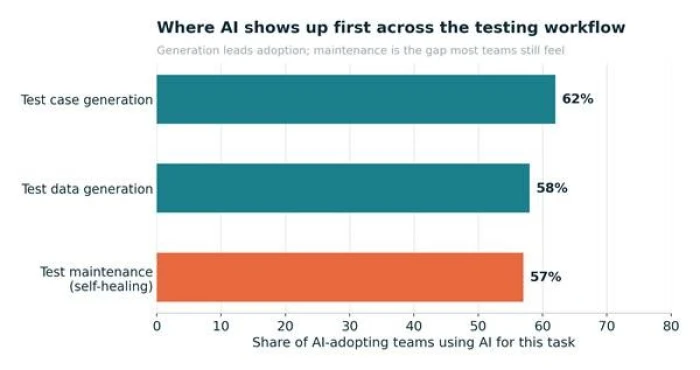
Reported gains are steep. Some platforms claim test creation up to 88% faster once natural-language authoring replaces manual scripting. The catch is trust: generated tests can be shallow or subtly wrong, so a human review step keeps false confidence out of the suite.
Pillar 2: Smart Test Execution
Once tests exist, execution is where AI earns its keep day to day. The single biggest drain in traditional automation is maintenance: keeping brittle scripts alive as the interface shifts. By various estimates, maintenance consumes 30% to 50% of a QA engineer's time, and by some accounts even more of the overall QA budget.
AI-assisted execution attacks that drain directly.
• Self-healing locators: when a button's ID or position changes, the system recognizes the element by multiple signals and repairs the test automatically, flagging behavioral changes for review.
• Flake reduction: multi-identifier matching and visual comparison cut false failures, with some frameworks reporting up to 80% fewer false alarms.
• Parallel and cross-environment runs: AI orchestration distributes tests across browsers, devices, and environments to compress total run time.
• Risk-based prioritization: instead of running everything, the system runs the tests most likely to catch a regression given recent code changes.
The maintenance savings are the headline number. Teams commonly report 40% to 60% reductions in test maintenance effort after adopting self-healing, and some vendor case studies claim considerably more.
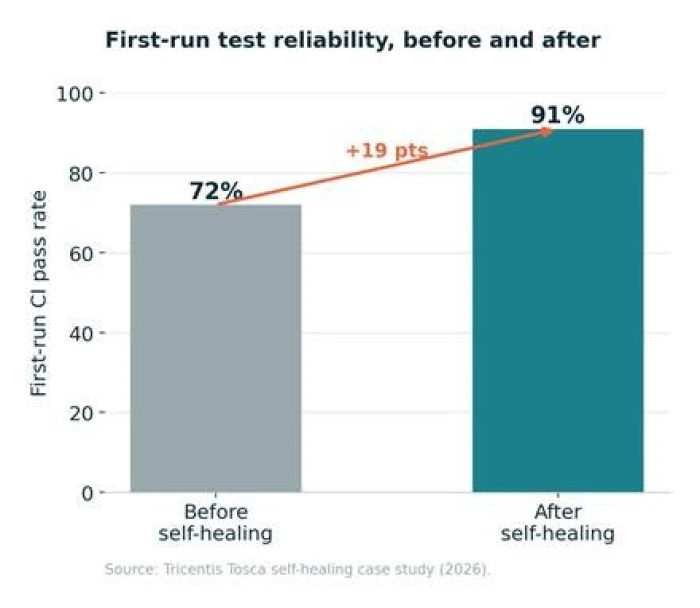
Reliability improves alongside effort. In one documented Tricentis Tosca deployment, first-run CI pass rates climbed from 72% to 91% within three months, and the team redirected roughly 40% of previously maintenance-bound time toward building new coverage. A veterinary technology platform reported saving around 200 engineering hours per quarter after adopting a self-healing tool.
Pillar 3: AI-Powered Analysis
The third pillar is the least visible and arguably the most valuable. Running tests produces mountains of results; AI-powered analysis turns that noise into decisions.
• Failure triage and root-cause analysis: models cluster related failures, separate genuine regressions from environment noise, and point to the likely cause, shrinking investigation from hours to minutes.
• Defect prediction: by learning from historical data, systems flag the modules most likely to harbor bugs before a single test runs.
• Coverage-gap detection: agents continuously compare tests against code and requirements to surface what is not being tested.
• Visual and UI validation: visual AI compares rendered screens against baselines, catching layout breaks that functional checks miss.
• Smarter reporting: natural-language summaries explain what failed and why, making results legible to product owners, not just engineers.
Analysis is also what closes the GEA Loop. Insight from one run, which tests are flaky, which areas are under-covered, which failures recur, feeds directly back into smarter generation and execution.
The Payoff: What Teams Gain, and What It Costs
Put together, the three pillars change the economics of quality. The table below contrasts the traditional approach with an AI-assisted one across the dimensions teams care about most.
| Dimension | Traditional approach | With AI assistance | Reported impact |
|---|---|---|---|
| Test authoring | Manual scripting by engineers | Natural-language and code-aware generation | Up to 88% faster creation |
| Maintenance | Hand-fixing broken locators | Self-healing repairs on the fly | 40% to 60% less effort |
| Flaky tests | Repeated false failures | Multi-signal and visual matching | Up to 80% fewer false alarms |
| Failure analysis | Manual log digging | Clustered triage and root-cause hints | Hours cut to minutes |
| Coverage | Plateaus as product grows | Continuous gap detection | 5x to 10x at same headcount |
| Feedback speed | Batched, end of cycle | Continuous, in pipeline | Faster, safer releases |
Impact figures are drawn from vendor reports, case studies, and industry surveys; results vary with suite size, application churn, and team maturity.
The financial case can be compelling, though it deserves scrutiny. Vendors report maintenance-budget savings of 70% to 80% and first-year ROI above 300%, with payback often inside six to twelve months. Independent numbers are scarcer, so the honest advice is to baseline current maintenance cost and measure against it rather than trusting a brochure.
The AI-Assisted Testing Tool Landscape
The market is crowded, and in 2026 nearly every vendor describes itself as AI-powered or autonomous. The label is cheap; capabilities differ sharply. The categories below group the field by how the tools actually work rather than how they market themselves.
| Category | Representative tools | Best suited for | Pricing model |
|---|---|---|---|
| Low-code AI platforms | mabl, Testim, Katalon, ACCELQ | A visual, UI-driven authoring layer | Free tier to custom; entry near $500/mo (est.) |
| Natural-language / autonomous | testRigor, Momentic, Virtuoso QA | Plain-language tests and heavy self-healing | Quote-based; step or seat metering |
| Visual AI validation | Applitools, Percy | Catching UI and layout regressions | Free tier to enterprise; usage-based |
| Cross-browser and device cloud | LambdaTest, BrowserStack, Sauce Labs | Scaling across browsers and real devices | Subscription by parallels or users |
| Enterprise autonomous suites | Tricentis, SmartBear, Parasoft | Large, regulated, complex estates | Custom enterprise contracts |
Pricing for most platforms is gated behind sales conversations; figures shown are third-party estimates as of 2026 and should be confirmed with each vendor. Katalon offers a free Studio tier, with paid runtime for CI and parallel execution.
The Honest Part: Limits, Risks, and What Still Needs Humans
For all the momentum, AI-assisted testing is not a magic wand, and the 2026 evidence is refreshingly candid about that. The barriers have shifted from strategic doubt to practical friction.
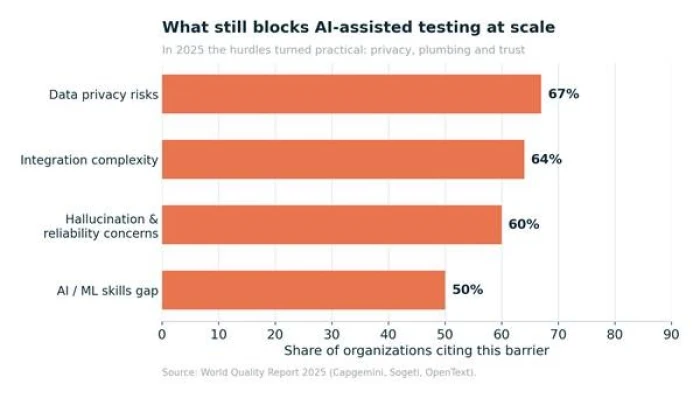
The recurring themes are worth internalizing before committing budget.
• Reliability and hallucination: models can generate plausible but wrong tests, or heal a script in a way that hides a real bug. Confidence thresholds and human review are non-negotiable.
• Data privacy: feeding requirements, code, or production-like data to AI systems raises real governance questions, cited by 67% of organizations as a top concern.
• Integration complexity: bolting AI onto existing pipelines and legacy suites is rarely plug and play, a friction 64% of teams report.
• The skills gap: about half of organizations say they lack the AI and machine-learning expertise to use these tools well.
• The coverage ceiling: even with automation, the industry has hovered near 25% automated test coverage, a reminder that tooling alone does not guarantee thoroughness.
• Probabilistic behavior: AI is not deterministic, so the same input can yield different output, which demands governance and audit trails.
The consistent lesson from teams that succeed is that AI handles the repetitive 80%, while humans own risk strategy, exploratory testing, and the judgment calls an agent cannot sign off on. The QA role is shifting from executing tests to orchestrating and supervising them.
How to Adopt AI-Assisted Testing Without Regret
Adopting AI-assisted testing well is less about picking the flashiest tool and more about sequencing. A pragmatic rollout tends to follow six steps.
1. Baseline the pain. Measure current maintenance hours, flaky-test rates, and coverage so improvement is provable, not anecdotal.
2. Start where it hurts. Point self-healing at the most brittle, high-churn suites first, where the payoff is immediate.
3. Prove value with one pillar. Many teams begin with generation or self-healing execution before layering on analysis.
4. Set confidence thresholds. Decide when the system may auto-heal or auto-generate versus when it must ask a human.
5. Keep humans in the loop. Review generated tests and healing logs regularly, especially early on, to catch shallow or masking behavior.
6. Expand deliberately. Once metrics improve, widen scope toward closed-loop, agentic workflows with governance in place.
Teams that skip the baseline step tend to argue about whether AI helped. Teams that measure tend to keep expanding, because the numbers make the case for them.
The Road Ahead
The direction of travel is clear even if the timeline is not. The frontier in 2026 is agentic testing, where autonomous agents plan, generate, execute, and repair tests against high-level goals rather than fixed scripts. Early adopters report test coverage growing five to ten times at the same headcount as the authoring bottleneck moves to the agent.
Three forces will keep pushing this forward. AI now writes a large and growing share of application code, which multiplies the volume of software that needs checking. Release velocity keeps rising, squeezing manual testing out. And a new task is emerging: testing the AI features inside modern products, from chatbots to recommendation engines, where behavior is probabilistic by design.
In that world, quality engineering does not disappear; it moves up a level. The most valuable testers become orchestrators who define what good looks like, supervise fleets of agents, and own accountability for what ships. The tooling gets more autonomous, and the job gets more interesting.
The Bottom Line
AI-assisted testing has crossed from experiment to expectation. The market is compounding at double-digit rates, nearly nine in ten organizations are already using generative AI in quality engineering, and the efficiency numbers, from maintenance cut by half to coverage multiplied several times over, are hard to ignore.
The winning pattern is not blind automation but a loop: generate tests intelligently, execute and heal them continuously, analyze the results, and feed that insight back in. Handle the repetitive work with machines, keep human judgment on risk and strategy, and measure everything. Teams that do this are not just testing faster. They are building the quality backbone that AI-generated software will increasingly depend on.


Comments 0
Join the discussion and share your perspective.
Sign in to post a comment and reply to other readers.
No comments yet
Be the first to share your perspective on this article.