Picture the page you are proudest of. It ranks first for a question thousands of people ask every month, and for years that top spot meant a steady stream of visitors. Then one quarter something odd happened. The ranking held and the impressions climbed, yet the visitors quietly thinned out.
Nothing broke. Google never penalised the page.
What changed sat above it. A block of text, written by an AI, now answered the question before anyone reached the blue links. That block carries a cost, and researchers have put a number on it. When an AI Overview appears, the click-through rate for the top organic result falls by about 58 percent, according to an Ahrefs study of more than 300,000 keywords published in December 2025. The answer arrived. The click did not.
This is the story of where those clicks went and why a new discipline called GEO is claiming ground that SEO used to own. It is also a practical guide to what the numbers say you should do about it. The headline above promises that GEO is replacing part of search. By the last section you will see exactly which part, and which part is staying firmly put.
So a machine started answering for you
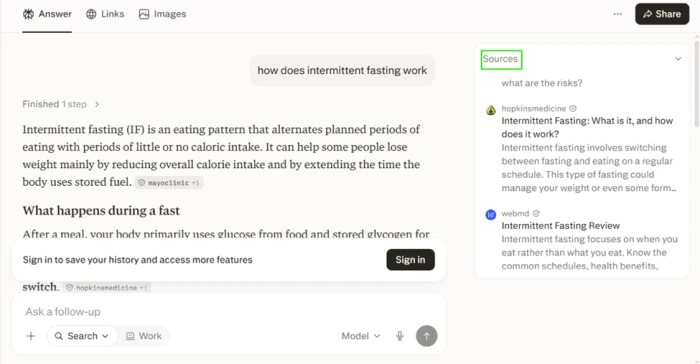
Search stopped being a plain list a while ago. Ask Google a question today and you often meet a summary at the top, stitched together from several pages, with the sites themselves shrunk to small links that most people never touch. Type “how does intermittent fasting work” and the answer is already sitting there, three tidy paragraphs deep, before a single website gets a look in.
The scale is hard to wave away. Google's AI Overviews now reach around 2.5 billion users a month, and its more conversational AI Mode has passed a billion monthly users on its own. Plenty of people skipped the search box altogether. ChatGPT handles roughly 2.5 billion prompts a day, and about 65 percent of them behave like searches.
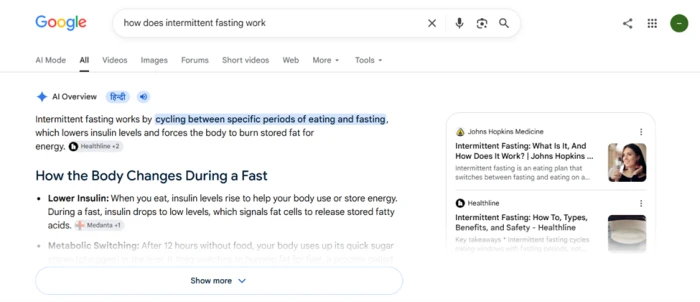
Two habits pull in the same direction. Some users read an AI summary sitting on top of Google and never scroll past it. Others open ChatGPT or Perplexity and never load Google at all. Both roads end the same way for your website. The answer gets delivered, and your page stays unopened.
So a fair question follows. If an AI is going to answer on your behalf, how do you make sure it answers using your material and credits you when it does? That question is the entire reason GEO exists, and it is where we head next.
GEO, defined
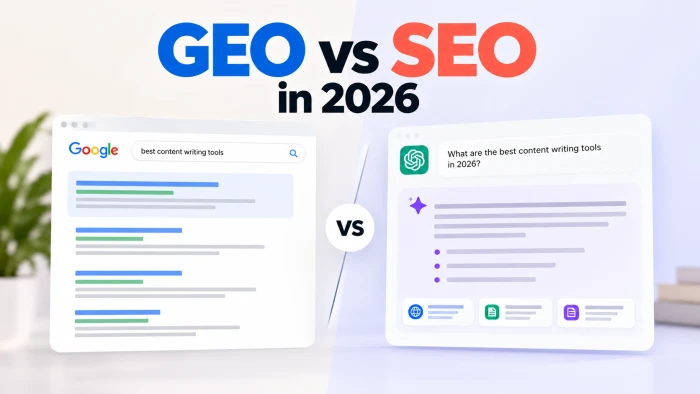
Generative Engine Optimization, or GEO, is the practice of shaping your content so that AI systems quote and recommend you inside the answers they generate. Where SEO fights for a rank on a results page, GEO competes to be the source an AI leans on while it writes its reply.
The term is not a marketing invention. It comes from a 2024 research paper called “GEO: Generative Engine Optimization.” A team from Princeton University and IIT Delhi wrote it and presented it at KDD, one of the field's serious academic conferences. The researchers ran 10,000 queries through AI answer systems to test what actually changes whether a page gets cited. We will return to their findings in a later section, because they cut against a good deal of popular advice.
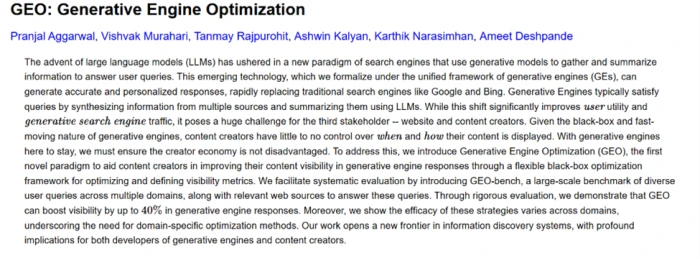
The paper also named a problem that had gone unspoken. Generative engines are a black box. A creator has little control over when their work gets pulled into an answer, or whether their name survives the summary. Search at least showed you your rank. This new layer can quote your sentence and leave you invisible, which is the gap GEO tries to close.
One clarification saves confusion later. You will meet a second acronym, AEO, or Answer Engine Optimization, aimed squarely at direct answers like featured snippets and the AI Overview box. GEO is the wider idea of influencing what any generative engine says about you. For this article, treat GEO as the umbrella and AEO as one room inside the house.
How an AI engine decides who gets quoted
To earn a mention, it helps to know how these systems assemble an answer in the first place.
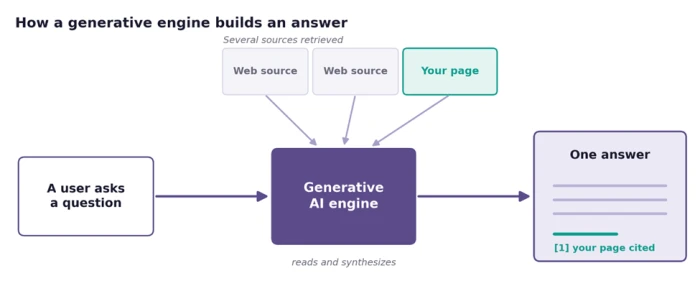
A generative engine does not hand you ten links and step back. It reads a question and pulls in a handful of sources it judges relevant, then writes one reply that blends them and sometimes cites the pages it used. Visibility here means landing inside that blend and getting named as a source.
Which sources make the cut is far from random, and two research findings from 2025 are worth knowing. Citations tend to concentrate on a small set of outlets, and different engines favour different ones, so being quoted by ChatGPT is no guarantee Perplexity will do the same. On top of that, models lean toward sources that are already widely cited elsewhere, a rich-get-richer effect that makes an existing reputation compound. Smaller sites have a hill to climb, and the climb is steeper than it looks.
Here is the part that keeps SEO breathing inside GEO. The AI usually draws from pages that already rank. One analysis by seoClarity found that 94 percent of AI Overviews cite at least one URL from the top 20 organic results. Strong traditional ranking is the doorway. Getting quoted is what happens once you are through it.
So the two disciplines are not rivals glaring at each other across a wall. They stack. Rank well enough to sit in the pool the AI reads from, then structure your content so the model reaches for your lines over a competitor's. The next section sets the two approaches side by side so the overlap and the split are both easy to see.
GEO and SEO, side by side
The two share a bloodline and part ways on nearly every goal that counts. The table below makes the contrast quick to scan.
| Aspect | SEO | GEO |
|---|---|---|
| Goal | Rank a page and win the click | Get cited inside the AI's answer |
| Success unit | Position and organic traffic | Mentions and recommendations in AI replies |
| Who reads your page | A human, after clicking | A model, before any human sees it |
| Main levers | Keywords, links, technical health, page speed | Clear claims, statistics, quotable lines, structured facts |
| How you measure it | Rankings and sessions | Share of AI answers that name you |
| Where visitors land | On your site | Often the AI's page, arriving pre-informed if they click |
Read down the table and one row jumps out: who reads your page. Under SEO, a person lands and forms an impression. Under GEO, a model reads you first and decides whether you are worth passing along. You are writing for an editor who summarises you before any human arrives.
That single shift explains the tension in this article's title. A slice of what SEO used to deliver is migrating into the AI's answer box. The next section shows, with the data, exactly which slice.
The part of SEO that is quietly disappearing
Informational search is the piece coming apart. When the query is a plain question with a factual answer, the AI now handles it on the spot, and the click that once followed frequently never happens at all.
The clearest proof sits in click-through data. Pew Research tracked real browsing and found that when an AI summary appears, people click a traditional result 8 percent of the time, against 15 percent when no summary shows. Inside the summaries themselves, barely 1 percent of users clicked through to a cited source.
Zero-click browsing is now the default rather than the exception. A SparkToro study of US Google searches found that 58.5 percent ended without a single click to another website.
The penalty has also been deepening. Ahrefs measured the click-through drop for the top result at 34.5 percent in April 2025, then 58 percent by December 2025. The slide reaches down the page too. The second position lost around 50.8 percent and the third around 46.4 percent when an AI Overview was present.
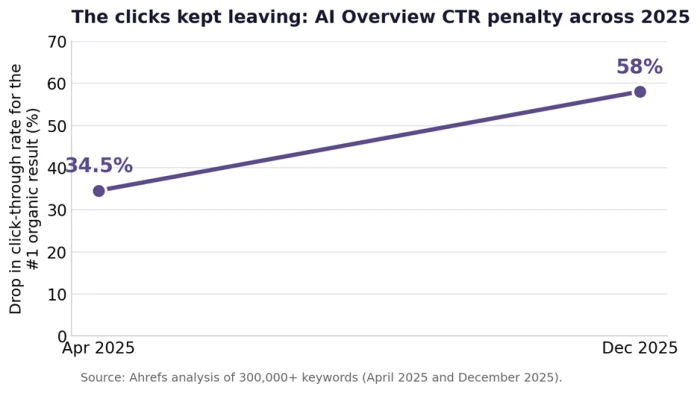
Look at that slope. In eight months the top spot shed a far larger share of its clicks, and little in the mechanics of AI answers suggests a reversal is coming. For factual, “just tell me” queries, the old bargain where a good ranking bought you a visit is the part of SEO that is wearing away.
Before you tear up the whole strategy around that chart, the erosion has a hard edge. A large block of search has barely felt it, and that block is next.
The part of SEO that is not going anywhere
Buying intent behaves nothing like curiosity. When someone is comparing vendors or pricing a service before a purchase, they still click, and they click often. People want to reach a real page, read the specifics, and judge for themselves before spending money. AI summaries answer the “what is” question well and the “which one should I buy, and from whom” question poorly.
The figures even hide a quiet gift. Being read by the AI can lift how often you are seen at all. BrightEdge found that impressions for pages rose by roughly 49 percent in the year after AI Overviews launched, because brands began surfacing across a much wider spread of long-tail questions. Your click rate on any one query can fall while your total reach grows.
And recall the doorway from two sections ago. 94 percent of AI Overviews quote a page from the top 20 results. Ranking has not stopped mattering. It has turned into the entry fee for the AI's shortlist rather than the finish line it used to be.
So SEO is not dying wholesale. The commercial and comparison-heavy half stays valuable. Ranking still qualifies you for citation, and your reach can climb even as raw clicks dip. What changes is the job ranking does. Getting seen and getting quoted have split into two separate wins, and the next section is about earning the second one.
What actually earns you a citation
This is where the Princeton study repays close attention, because it tested tactics instead of guessing at them, and some crowd-favourite advice failed outright.
Three edits stood out. Two were about evidence: adding relevant statistics and citing credible sources. The third was quoting named experts. Each pushed a page's visibility in AI answers up by more than 40 percent. The logic is easy to picture once you imagine the model's job. It wants evidence it can repeat with confidence, and a hard number or a sourced quote is simpler to trust than a vague assertion.
Clear writing carried its own weight. Improving fluency, meaning cleaner and more readable prose, lifted visibility by about 28 percent without adding a single new fact. Tangled sentences work against you, since a model that struggles to parse your page will happily reach for one it can read.
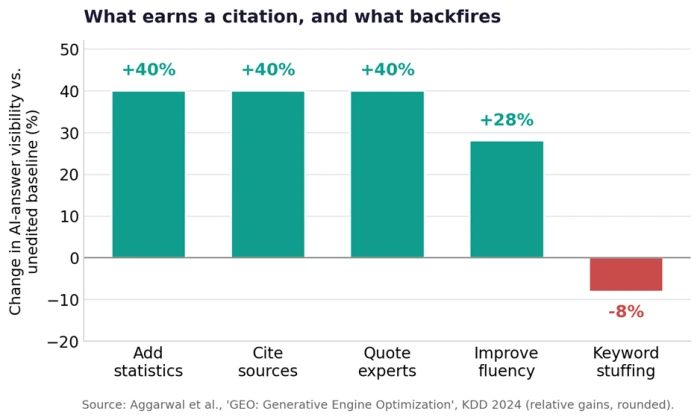
Now the cautionary half. Keyword stuffing, the old reflex of cramming a target phrase in over and over, scored about 8 percent below the untouched baseline. The trick did more than fail. It pushed the page down the citation order. A separate 2025 benchmark called C-SEO Bench reached a matching verdict: many “optimise for the chatbot” gimmicks add nothing, several cause harm, and plain source relevance keeps winning.
A quick before-and-after shows the shape of the fix. “Many companies struggle to measure this” gives a model nothing to hold. “In a 2026 survey, 65 percent of marketers named AI search as their single biggest challenge” hands it a fact it can lift word for word. The second sentence is the citable one, and the difference is the presence of a source and a number.
The takeaway is pleasantly old-fashioned. Write something accurate, back every claim with evidence, quote real people, and say it plainly. The AI rewards the qualities a sharp human editor always has. If that reads like good writing rather than a growth hack, that is rather the point.
Why one AI mention can beat a top ranking
There is a reason to chase these citations that goes past vanity, and it lives in the conversion data.
A visitor who arrives through an AI answer tends to show up further along in their thinking. The AI has already covered the basics and weighed the main options for them. By the time that person reaches you, they sit closer to a decision than a cold searcher poking around page one.
The gap shows up plainly in the rates. Traffic referred from AI tools converts at about 14.2 percent, against roughly 2.8 percent for standard Google organic traffic, per SEOmator's 2026 analysis.
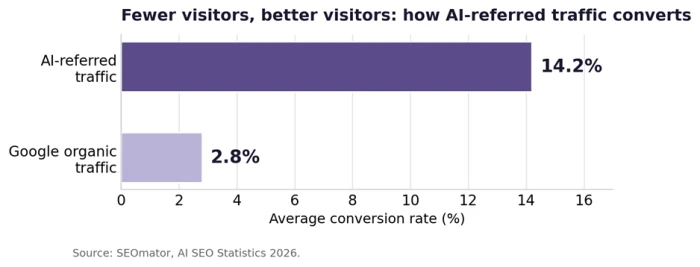
Sit with that multiple for a second. An AI-referred visitor is worth several ordinary organic ones on the metric that actually pays your bills. Fewer people may reach your site through an AI answer, and the ones who do land warmer and readier to act. A single well-placed citation, feeding a thinner stream of high-intent visitors, can out-earn a top ranking that pours cooler traffic onto the page.
That reframes the whole exercise. GEO is no consolation prize for the clicks the AI carried off. On the numbers above, the visitors it sends you can be the most valuable ones you get all month.
Where to point your effort next
The strategy that falls out of all this is calm rather than frantic. You are tuning a proven system, not torching it.
Start by learning where you already stand. Put the questions your customers ask to ChatGPT and Perplexity, and note whether your brand appears as a named source or never surfaces at all. That quick audit becomes your baseline, and it tends to be a humbling read the first time.
Then work through a short, evidence-led checklist.
• Feed the models evidence. Add specific figures and sourced quotes to the pages that matter most, since those were the strongest citation signals in the Princeton results.
• Answer the question in the first line. Lead each section with the direct answer, then explain beneath it, so an engine can lift a clean response.
• Keep the page reachable. Make sure your content is crawlable and rendered server-side, because an AI cannot read what it cannot load.
• Protect your ranking. Hold your place in the top results for priority queries, since that top-20 pool is where most AI citations still come from.
• Measure mentions, not only sessions. Track how often AI answers name you, right alongside your usual traffic reports.
None of this asks you to walk away from the SEO work you have banked. It asks you to stretch that work toward the answer box, the place your audience keeps drifting, and to write in the plain and sourced way those systems reward. The clicks that left are settling into a new pattern, and the pages that earn the citation are the ones getting carried along with them.


Comments 0
Join the discussion and share your perspective.
Sign in to post a comment and reply to other readers.
No comments yet
Be the first to share your perspective on this article.