Every support agent knows the moment. A ticket opens, the tone is sharp, and the reply box sits there blinking. The customer wants a refund you cannot give, or a feature that will never ship, or they are simply furious and you have not even worked out why yet. Whatever you type next decides whether this person stays or leaves for good.
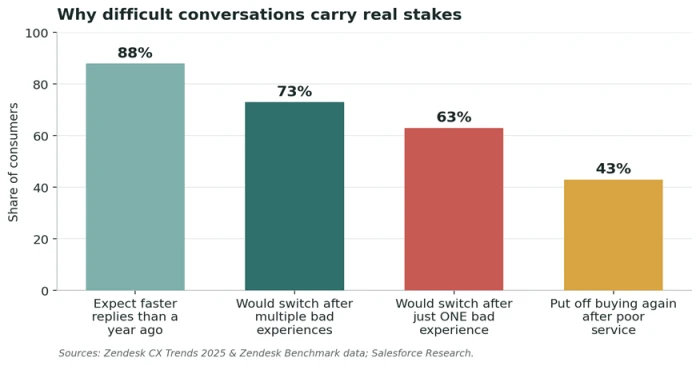
The stakes are not abstract. Zendesk's benchmark data shows 63% of consumers will switch to a competitor after a single bad experience, a figure that climbs to 73% after repeated ones. Salesforce research found 43% of customers were put off buying again after poor service. The words you choose in a hard conversation are, quite literally, retention work.
This guide is built differently from the usual copy-and-paste roundup. Every template below comes with the framework it rests on, the reasoning behind each line, the phrases that will quietly sabotage you, and variations for different channels and anger levels. At the end, there is a free editable swipe file with all of it. Use the templates as a foundation to adapt in your own voice, never as scripts to paste blind.
How to use these templates so they don't sound canned
A template saves you from staring at a blank box. It does not save you from sounding like a robot. The difference between a reply that lands and one that makes things worse is almost always personalization, and that starts before you touch a template at all.
Read the message twice. The first read tells you what the customer asked for. The second tells you what they actually want, which is often different. Someone demanding a refund often wants, above all, to feel that their complaint was heard. Someone shouting about shipping may be anxious about a gift arriving late. Match that underlying need, then reach for the template.
The one rule: Acknowledge the human before you address the problem. Skip that step and even a technically perfect answer reads as cold. Every template here opens with acknowledgement for exactly this reason.
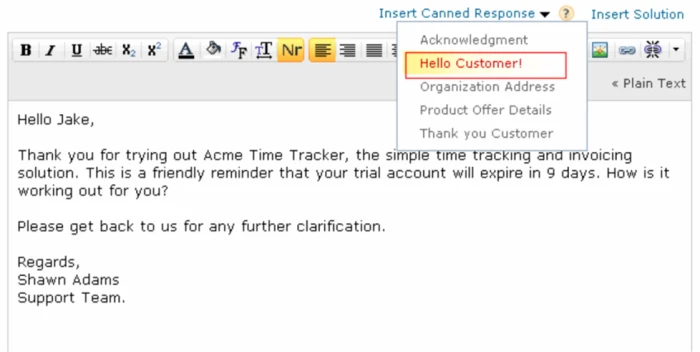
Mirror the customer's formality, keep paragraphs to two or three lines, and delete any placeholder you did not personalize. A template with an unfilled bracket is worse than no template at all.
The 5-step structure behind every good difficult-situation reply
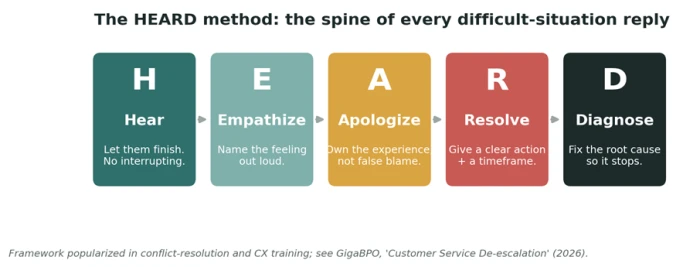
Before the specific templates, learn the shape they all share. Once you internalize the sequence you can handle situations no template covers, which is the real goal. Support leaders in hospitality and contact centers have used variants of this structure for years under names like LATTE (Starbucks) and LEARN (Marriott). The version below, HEARD, maps cleanly onto written replies.
Validate first, solve second
De-escalation research is consistent on one point: emotion comes before logic. A call-center de-escalation guide from ServiceSkills frames the correct order as validation first, then information, then resolution. Lead with the fix and the customer feels unheard, so they dig in. Name the feeling first and their guard drops enough to actually read your solution.
Own the experience without accepting false blame
There is a wide gap between "I'm sorry this happened to you" and "we were completely wrong." The first works even when your company did nothing incorrect, such as a package delayed by the courier. The second is reserved for genuine mistakes. Apologize for the experience freely; admit fault only when there is fault.
Always close with a concrete next step and a timeframe
Vague endings breed re-contacts and escalations. "We'll look into it" tells the customer nothing. "I've flagged this to our billing team and you'll have a decision from me by Thursday" tells them who is doing what, by when. That single habit reduces the follow-up messages that clog a queue.
De-escalation frameworks that make the templates work
HEARD is the everyday workhorse, but a few named models are worth knowing because each fits a different situation. They share the same DNA and differ mainly in emphasis and length.
| Framework | Steps | Best for | Origin |
|---|---|---|---|
| HEARD | Hear, Empathize, Apologize, Resolve, Diagnose | Emotionally charged tickets where the customer needs to feel heard | Conflict-resolution / CX training |
| LAST | Listen, Apologize, Solve, Thank | Fast, lower-heat complaints that need a clean, quick recovery | Widely used service model |
| LATTE | Listen, Acknowledge, Thank, Take action, Explain | Front-line moments where warmth matters as much as the fix | Starbucks |
| LEARN | Listen, Empathize, Apologize, React, Notify | Higher-stakes failures where follow-up and internal handoff matter | Marriott |
The service recovery paradox: why a great recovery can beat no problem at all
Here is the finding that should change how you view every angry ticket. When a company resolves a failure exceptionally well, the customer's satisfaction can end up higher than if nothing had gone wrong. Researchers call it the service recovery paradox, and it holds because a failure lowers expectations, so a strong recovery clears a bar the customer has quietly dropped.
The catch: The paradox rewards recovery, not carelessness. It is most likely to appear after a one-time slip that you handle brilliantly, and it evaporates if failures repeat. Never manufacture problems to look heroic. Plenty arrive on their own.
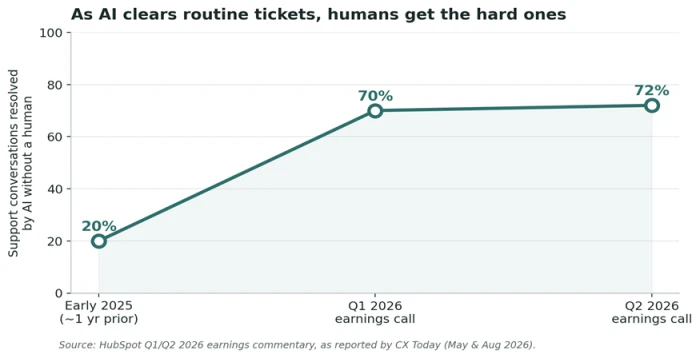
There is a practical reason difficult conversations now demand more skill than ever. AI is absorbing the routine volume. HubSpot reported on its 2026 earnings calls that its Breeze Customer Agent went from resolving around 20% of support conversations autonomously to 72% within roughly a year. As bots clear the password resets and order-status checks, the tickets that reach a human skew harder, angrier, and more nuanced. The premium on handling them well keeps rising.
Phrases to avoid, and what to say instead
Some of the most common support phrases actively make things worse. They sound professional and feel safe, which is exactly why they slip through. Swap them out.
| Avoid this | Why it backfires | Say this instead |
|---|---|---|
| "I understand." | Vague and easy to read as a brush-off. It claims a feeling without proving it. | "That sounds frustrating, especially right before your deadline." |
| "Per our policy..." | Hides behind rules and signals you have stopped thinking about them. | "Here's what I can do, and why it's set up this way." |
| "Please calm down." | Tells someone their emotion is the problem. It escalates almost every time. | "I want to get this sorted for you. Let's start with what happened." |
| "Unfortunately..." | Front-loads bad news and braces the reader for a no before you offer anything. | Lead with the option you can offer, then note the limit. |
| "You misunderstood." | Assigns blame and puts the customer on the defensive. | "I don't think I explained that clearly. Let me try again." |
Notice the pattern. The weak phrases protect the agent. The strong ones serve the customer. Aidly's refund-denial guidance makes the same point about over-apologizing: a string of "I'm so, so sorry" reads as weakness and invites escalation, while one sincere apology plus a clear next step holds the line.
Reply templates for difficult situations
Below are the situations that reach support queues most often and cause the most hesitation. Each one opens with the move to make, then the template, then the reasoning. Copy the wording, fill every bracket, and adjust the tone to the person in front of you. The index table points you to the right one fast.
| Situation | Core move | Framework fit |
|---|---|---|
| Refund you must decline | Decline with a reason, then offer an alternative | LAST |
| Discount request | Hold price, demonstrate value | LATTE |
| Feature you'll never build | Honest no, plus a workaround | LAST |
| Angry, company at fault | Full ownership and a real fix | HEARD |
| Angry, nothing went wrong | Validate the feeling, share context | HEARD |
| Abusive customer | Set a firm, kind boundary | HEARD + boundary |
| "Call me now" | Warm channel reset | LATTE |
| Account access / security | Protect first, help second | LEARN |
| Chargeback or legal threat | Stay calm, document, next step | LEARN |
"I want a refund" when you have to say no
The move: be explicit about the decision, give a reason, then pivot to what you can do and dig for the real problem. A refund request is often a signal that the customer feels they got no value, and that is fixable even when the refund is not.
Hi [Name],
I'm sorry [product] hasn't worked out the way you hoped. I'm
not able to process a refund on this order, since it falls
outside our 30-day window (details here: [policy link]).
What I can do is [store credit / one month free / a working
session with our team]. Before we set that up, I'd like to
understand what went wrong. It looks like you were trying to
[best guess at their goal] and hit a wall at [step]. Is that
right?
Tell me a bit more and I'll come back with the best option
for you today.
The reason lands the no. The alternative keeps the relationship alive. The question reframes the exchange from a fight over money to a shared problem, which is where you want it. On live chat, compress this to two short messages so the customer is not left watching a typing indicator for a paragraph.
"I need a discount" without dropping your price
The move: stay firm on price, then do the work of showing value this specific customer is missing. Apologizing for your pricing signals it is negotiable.
Hi [Name],
We don't discount [product], and I want to make sure you're
getting full value for what you pay. I had a look at your
account and you're not yet using [feature], which is what
most customers rely on to [common goal].
If cost is the pressing issue, two options: switching to an
annual plan saves you [X], or the [lower tier] would cut your
bill by [Y] (you'd lose [feature] you currently use). Happy
to walk through either.
This borrows from Help Scout's approach to discount requests: refuse the discount, but never refuse to help the customer spend less intelligently.
"When are you adding [feature]?" for something you'll never build
The move: tell the truth kindly. Stringing a customer along with "it's on the roadmap" when it is not costs you more trust later than an honest no costs you now.
Hi [Name],
Thanks for explaining how [feature] would help. I'll be
straight with you: it isn't something we plan to build, so I
don't want you waiting on it.
What I can suggest is [workaround], which gets you most of the
way to [their goal]. Want me to set it up with you?
The angry customer when your company is at fault
The move: full HEARD. Hear it, name the impact, apologize once and sincerely, fix it with a timeframe, and tell them what you are changing so it does not recur. Former HubSpot support reps advise that the first line should be a genuine apology, approached from empathy rather than ego.
Hi [Name],
You're right, and I'm sorry. We charged you twice for [order]
and that's on us, not something you should have to chase.
I've refunded the duplicate charge of [amount]; it'll land in
[timeframe]. I've also flagged the billing glitch that caused
it so it doesn't hit you again.
If it hasn't cleared by [date], reply here and it comes
straight back to me.
Tone check: One apology, not five. Ownership without grovelling. A specific action with a specific date. That combination reads as competence, which is what an angry customer actually wants to see.
The angry customer when nothing actually went wrong
The move: the delivery is in transit and on schedule, but the customer is upset anyway. Reframe it in your own head as someone who wants your product badly, then take their side without changing facts that cannot change.
Hi [Name],
I get how frustrating it is to be watching the door for a
delivery. Here's exactly where things stand: your order left
our warehouse on [date] and it's with [courier] now, due to
you by [date].
The moment it's marked delivered I'll be watching this
thread, so if anything looks off, one reply and I'm on it.
The abusive customer: setting a firm, kind boundary
The move: empathy has limits, and personal abuse is one of them. You can hold a boundary without matching the customer's heat. GigaBPO's de-escalation guidance recommends calmly stating the limit and repeating it if needed.
Hi [Name],
I want to help you fix this, and I will. I'm not able to
continue if the messages stay abusive, so let's reset.
Tell me the outcome you need and I'll tell you honestly
whether I can get you there and how.
If the behavior continues after a clear warning, escalation to a supervisor is the right call, and documenting the exchange protects both the agent and the company. Boundary-setting is a support skill, not a failure of one.
"Call me now" when you can't offer a phone call
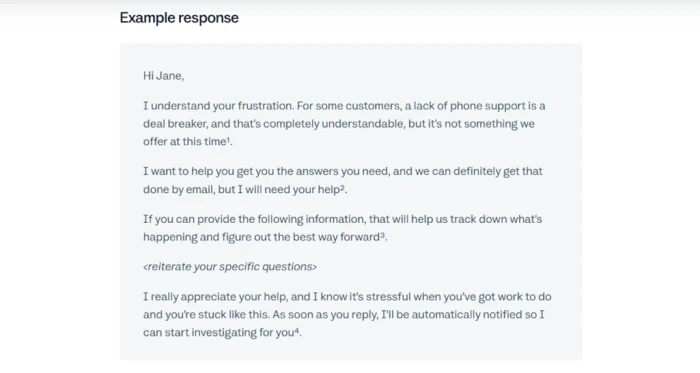
The move: be firm about the channel, warm about the intent. People demand calls because they fear being slow-walked or ignored, so address that fear directly by telling them what happens to their reply.
Hi [Name],
I know a call feels faster, and I hear that this is urgent.
We handle support over email so I can pull in our engineers
and keep a written record for you, and I can absolutely get
this solved here.
Send me [specific info] and I'll start digging the second it
arrives. You'll hear back from me within [timeframe].
"I need access to this account" when they can't pass security
The move: position your team as the customer's protector, not their obstacle. Support teams are a growing target for social-engineering, so this boundary is genuine, and framing it around the customer's own safety makes it land.
Hello [Name],
I understand you just want back into your account, and I want
that for you too. Because this data is yours, we have to be
careful about who we hand it to, so here's how to regain
access safely:
[verification steps]
Work through those and I'll have you back in quickly. If any
step is unclear, tell me which one.
The chargeback or legal threat
The move: do not flinch and do not capitulate. A threat is often frustration reaching for something that will force a response. Stay calm, keep a clean record, and offer a concrete path forward. This is a high-stakes moment that most template roundups skip entirely.
Hi [Name],
I understand you're considering a chargeback, and I'd like
the chance to resolve this with you directly first, which is
usually faster for you.
Here's what I can offer: [specific resolution]. If that works,
reply and I'll process it today. Either way, I've logged the
full history of your order on our side.
Why the record matters: Naming that you have documented the history is not a threat back. It quietly signals you are organized and fair, which often defuses the impulse to escalate.
Adapting one reply across channels and anger levels
The same situation does not get the same message everywhere. A furious public tweet, a live chat, and an email each call for a different length and register, even when the underlying answer is identical. Competitors almost always write for email only. Here is how to flex.
| Channel | Length & tone | What changes |
|---|---|---|
| Full structure, a short paragraph per step | Room to explain context and link to policy or docs | |
| Live chat | Two or three short messages, quick and warm | Break the reply up so the customer is not left waiting; drop long context |
| Public social | Brief, calm, move to private fast | Acknowledge publicly, resolve privately; never argue in the open |
| Phone follow-up | Spoken, then a written recap | Confirm the agreed action in writing so nothing is lost |
Severity is the second dial. Match the size of your response to the size of the problem, on both the emotional and the compensation side. As an apology-email guide from Tremendous puts it, a small perk suits a minor issue while a major failure calls for a full remedy and a goodwill gesture. Over-compensating for a trivial slip trains customers to escalate; under-compensating for a real one loses them.
Read the anger level too. A calm, low-severity note wants an efficient fix and little ceremony. A furious, high-severity message wants more validation up front before you get anywhere near logistics. Same template, different weighting.
Your pre-send checklist
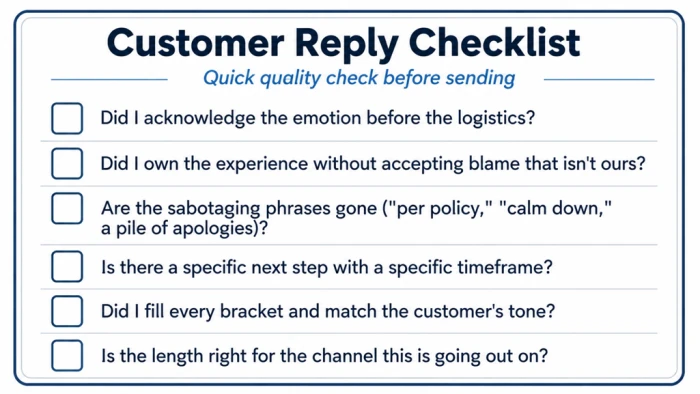
Before you hit send on any difficult reply, run it against these. It takes fifteen seconds and catches the mistakes that turn a good answer into a new complaint.
1. Did I acknowledge the emotion before the logistics?
2. Did I own the experience without accepting blame that isn't ours?
3. Are the sabotaging phrases gone ("per policy," "calm down," a pile of apologies)?
4. Is there a specific next step with a specific timeframe?
5. Did I fill every bracket and match the customer's tone?
6. Is the length right for the channel this is going out on?
Building and maintaining your template library
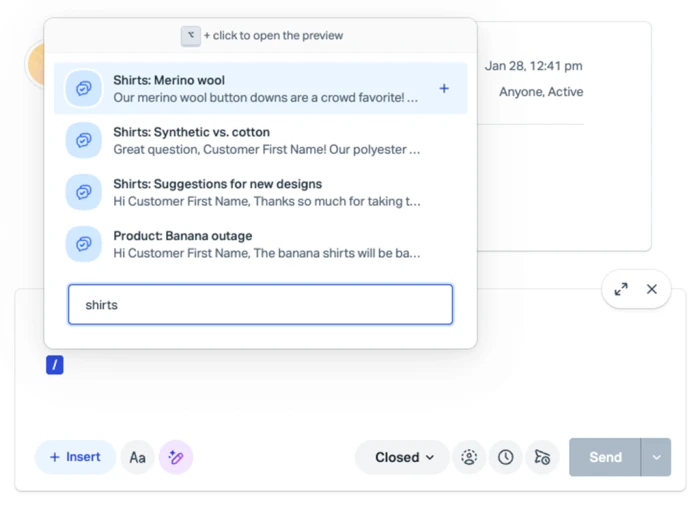
For team leads, a scattered set of personal saved replies is not a system. A shared, versioned library is. Store these as canned responses or macros in your help desk so the whole team pulls from the same wording, and use them in new-hire training so agents practice the hard scenarios before a live one lands.
Review the library on a schedule. SupportBee recommends revisiting templates at least quarterly, and updating them whenever customers keep asking the same follow-up question (a sign the wording is not clear) or when a product or policy changes. A template that no longer matches reality does more harm than none.
Get the free difficult-situations swipe file
Every template on this page, plus the pre-send checklist and the phrase-swap table, is available as a free editable document you can copy into Google Docs, Notion, or your help desk. No form, no gate. Copy it, make the wording your own, and load the ones your team hits most into your saved replies.
Grab it here: [Download the difficult-situations swipe file] and adapt it to your brand voice. If you only load one to start, make it the angry-customer-at-fault template. It is the one agents freeze on most.
The templates matter less than the sequence and the sincerity underneath them. A customer can tell within a line or two whether you are reading from a script or actually reading them. The service recovery paradox works because people remember how you made them feel when things went wrong, not the exact phrasing you used. Get the order right, mean the apology, and name a real next step, and the words will carry themselves.



Comments 0
Join the discussion and share your perspective.
Sign in to post a comment and reply to other readers.
No comments yet
Be the first to share your perspective on this article.