
You can learn prompt engineering without a course, and for most people that is the better route. The labs that build these models publish their own training material for free, they revise it when the models change, and a large share of paid courses is that same material repackaged several months late. Budget 25 to 40 hours across one month.
What follows is a day-by-day plan built from primary sources, plus the two things a paid course gives you that free material usually does not: a way to measure whether you are actually improving, and something to show at the end. By day 30 you will have a working prompt library, a small test set you run every prompt against, and one documented piece of work you can send to a hiring manager.
Why Free Beats Paid for This Particular Skill
Most skills have a knowledge bottleneck. Someone knows the thing, you do not, and paying them shortens the gap. Prompting has almost no bottleneck. OpenAI, Anthropic, Google, and Microsoft all publish detailed prompting documentation because better prompts make their products look better. The incentive runs in your favour.
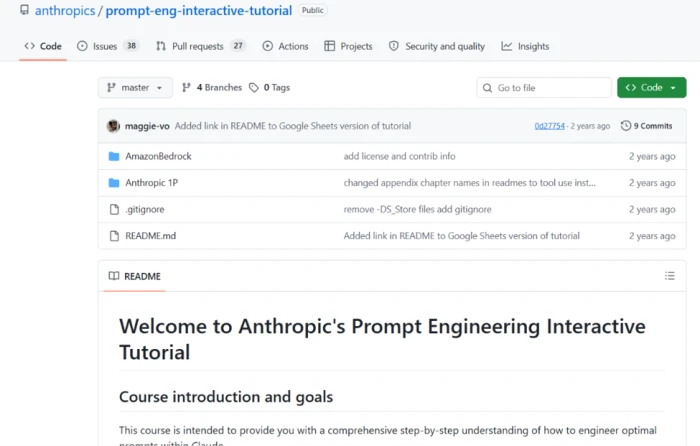
Free material also decays more slowly, because updating a documentation page costs a pull request while updating a course costs a re-shoot. Decay is still real. Anthropic's own interactive tutorial, one of the best free resources available, uses Claude 3 Haiku throughout its examples and describes Opus as the most intelligent option in the lineup. That was accurate when written. If the flagship free resource drifts, courses built on top of it drift further.
The core point: prompting is a practice skill, closer to writing or shooting free throws than to accounting. Watching someone else do it well teaches you little. The bottleneck is reps with feedback, and reps are free.
What a course actually gives you
Three things, and they are worth naming honestly so you can replace each one on purpose:
• Structure: a study sequence, so you never have to decide what to learn next
• Accountability: a sunk cost and a deadline, which some people need to finish anything
• A credential: a certificate you can put on a profile
The 30-day plan below replaces the first. A calendar block replaces the second. The portfolio section near the end replaces the third.
When paying for a course is the right call
There are real cases. Your employer reimburses tuition and wants a named provider on the record. You work in a regulated field where AI use requires documented training. Or you have started and abandoned enough self-directed projects to know, honestly, that you need a cohort and a deadline. If none of those describes you, the free route is faster and more current.
What You Are Actually Learning in 2026
Before the plan, one piece of context that should change how you spend your hours. If you are learning this because you read that prompt engineer was a six-figure job requiring no degree, the hiring data has moved.
Microsoft's 2025 Work Trend Index surveyed 31,000 knowledge workers across 31 markets and asked leaders which new AI roles their companies were considering adding over the following 12 to 18 months. Seventy-eight percent said they were considering AI-specific roles. The report lists the top ten. Prompt engineer is not one of them.
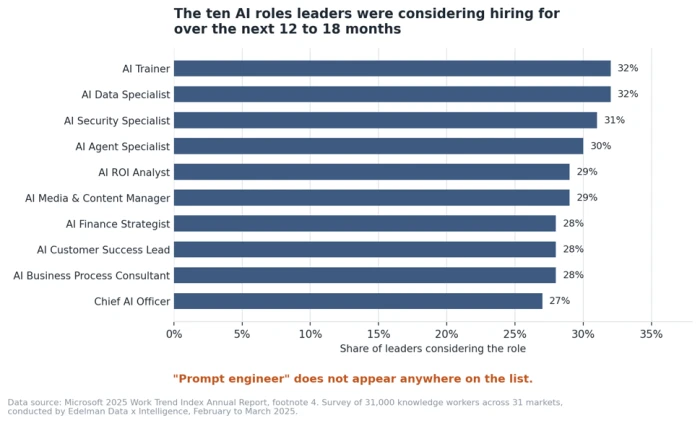
Look closely at what did make the list. AI Trainer. AI Agent Specialist. AI Business Process Consultant. Every one of those roles requires prompting competence as a baseline. None of them is a prompting job. The skill was absorbed into other work rather than retired.
Search behaviour tells the same story from the other direction. Interest in the term collapsed after the 2023 hype spike, flatlined through 2024, then climbed again through 2025 and 2026 as agentic tools reached ordinary desks.
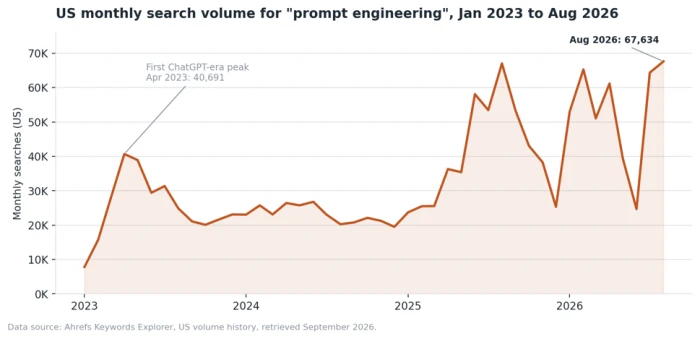
US monthly searches for the term hit 40,691 in April 2023 at the peak of the first ChatGPT wave. In August 2026 the figure was 67,634, well above that early peak. The label lost prestige. Demand for the underlying competence did not.
Prompt engineering and context engineering
The second shift matters more for your study plan. Through mid-2025, practitioners started using context engineering to describe the wider job of deciding everything a model sees before it answers, including retrieved documents, tool definitions, memory, and conversation history. Anthropic adopted the term formally on 29 September 2025, describing context engineering as the natural progression of prompt engineering. Prompt writing sits inside that larger discipline as one layer.
There is a hard result behind the shift. In July 2025, Chroma published a technical report evaluating 18 frontier models, including GPT-4.1, Claude 4, Gemini 2.5, and Qwen3, on deliberately simple tasks at increasing input lengths. Every model tested became less reliable as input grew, well before hitting its advertised context limit. Bigger context windows made careful curation more important, not less.
What this changes about your plan
Spend less time memorising the names of exotic techniques and more time on four things: giving structure to your instructions, showing examples, deciding what information the model actually needs, and testing whether your changes helped. The plan below weights toward those.
The Only Theory You Need Before Day One
A prompt is an instruction plus whatever context you attach to it. The model reads that combined input as tokens, roughly three-quarters of a word each, and its context window is the ceiling on how many tokens it can hold at once. Treat that window as a budget rather than a container to fill.
One property matters more than the rest: these models are probabilistic. Run the same prompt twice and you can get different answers. This single fact carries a large consequence that most beginners miss for months. A prompt that produced a great answer once has not been proven to work. It has produced one sample. Everything in week 3 of the plan exists because of this.
That is the whole of the theory you need to start. You will pick up temperature, system prompts, delimiters, and output schemas as you hit situations that require them, which sticks better than reading definitions in advance.
The 30-Day Self-Study Plan
Roughly 60 to 90 minutes a day. Every day ends with something written down, because reading about prompting produces no measurable skill gain. The week structure:
| Week | Focus | Primary source | Hours | What you finish with |
|---|---|---|---|---|
| 1 | Structure and clarity | Anthropic interactive tutorial, chapters 1 to 4 | 7 | 20 rewritten prompts from your real work, with notes |
| 2 | Techniques with evidence behind them | Learn Prompting guide; OpenAI prompting docs | 8 | A tested pattern for each of four task types you do often |
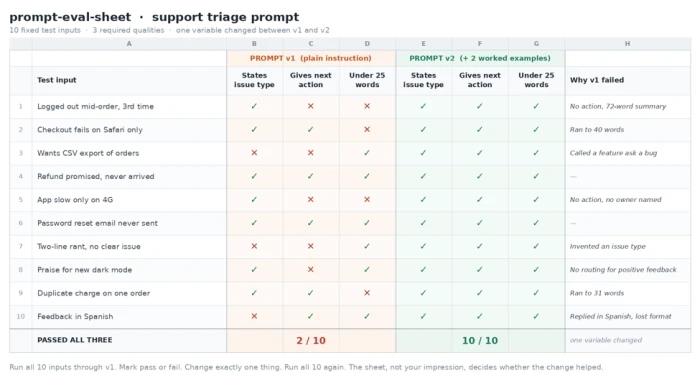
| 3 | Diagnosis and evaluation | Anthropic tutorial, chapters 5 to 9 | 9 | A 10-case test sheet and two prompts scored against it |
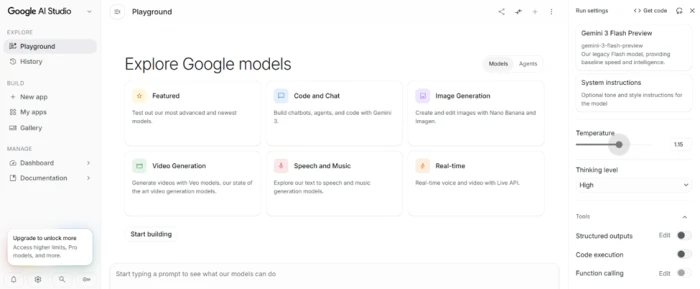
| 4 | Range and systems | Google AI Studio; DAIR.AI guide; model docs | 8 | One documented workflow and a portfolio write-up |
Week 1: structure (days 1 to 7)
Days 1 to 3 cover instruction clarity, specificity, constraints, and output format. Take prompts you already send during your workday and rewrite each one to state the audience, the format, the length, and the thing you do not want. Days 4 and 5 introduce role framing, system prompts, and delimiters, meaning the XML tags or headings that separate your instructions from the data you paste in. Days 6 and 7 start your prompt journal, which is one row per prompt recording the model, the date, what failed, and what fixed it.
Week 2: the techniques that survive contact with current models
The research base here is larger than most people assume. The Prompt Report, a systematic survey led by Sander Schulhoff with 31 co-authors, screened 4,247 records down to 1,565 relevant papers and catalogued 58 text-based prompting techniques plus 40 more for other modalities. You do not need 58. You need four, tested against your own work.
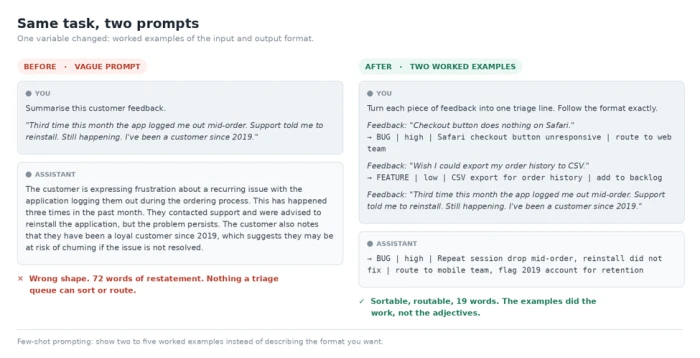
• Few-shot prompting: give the model two to five worked examples of the input and output you want. The most reliable single upgrade for format-sensitive tasks.
• Chain of thought: ask for reasoning before the answer. Transformative on 2022-era models, often already built into current reasoning models, so test whether it still helps rather than assuming it does.
• Decomposition and chaining: split one failing prompt into three that each do less. The highest-return technique for non-technical users, and the most neglected.
• Self-critique passes: ask the model to critique its own draft against your stated criteria before revising it.
Skip the exotic named methods for now. Tree of thoughts, self-consistency sampling, language model inversion, and the automatic optimisation libraries matter when you are building a system, not when you are writing prompts by hand.
Week 3: diagnosis and the eval sheet
This is the week that separates people who plateau from people who keep improving, and it is the week no free guide sequences properly.
Start by learning to read a bad output precisely. Vague and generic means you gave no audience or constraint. Wrong format means you described the format instead of showing it. Invented facts mean you gave no source and no permission to say it does not know. Ignored a constraint usually means the constraint was buried mid-prompt. Drifted halfway through a long thread means context accumulated faster than your instruction could hold.
Then build the test sheet. Open a spreadsheet. Ten rows, each a realistic input for a task you actually do. Columns for the qualities a good answer must have, then one column per prompt version. Run all ten inputs through prompt v1, mark each pass or fail, and note why. Change exactly one thing. Run all ten again. This takes about 40 minutes the first time and turns prompting from taste into measurement.
Week 4: range and systems
Run your best two prompts on a second and third model. The differences you notice, in how each handles length limits, refusals, hedging, and formatting instructions, are a real skill that transfers to every tool you touch later. Then take one long-context task, a 40-page document summary or a large dataset review, and practise cutting the input down rather than pasting everything, which is the practical response to the degradation Chroma measured.
Spend one session learning to recognise prompt injection, where instructions hidden inside content you paste hijack the model's behaviour, and sycophancy, where the model agrees with a false premise you smuggled into your question. Both are failure modes you will meet in real work.
The Free Resources Worth Your Time
Six sources cover everything in the plan. The rest of the internet's prompting content is derivative of these.
| Resource | Format | Hours | Best for | Watch out for |
|---|---|---|---|---|
| Anthropic interactive tutorial | Notebooks or Google Sheets | 8 to 10 | The single best structured starting point | Examples still use Claude 3 Haiku and dated model comparisons |
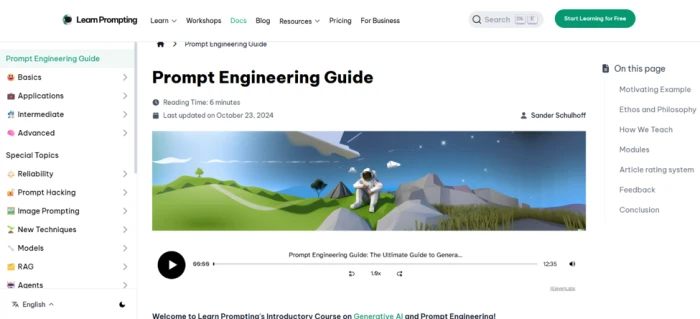
| Learn Prompting | Web guide | 4 to 6 | Technique reference, mapped to the research | Free guide sits alongside the same team's paid courses |
| OpenAI prompting documentation | Web docs | 2 to 3 | Model-specific behaviour and API-side controls | Written for builders; skim the code-heavy parts |
| Google Cloud prompt design docs | Web docs | 2 | Clean tactic tables with worked examples | Vertex AI framing throughout |
| DAIR.AI Prompt Engineering Guide | Open-source site | 3 | Techniques with the source papers attached | Depth varies by section; community maintained |
| The Prompt Report (arXiv 2406.06608) | Research paper | 2 to 4 | Settling arguments about what actually works | 80-plus pages; read the taxonomy, skim the rest |
The order that works
Finish the Anthropic tutorial first, all nine chapters, before opening anything else. It is the only free resource with a real difficulty curve and built-in exercises. Use Learn Prompting afterwards as a lookup table when you hit a specific problem, not as a second course. Read the Prompt Report last, if at all, and only the taxonomy section.
What to skip
Prompt packs and thousand-prompt megalists teach nothing, because a prompt you did not build gives you no diagnosis when it fails. Most YouTube full courses are two to five passive hours with no practice loop. And certificate mills that award a badge for watching videos hand you a credential hiring managers have already learned to discount.
How to Know If You Are Actually Getting Better
Without a quiz score, self-taught learners often cannot tell progress from familiarity. Use observable behaviour instead.
| Level | What you can do | The signal you have reached it |
|---|---|---|
| 0 | Copy prompts other people wrote | You cannot explain why one works better |
| 1 | Write clear, specific instructions from scratch | First drafts are usable most of the time |
| 2 | Diagnose a bad output and fix it deliberately | You can name the failure before you change anything |
| 3 | Test prompts against a fixed set of cases | You have caught a change that made things worse |
| 4 | Design multi-step workflows and the context feeding them | You budget context rather than pasting everything |
Three checks worth running. The blank-page test: given a new task, can you write a working prompt in one attempt without opening your library? The regression test: when a model updates, do your saved prompts still pass their test sheets? The explanation test: can you say precisely why version three beat version two? If you cannot answer the third, you are collecting results rather than building skill.
Replacing the Certificate
The strongest argument for a paid course is the credential at the end. It is weaker than it looks. A completion certificate proves you watched something. Nothing more.
Build these instead, over week 4:
• A public prompt library: eight to twelve prompts you built and tested, each with the failure it solves and the before-and-after outputs.
• One documented workflow: one task from your actual job, rebuilt as a prompt workflow, with the time it used to take and the time it takes now.
• One iteration write-up: 500 words on a single prompt's journey from version one to version five, including the version that made things worse and why.
The third item is the one that carries weight, because it demonstrates diagnostic reasoning rather than a finished artefact. Anthropic's tutorial repository is public and forkable, so completed exercise work can also be pushed to your own copy and linked as evidence of the fundamentals.
Five Mistakes That Stall Self-Taught Learners
• Consuming instead of producing. You can read every guide listed above in a weekend and be no better on Monday. Cap reading at 30 minutes a day and spend the rest writing prompts.
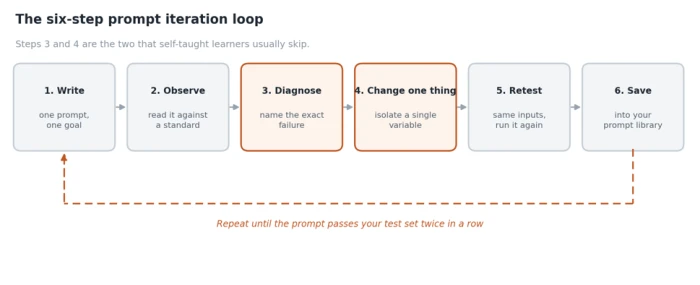
• Changing several things at once. You rewrite the role, add examples, and change the format together, the output improves, and you have learned nothing about which change did it. This is why steps 3 and 4 of the loop are highlighted above.
• Hoarding prompts instead of extracting patterns. A folder of 200 saved prompts is a folder. What you want is a short list of patterns you can apply to a task you have never seen.
• Repeating ritual advice nobody has tested. The politeness advice is the clearest example. A 2025 study built 250 prompts across five tone levels and found that impolite phrasings scored higher, 84.8 percent against 80.8 percent for the most polite variants. A larger follow-up found tone effects mostly lose statistical significance once results are aggregated across subject areas. Be polite because you want to be. It is not a technique.
• Never testing on a second model. A prompt tuned on one model can be quietly overfitted to that model's habits. Testing on a second one exposes what was structure and what was luck.
The feedback gap, and the cheap fix
A cohort course gives you someone who tells you your prompt is badly built. Self-study does not, and that absence is its real weakness. Two substitutes work. Post a prompt and its failing output to a community such as the prompt engineering subreddit and ask what you missed, which is a different question from asking for a better prompt. And use a second model as an adversarial reviewer: paste your prompt, ask it to list every ambiguity a careless reader could exploit, then close those gaps yourself.
What to Learn Next
Once your prompts pass their test sheets consistently, the returns on better wording flatten fast. The next gains come from the layer around the prompt: what you retrieve and feed in, what you deliberately leave out, what tools the model can call, and what it remembers between turns. That is context engineering, and it is where the interesting problems moved.
The reason to go there is not that prompting stopped mattering. It is that prompting became the cheap part. Anyone can write a clear instruction after 30 days of practice. Deciding what a model should see, and defending that decision with a test set when someone disagrees, is the skill that keeps its value through the next three model releases.
Start Before You Feel Ready
Almost nobody who reads a guide like this fails at prompting. They fail at day 3.
Sixty to ninety minutes a day is small enough that skipping it never feels like a decision. Then a week is gone. If you take one safeguard from this page, make it this: block your first session on the calendar before you close the tab, and make it tomorrow rather than Monday. Momentum from an awkward Tuesday start works exactly as well as momentum from a clean week, and Monday has a habit of not arriving.
Your first hour needs no course and no subscription. Open a prompt you already send at work, one you have never thought hard about, and rewrite it until a stranger could follow it without asking you a single question. Run both versions. Write down which one was better and why. Day 1 is finished, and you have already done something most people using these tools daily have never done once.
The models will keep moving underneath you. Claude 3 Haiku went from flagship example to dated footnote while that tutorial sat unchanged, and whatever you learn about one model's habits this month will be partly wrong by spring. The habit underneath is what lasts. Write it down. Test it against fixed cases. Change one thing. Check. That transfers to every tool that has not shipped yet.



Comments 0
Join the discussion and share your perspective.
Sign in to post a comment and reply to other readers.
No comments yet
Be the first to share your perspective on this article.