1
Dating app profile search
Core feature, heavily praised when matches appear but criticized as ineffective when searches return nothing.
Cheaterbuster AI scans dating platforms using profile details and photos to surface possible accounts. It targets suspicious partners and anxious spouses, but mixed accuracy, aggressive upsells, and billing complaints make results highly situational.
Independent review — we test tools ourselves and analyze public user reviews. How we test.
Cheaterbuster AI can surface dating profiles quickly when matches exist, and many users credit it with confirming serious infidelity and providing evidence. However, a large cluster of reviews report no results, false positives when searching themselves, and a sense that the technology overpromises accuracy. Pricing is frequently described as confusing, with constant add ons, recurring charges, and difficulty canceling. Overall, it is best suited for highly motivated partners who accept subscription billing risk and want another data point, not definitive proof.
Cheaterbuster AI is a web-based people-search service that markets itself as a way to check whether someone holds an active dating profile. It began years ago as Swipebuster and now leans on its “AI” positioning, with Tinder as its main target rather than broad coverage across every dating app.
The pitch is built for one situation: a person who suspects a partner is quietly swiping. You give the site a first name and a rough location, and it offers an optional photo upload that runs a facial-recognition match against dating profiles. The company frames this as discreet, since the person being searched gets no notification and no account of their own is required.
Access is paid. You reach the results only after the site asks for money, which places it among the growing set of relationship-surveillance tools.
One point a reader should keep in mind: the service sits in a legal gray area. It draws on publicly visible profile data, yet searching a named individual without consent can brush against privacy and data-protection rules that differ by country.
Core feature, heavily praised when matches appear but criticized as ineffective when searches return nothing.
Photo based matching tool, described as impressive and accurate by fans, but some report irrelevant or blurred results.
Collects relationship and behavior details; some appreciate explanations, others find questions intrusive or unnecessary.
Following AI feature helps users see social follows, praised as crucial by some reviewers when confirming concerns.
Supplementary lookup, mentioned positively as clear and helpful when used alongside dating searches.
Results locked behind recurring plans; widely criticized for hidden fees, add ons, and unexpected repeat charges.
Interface described as clean, organized, and easy to navigate, with straightforward step by step flow.
Some users note timely alerts to phones, reducing need for manual checking once monitoring is active.
Reports used in divorces and court, valued by users who successfully obtained clear proof of infidelity.
We did not want to judge Cheaterbuster AI on its marketing. So we signed up, watched every screen, and ran searches to see whether the tool does what the homepage claims. What we found was a long questionnaire and a paywall standing in front of results we were never allowed to verify.
The homepage sells speed. It frames the whole product as three steps. Enter a name. Read the results. Keep monitoring over time.
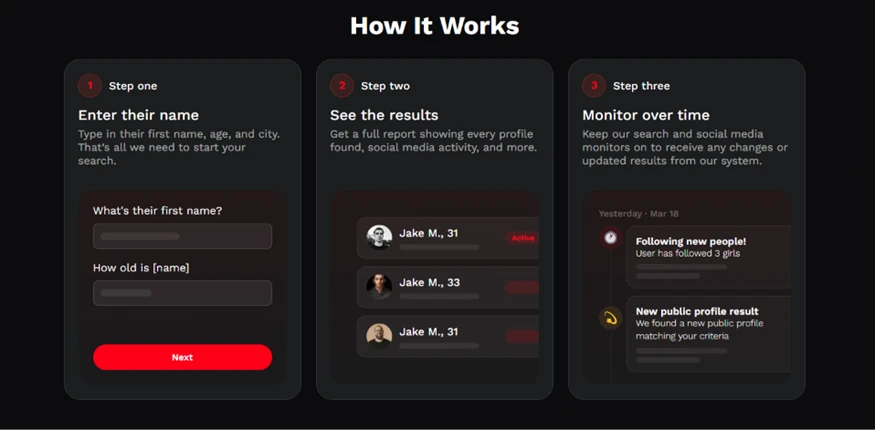
That is the promise. The real flow told a different story.
We opened the site, which greets you with a claim of more than a million searches completed and a single box asking who you are looking for. We typed in a test subject named Mike.
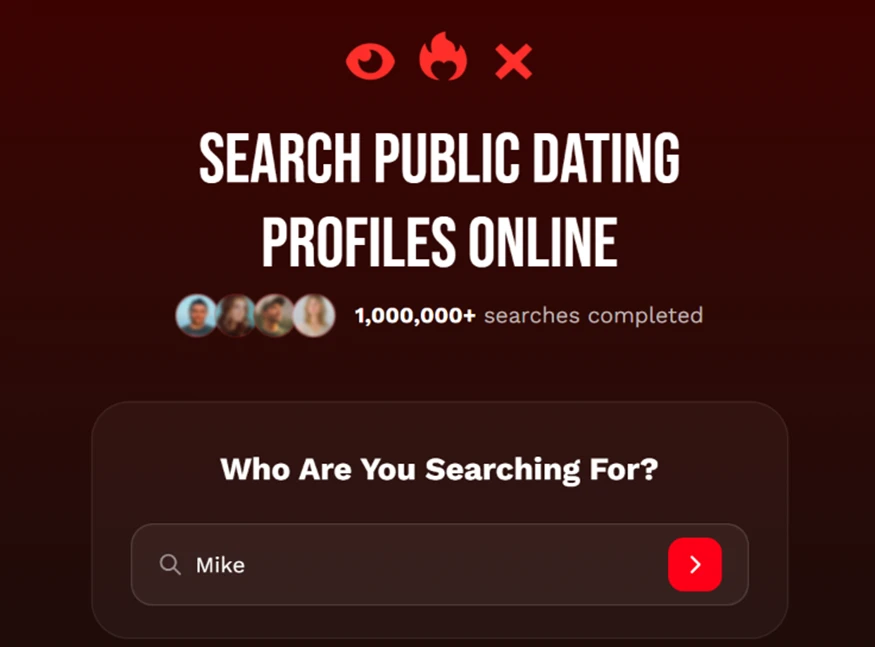
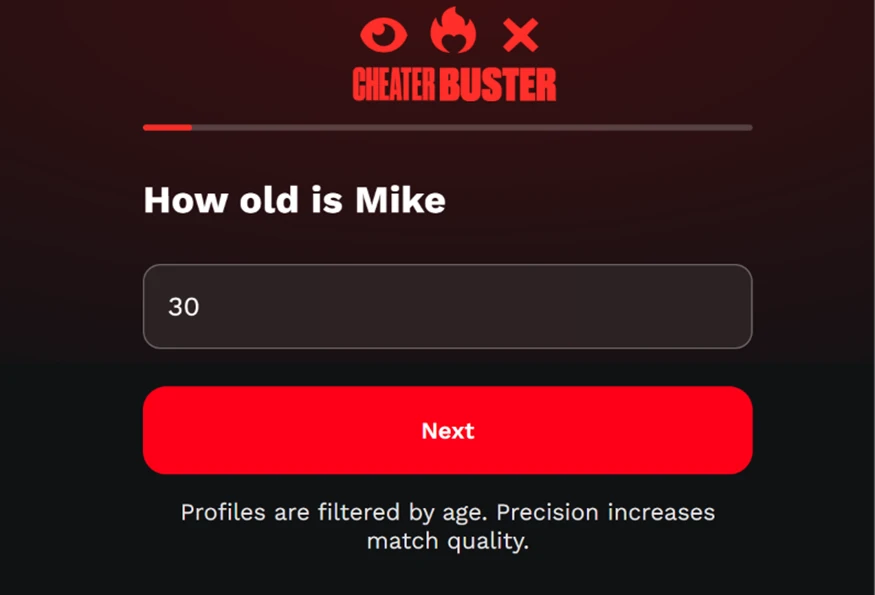
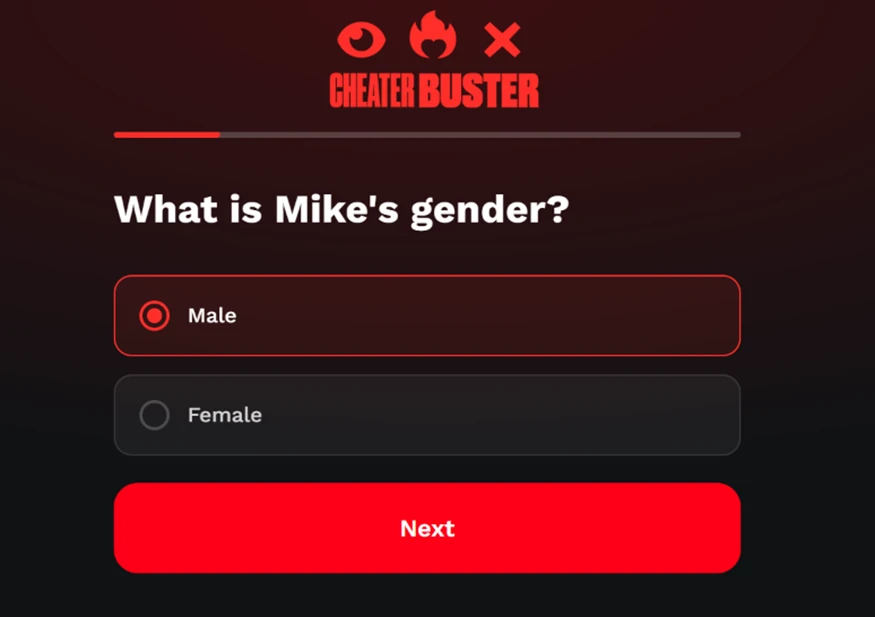
The questions started at once. The site asked Mike’s age, then moved to his gender.
 |  |
Then it got personal, asking what our relationship to Mike was and offering choices down to “just curious.”
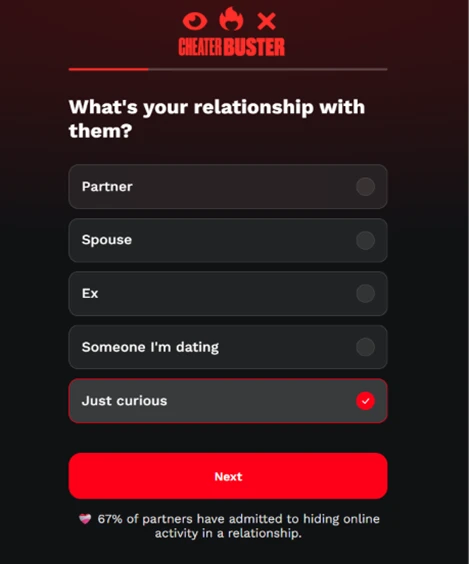 | 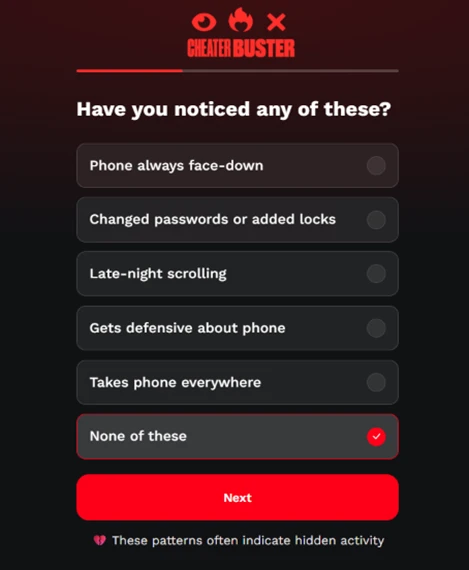 |
The screens that followed had no connection to any database search. One asked whether we had noticed certain behaviors, prompting us about a phone kept face-down and someone getting defensive about their screen.
Another asked where Mike might be using dating apps and dropped a pin on a specific Manhattan street address.
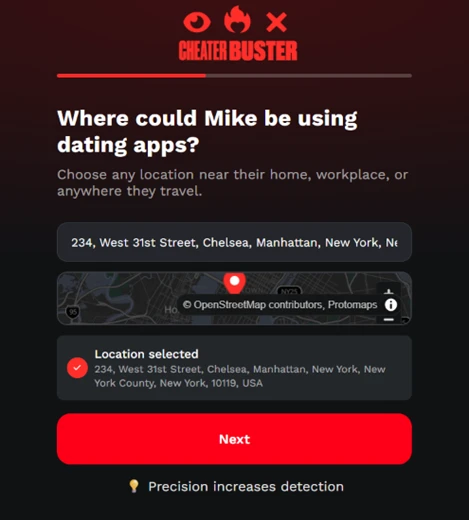
It wanted his travel habits next, then the hours when he seemed most active, listing options as pointed as late-night scrolling and long bathroom breaks.
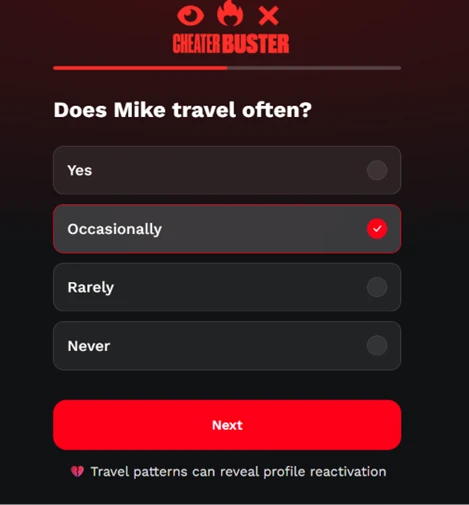 | 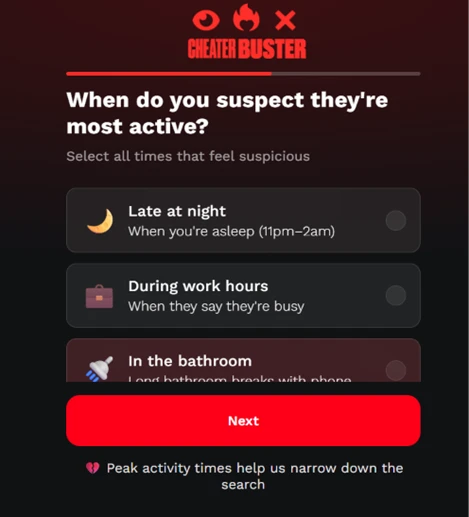 |
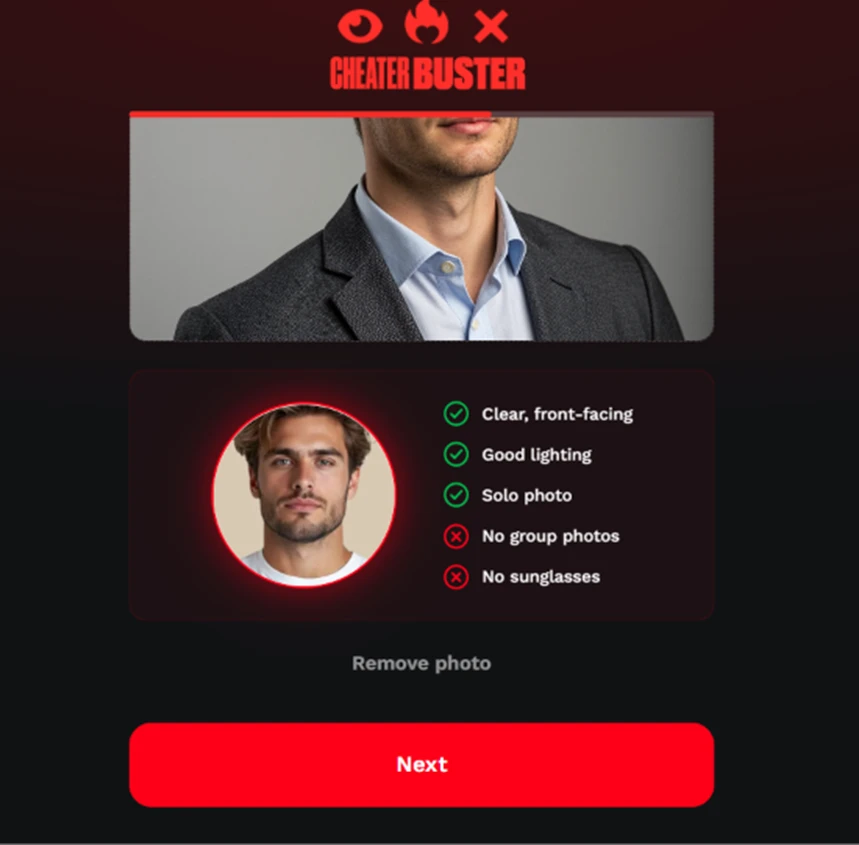
A later screen made us upload a photo and graded it against a checklist before it would accept the image.
Close to the finish, it asked for Instagram and TikTok handles.
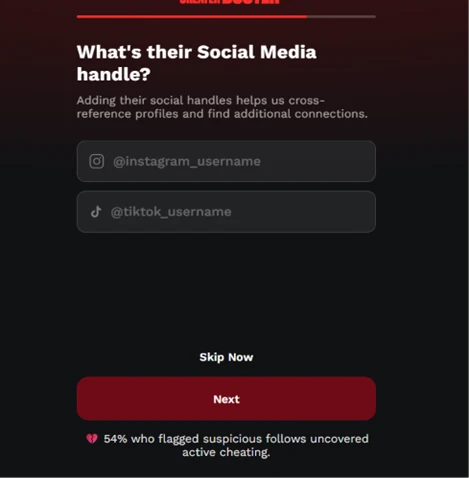
By the time a search button appeared, we had cleared roughly a dozen screens. Most of them cannot feed a profile lookup. Whether a man carries his phone into the bathroom has no bearing on whether a dating profile exists under his name. Questions like that exist to build suspicion and harvest personal data before anything is searched.
With the questions done, the site ran what it called a scan.
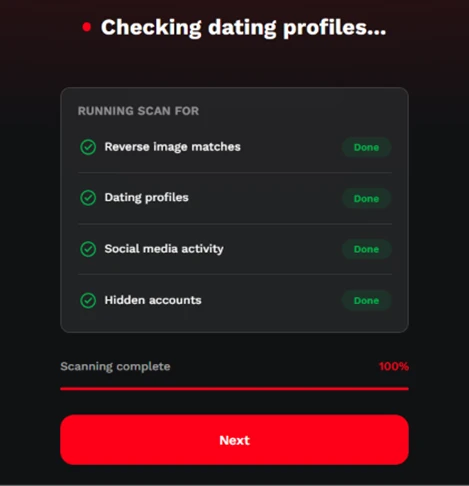
It cycled through four checks, reverse image matches, dating profiles, social media activity, and hidden accounts, and stamped each one “Done” at 100 percent in a few seconds. A map then appeared with a red radius over New York and a bar that filled under the words “Search complete.”
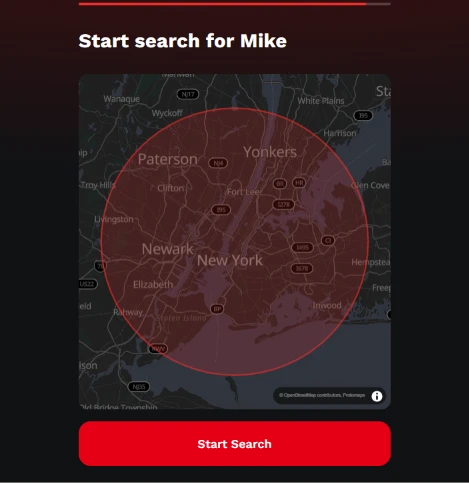 | 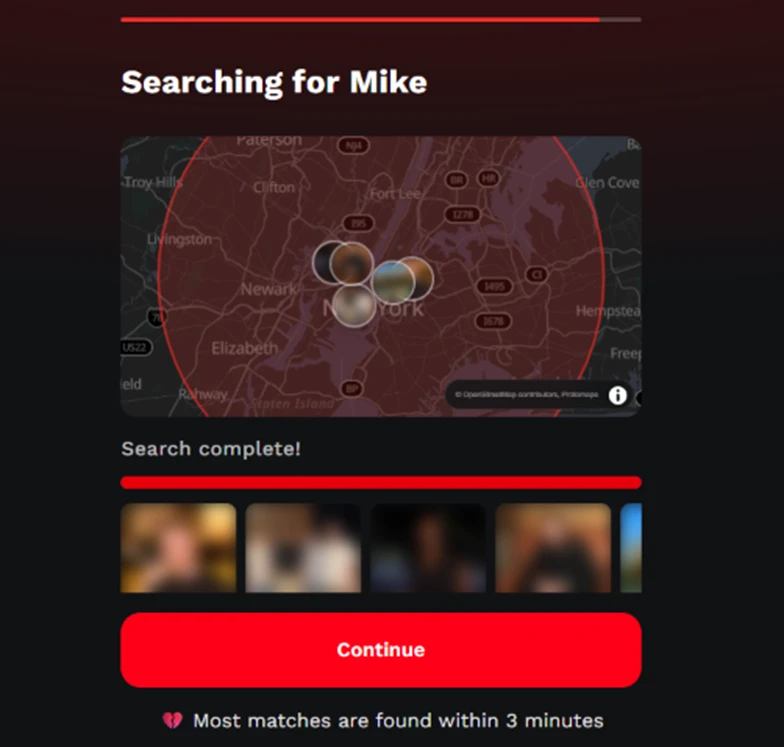 |
Every face in the results was blurred. There was nothing on the page we could match to a real person.
The site announced that the report was ready and pushed us to make an account. The sign-in wall put Google and Apple buttons above an email field.
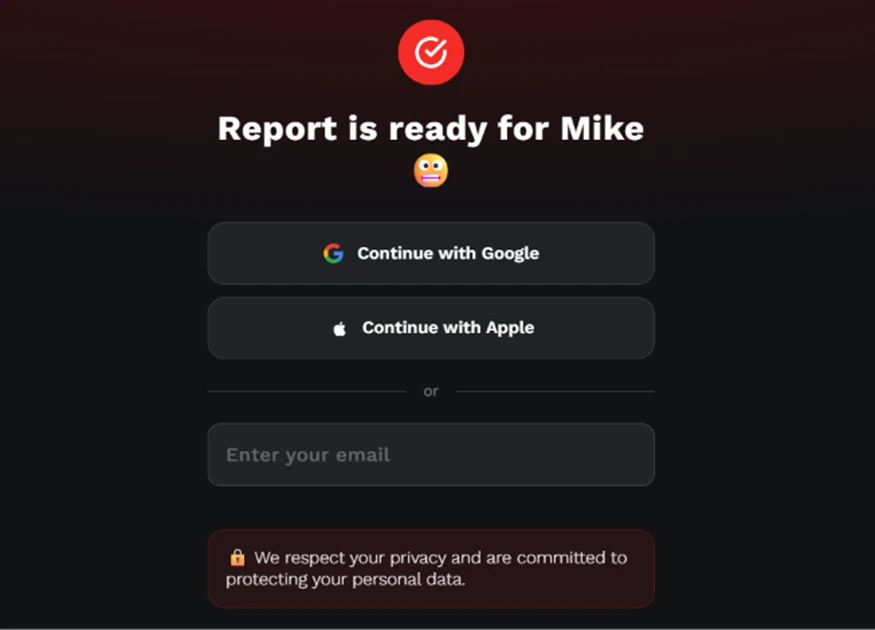
Creating the account did not reveal the report. It opened a paywall. The profile sat “blurred until unlocked,” a banner warned that the results were being held for just over thirteen minutes, and the plan billed $19.99 immediately while presenting itself as $4.99 a week.
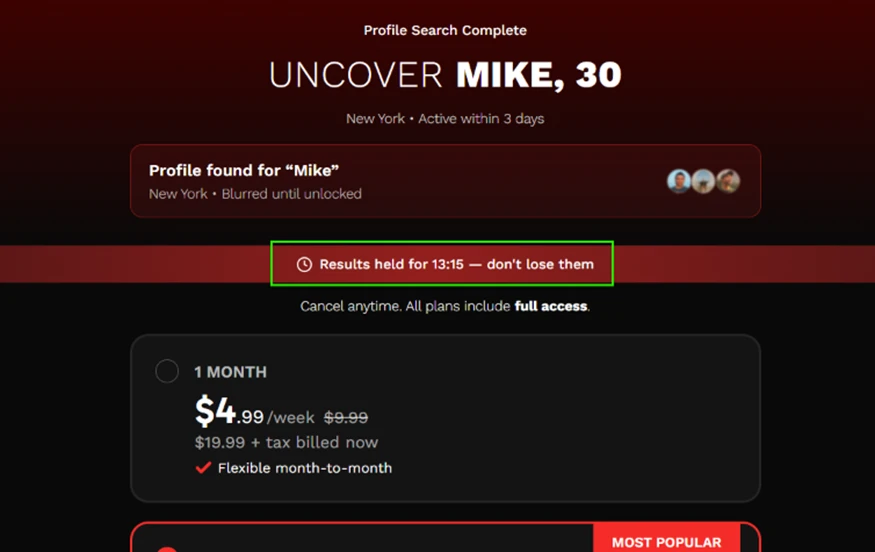
The order was unmistakable. Payment came first, and the site had shown no proof there was anything real to unlock.
To find out whether the search engine did anything, we ran it again with a name no person carries. We typed “Ajhkjvjk” into the box.
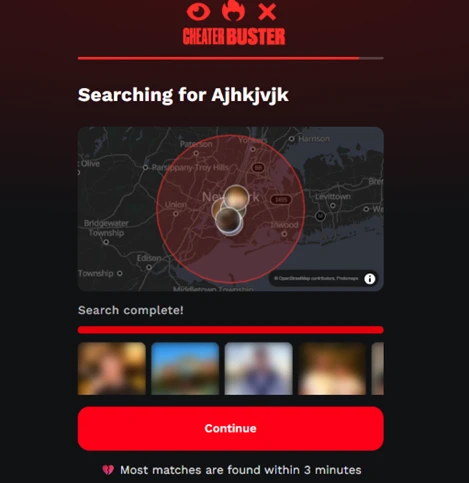
The site behaved precisely as it had for Mike. It declared “Search complete,” drew the same map with a search radius, and lined up a row of blurred matches. A string of random keystrokes returned the same confident result as a real name. A genuine lookup would have found nobody for a name that belongs to nobody. Matching output for gibberish points to canned screens rather than a real search.
The run answered the question we came with. The search is a performance, and the paywall is the actual product.
A few of the methods are worth naming so you can recognize them:
Anyone trying to check a partner’s dating activity will get further through an honest conversation or a people-search service that shows a result before asking for a card.
| Dimension | Our test | User signal | Verdict | Composite |
|---|---|---|---|---|
| Search Accuracy Correctly finds real profiles | 5 | 5 | Weak | |
| Ease of Use Interface clarity and navigation | 8 | 8.5 | Good | |
| Pricing Transparency Clarity of costs and upsells | 3 | 2.5 | Weak | |
| Billing Reliability Subscriptions and charge handling | 3 | 2 | Weak | |
| Customer Support Speed and usefulness of help | 4 | 3 | Weak | |
| Emotional Usefulness Clarity in relationship decisions | 7.5 | 8 | Good | |
| Data Trust and Privacy Perceived safety of data handling | 4.5 | 4 | Weak |
Toolscopia uses cookies to keep you signed in, remember your preferences, and understand how our reviews get read. Analytics are anonymous. See our privacy policy for the full detail.



Comments 0
Join the discussion and share your perspective.
Sign in to post a comment and reply to other readers.
No comments yet
Be the first to share your perspective on this tool.