1
Thesis and essay drafting assistance
Frequently praised for helping structure theses, essays, and reports and overcoming writer’s block.
Jenni AI is a citation aware writing assistant for students and researchers. It speeds up drafting, structuring and academic tone, but raises real concerns around billing transparency and cancellation hassles.
Independent review — we test tools ourselves and analyze public user reviews. How we test.
Jenni AI delivers strong value for academic drafting, thesis structuring, citations and overcoming writer’s block, especially for intensive research workflows. Many users praise its interface, idea generation and remarkably responsive agents like Kate and Marc. However, recurring complaints about auto renewals, difficult cancellations, inconsistent refunds and occasional citation or editing errors signal serious trust and reliability issues. It suits disciplined academic users who monitor billing closely and manually review AI edits, but is a risky choice for casual users or anyone sensitive to surprise charges.
Jenni AI is a writing tool built for one job: producing source-backed academic text without leaving the editor. It started life as a B2B SEO writer before pivoting to students and researchers, and that focus shows. Where a general chatbot hands you prose and leaves sourcing to you, Jenni works sentence by sentence, suggesting completions and pulling real, indexed papers straight into your draft as you type.
The core loop is autocomplete plus citations. You write a claim, Jenni proposes the next line and attaches a reference it can point to in an actual PDF. Around that sit editing tools, an AI Chat for querying your sources, and review features that grade a draft for weak claims and citation quality.
It runs freemium. The free plan lets you test the workflow but caps daily AI words and locks reference export behind payment. The target user is someone writing essays, literature reviews, or research papers who wants drafting and sourcing in the same window rather than scattered across four tabs.
Frequently praised for helping structure theses, essays, and reports and overcoming writer’s block.
Widely used for in text citations and references, though some report repetition and incorrect or invented citations.
Users value uploading PDFs and drawing suggestions from a personal Library for research focused writing.
Commonly mentioned for generating outlines, paraphrasing, and re organizing ideas during early drafting.
Interface often described as intuitive and user friendly, assisting focus, though some find it clunky.
Highly praised when handled by agents like Kate or Marc, but many others report no responses at all.
Frequently criticized for unexpected renewals, limited refund window, and difficulty cancelling subscriptions.
Generally responsive, though some report busy server messages, long waits, and poor answer quality.
Often commended for improving academic tone, coherence, and grammar in research writing.
I spent a working session pushing Jenni AI through the parts of academic writing that actually matter to me. I drafted with it, sourced with it, then turned its own tools back on the text to check whether the claims held. Everything below was done on the free plan, which capped me at a small daily pool of AI words and reset once every 24 hours. That limit shaped the order of my testing, so I front-loaded the generation tasks before the counter ran out.
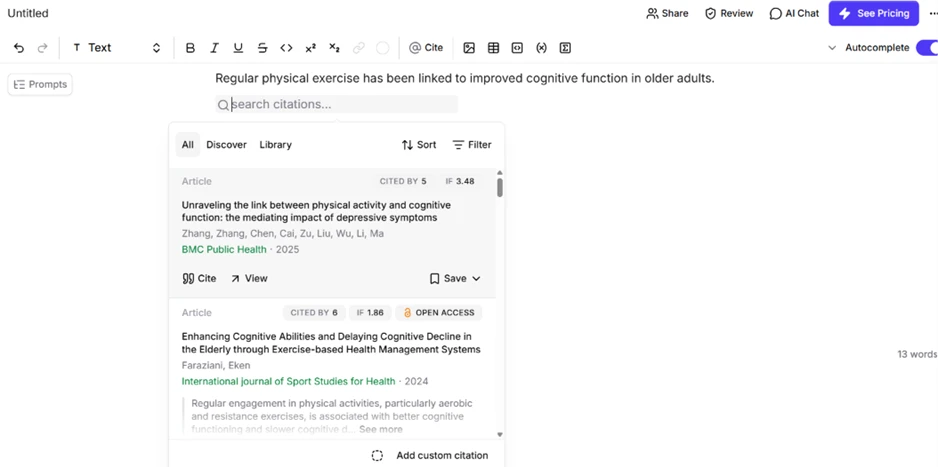
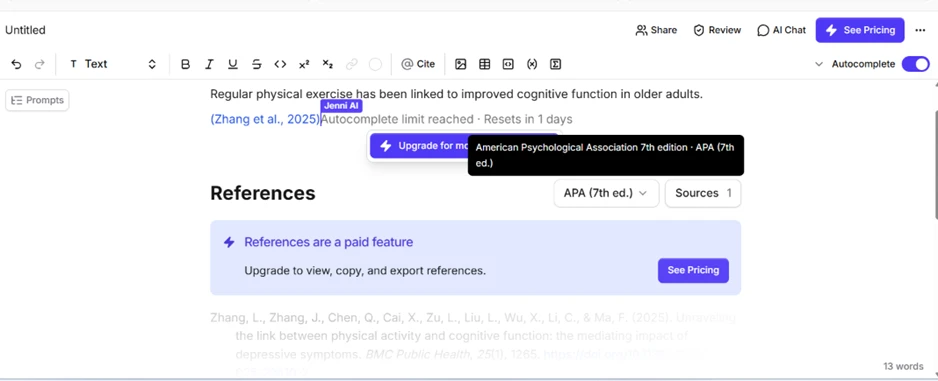
I opened a blank document and typed a single factual sentence: “Regular physical exercise has been linked to improved cognitive function in older adults.” The moment I triggered the citation lookup, Jenni pulled real, relevant papers straight into a dropdown over my text. The top hit was a 2025 BMC Public Health article on physical activity and cognitive function, complete with a citation count and impact factor. A second open-access paper sat right below it with a matching abstract snippet.
This is the feature that separates Jenni from a general chatbot. I did not leave the editor, search a database, or hunt for a PDF. The sources arrived attached to the exact sentence I was writing.
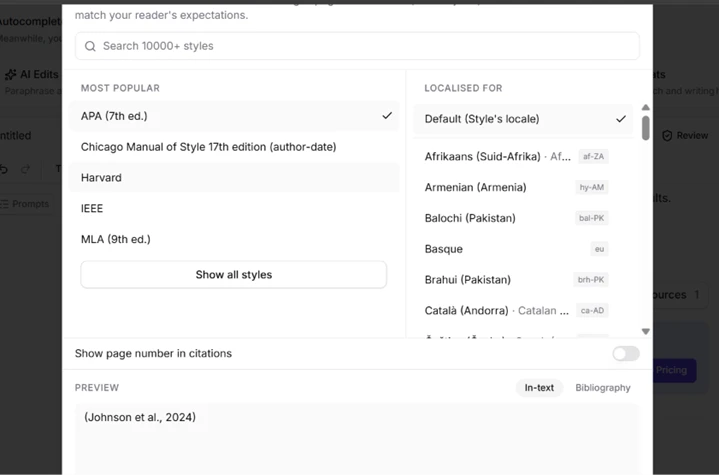
Reformatting was equally quick. Jenni lists more than 10,000 citation styles, with APA 7th, MLA 9th, Chicago, Harvard, and IEEE sitting at the top of the picker. For a US readership that ordering is convenient, since APA and MLA cover most coursework here. I switched styles and watched the in-text preview update live to (Johnson et al., 2024).
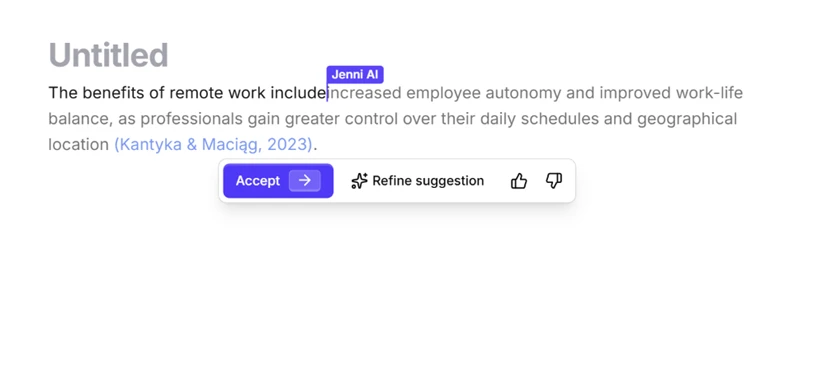
I started a sentence, “The benefits of remote work include”, and let Jenni finish it. The completion was clean and on topic, covering employee autonomy and work-life balance, and it dropped in a citation to Kantyka & Maciąg, 2023 without my asking. The Accept and Refine controls made it easy to take the suggestion or nudge it.
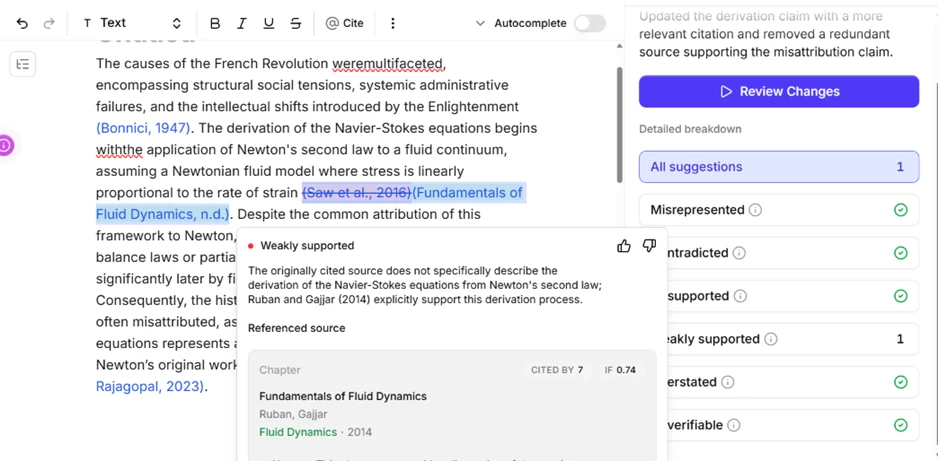
The interesting part of my test came when I pushed Jenni onto a technical topic and then asked it to check its own work. I prompted a passage on the derivation of the Navier-Stokes equations. Jenni produced a paragraph that reads as confident, well-structured academic prose, and it even flagged a genuine historical point, that the equations are often misattributed to Newton. On a quick read it looks publishable.
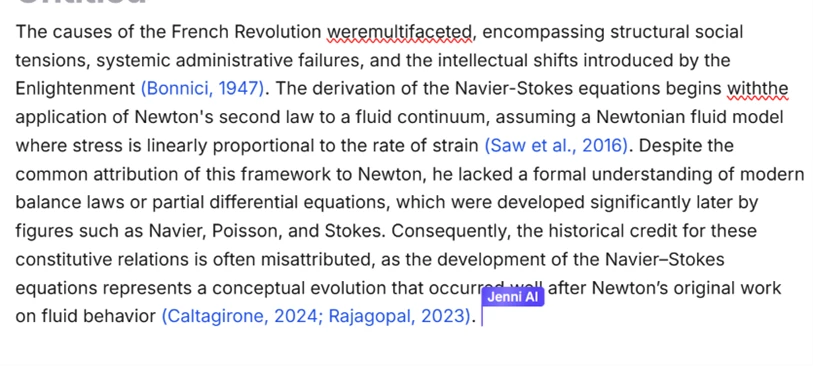
One small bug is visible right in the text. Autocomplete twice merged two words without a space, producing “weremultifaceted” and “withthe.” Minor, but it means a draft needs a spacing pass before anyone reads it.
Then I fed that same paragraph into Jenni's own review tools, and the picture changed.
Jenni's citation checker flagged one of the sources it had inserted itself. The tool marked the Saw et al. reference as “Weakly supported,” explaining that the cited source does not actually describe the Navier-Stokes derivation, and it suggested a replacement chapter that does. Jenni caught Jenni inserting a citation that did not back the claim.
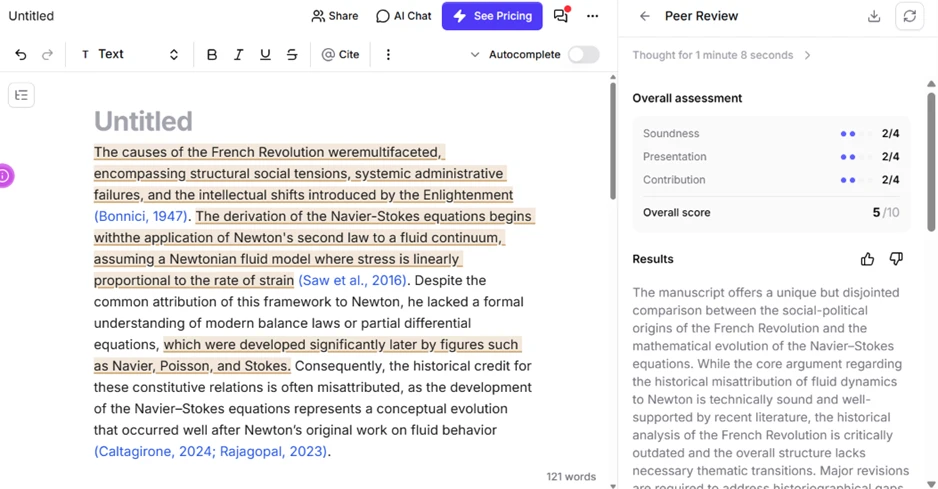
The Peer Review feature went further. After thinking for a little over a minute, it scored my Jenni-written paragraph at 5 out of 10. Every criterion it measured, soundness through to contribution, landed at 2 out of 4. The written assessment called the historical analysis “critically outdated” and said the structure lacked thematic transitions.
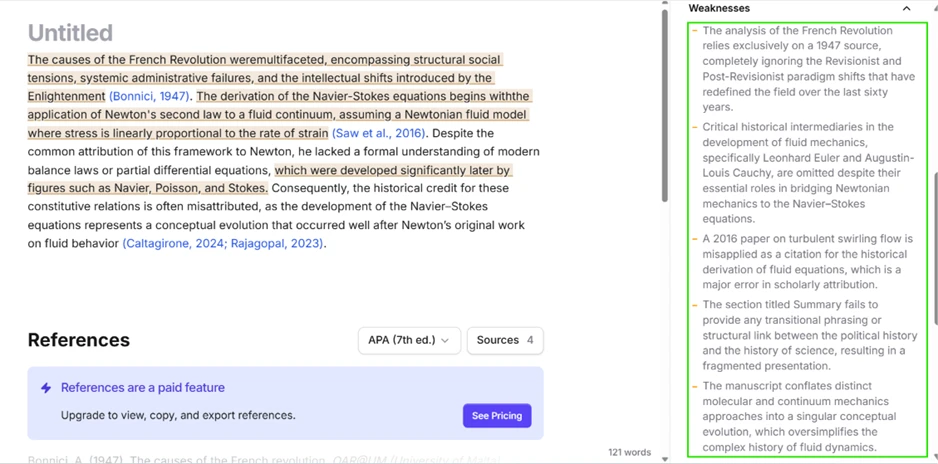
The weaknesses panel was specific rather than generic. It called out reliance on a single 1947 source, the omission of key figures such as Euler and Cauchy, and a misapplied 2016 citation that it labeled “a major error in scholarly attribution.” These are the exact problems a human reviewer would circle.
My finding from this sequence is straightforward. Jenni's drafting engine and its reviewing engine disagree with each other, and the review side is right. The autocomplete produces prose that sounds authoritative while quietly leaning on citations that do not hold up. The same product then tells you so, if you run the checks. A writer who accepts suggestions without reviewing them ships flawed work. A writer who runs Review and Peer Review catches the problems before submitting.
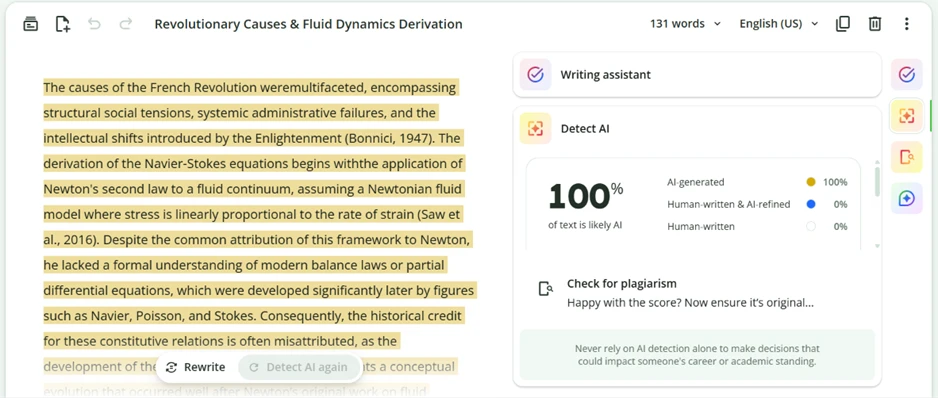
I copied a Jenni-generated paragraph into QuillBot's free AI detector to see how it would fare against the tools US instructors actually use. The verdict was blunt: 100 percent likely AI. For a student whose professor runs submissions through a detector, that result is the whole ballgame. Jenni's own interface, to its credit, warns against treating detection scores as a final judgment on someone's academic standing.
The free plan also drew a hard line around the output I most wanted. My autocomplete allowance hit its cap mid-session and displayed a 24-hour reset timer. When I opened the References section to export my citations, Jenni gated it behind a paywall, reserving even the ability to view and copy the references for paid tiers. The sourcing that makes Jenni worth using is visible on the free plan but not portable off it.
| Dimension | Our test | User signal | Verdict | Composite |
|---|---|---|---|---|
| Academic Output Quality Clarity, coherence, citation reliability | 7.5 | 7.8 | Good | |
| Ease of Use Learning curve and daily usability | 7.2 | 8 | Good | |
| Billing Transparency Clarity of pricing and renewals | 3 | 2.5 | Weak | |
| Customer Support Speed and helpfulness of responses | 6 | 6.5 | Moderate | |
| Platform Reliability Uptime, glitches, server behavior | 6.5 | 6 | Moderate | |
| Value for Money Perceived usefulness versus pricing | 6.8 | 6 | Moderate |
Toolscopia uses cookies to keep you signed in, remember your preferences, and understand how our reviews get read. Analytics are anonymous. See our privacy policy for the full detail.



Comments 0
Join the discussion and share your perspective.
Sign in to post a comment and reply to other readers.
No comments yet
Be the first to share your perspective on this tool.