1
AI content generation
Produces emails, posts, stories, and documents quickly, widely praised for speed and usefulness.
Rytr is an AI writing assistant for people who need fast, decent quality text for emails, posts, essays, and ideas. It shines on short-form content, free and low-tier plans, and simple, easy-to-use workflows.
Independent review — we test tools ourselves and analyze public user reviews. How we test.
Rytr delivers fast, generally high quality short form writing that many users describe as human like and helpful for emails, social posts, academic work, and brainstorming. The interface and setup feel simple, and the free or affordable paid tiers make it attractive for budget conscious users. However, several reviewers highlight generic or repetitive long form output, a very short trial, and serious frustrations with billing, refunds, and account deletion. Competing AI tools are often seen as stronger for advanced use. Rytr suits creators, students, and small teams who value speed and ease over depth and who are comfortable working within firm subscription policies.
Rytr is a template-driven AI writing tool built for short marketing copy. You pick a use case from a list of around 40, fill two or three fields, choose a tone, and get a draft in seconds. That structure is the product. Rather than a blank prompt box, you get pre-built scaffolding for product descriptions, cold emails, ad copy, and meta titles, which removes the need to learn prompting. Abhi Godara launched it in 2021, and it has run at the budget end of the category since, with a free tier and paid plans starting around $9 a month.
Understanding that design explains its behaviour under testing. Rytr optimises for speed over depth, so its templates supply structure while you supply substance. Two consequences follow. Output that reworks facts you provide is reliable, and output requiring facts Rytr must generate is not. The tool also carries an unusual regulatory footnote: the FTC filed a complaint in 2024 over a testimonial generator template, imposed a ban, then set that order aside in December 2025.
Produces emails, posts, stories, and documents quickly, widely praised for speed and usefulness.
Multiple tones and formality levels, often praised for human like, non robotic outputs.
Supports social captions, product descriptions, cover letters, and more, valued for versatility.
Free tier helps light users and testers, but several note strict monthly limits.
Assists nonnative speakers with English writing, repeatedly highlighted as very helpful.
Mentioned ability to check plagiarism, appreciated for academic and book writing.
Generates tags and ideas for videos and posts, saving time on SEO oriented tasks.
Frequently criticized for auto renewal, no refunds, and difficult account deletion.
Sometimes fails to extend text, instead summarizing, criticized as not fit for purpose.
I tested Rytr in three areas. Short product copy came first, then long-form blog sections. The final test covered factual output, where the tool had to supply information rather than rework what I gave it.
Each prompt was written out before I ran it. When I changed a single setting I reused the identical input, so the variable under test stayed isolated. Every screenshot below is unedited apart from annotation.
Rytr meters usage by character count, and that counter shapes how you work.
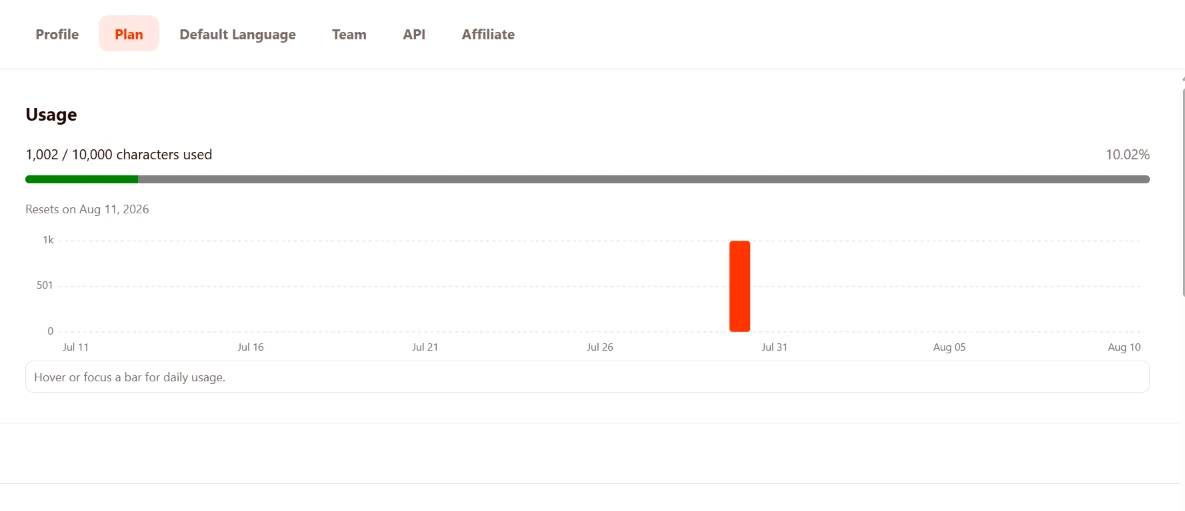
A single 103-word product description cost 1,002 characters against a 10,000 character monthly allowance. Ten percent of a month's output went on one paragraph, which sets a practical ceiling near fourteen generations and explains why every prompt here was drafted in advance rather than improvised.
I opened the Product Description template and entered a product name of Urban Grace Tote. The About field got the full spec: PU leather, beige colour, spacious main compartment with zip closure, multiple inner pockets, adjustable and detachable shoulder strap, gold-tone hardware. Tone was set to Convincing and creativity to Optimal.
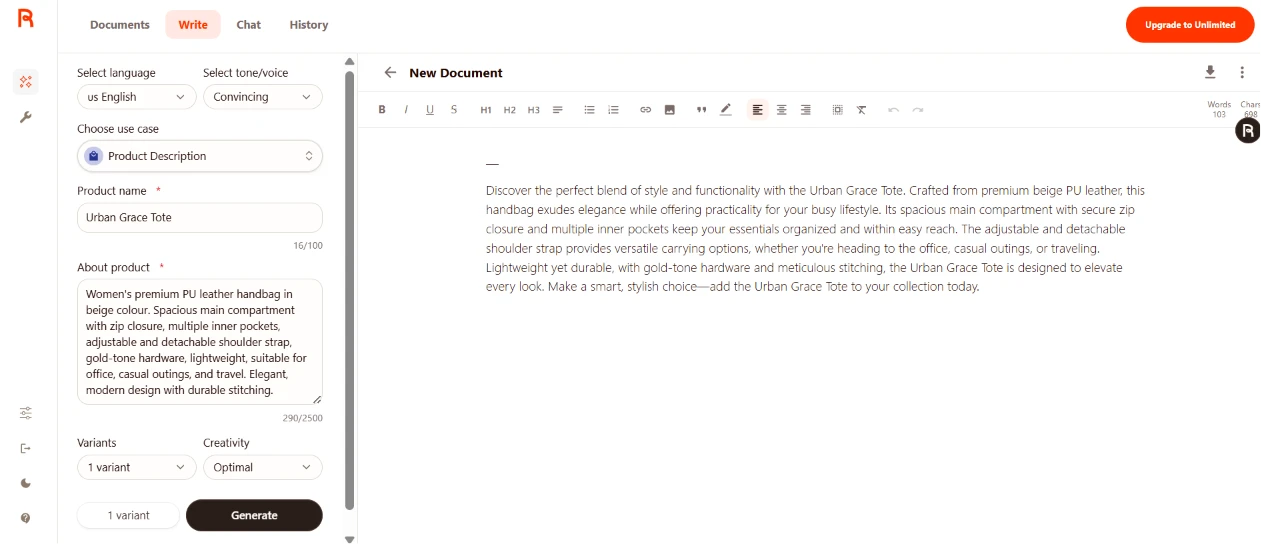
The draft came back in about two seconds at 103 words. Rytr used every detail I supplied and invented nothing. Phrases like “elevate every look” are filler, but a copywriter working through a catalogue produces the same filler. For a store with 200 SKUs, this is a real time saving.
I then ran the identical input through Humble and Inspirational tones to see how much the tone selector actually changes.
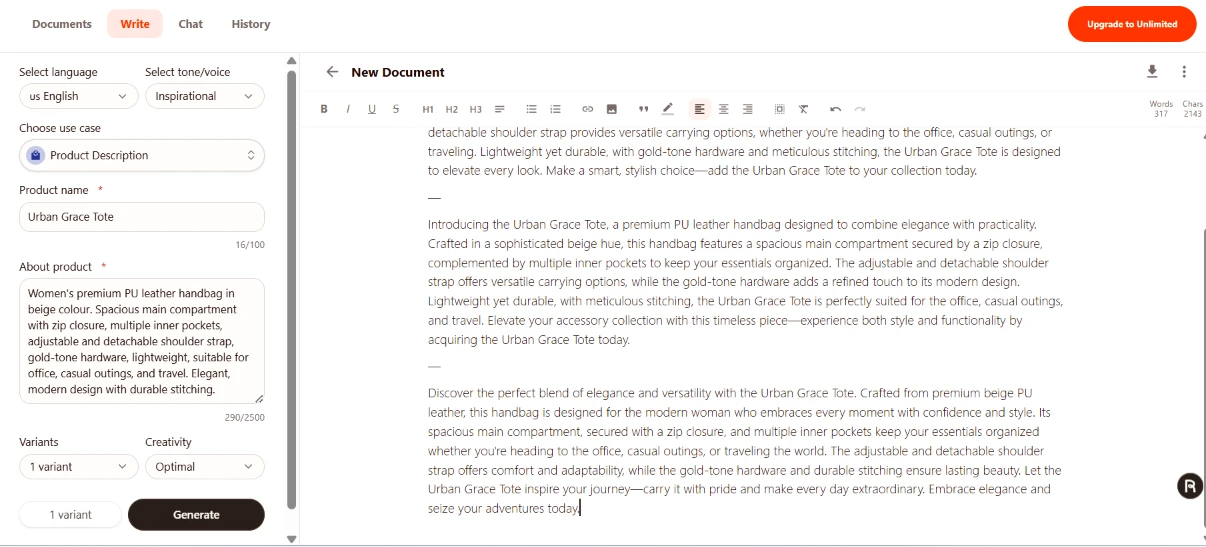
Compare the opening lines. Convincing begins “Discover the perfect blend of style and functionality.” Inspirational begins “Discover the perfect blend of elegance and versatility.” One sentence, two nouns swapped. All three variants present the specifications in the same sequence and reuse “versatile carrying options” and “meticulous stitching” word for word.
The tone selector swaps vocabulary. Sentence structure and register stay fixed. Rytr promotes its tone library as a headline feature, and on this test the difference between several of those tones is cosmetic.
Blog Section Writing exposed a gap in the interface. There is no word count or length field anywhere in the panel. Rytr decides how long your section runs, and you get what you get.
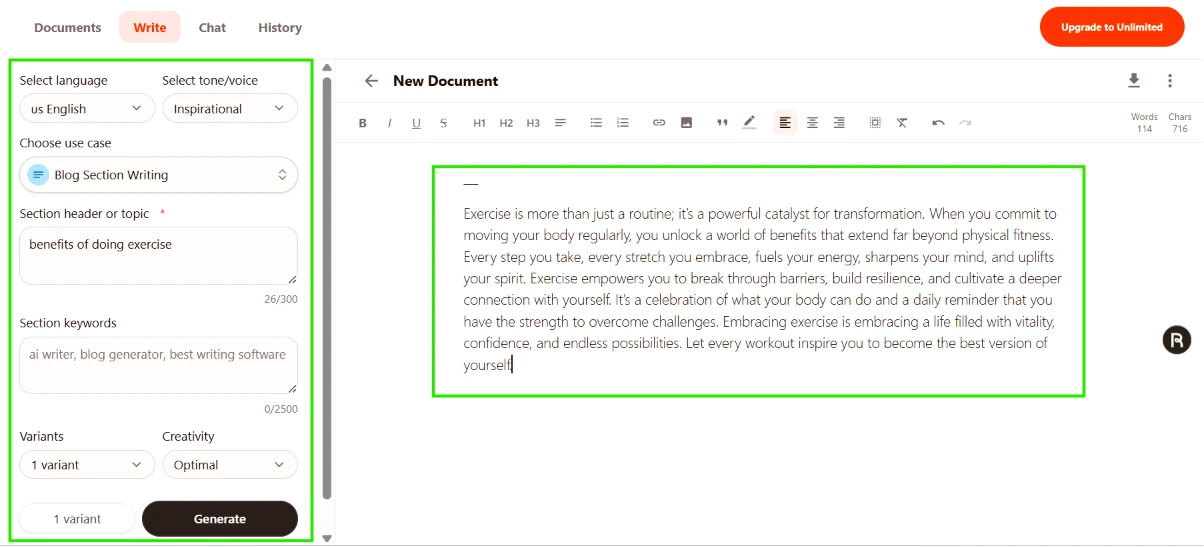
Rytr returned 114 words containing no specific benefit. Nothing on cardiovascular function, nothing on strength, sleep quality, bone density, or mood regulation. What arrived instead was motivational padding, opening with exercise as “a powerful catalyst for transformation”.
Next I tested the Creativity control on a second topic, the effects of stress on health, running it first at Optimal and then at Max.
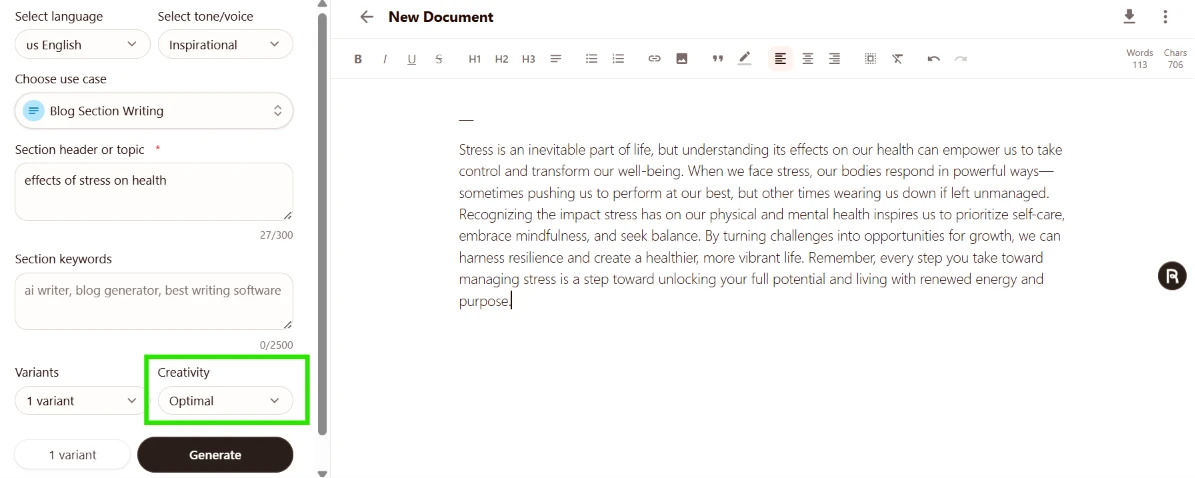
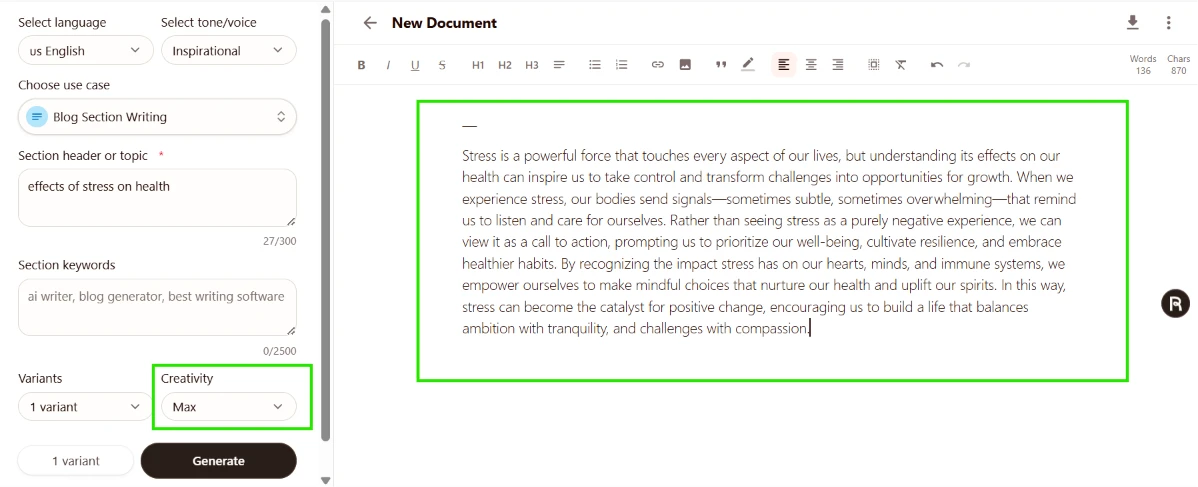
Optimal gave me 113 words. Max gave me 136. Neither named a single physiological effect of stress. Both delivered reframing in place of information, describing stress as “a call to action” and urging me to build a life “that balances ambition with tranquility”. The extra 23 words at the Max setting added length and nothing else.
Four long-form generations produced the same outcome every time: fluent paragraphs and clean grammar with no informational content. Anyone using Rytr for blog work supplies the facts themselves and uses the tool for connective tissue.
The tests above handed Rytr the facts up front. The harder question is what it produces when nobody supplies them. I asked Blog Section Writing for recommended daily water intake and hydration guidelines for adults, left the keywords field empty, and set creativity to Max.
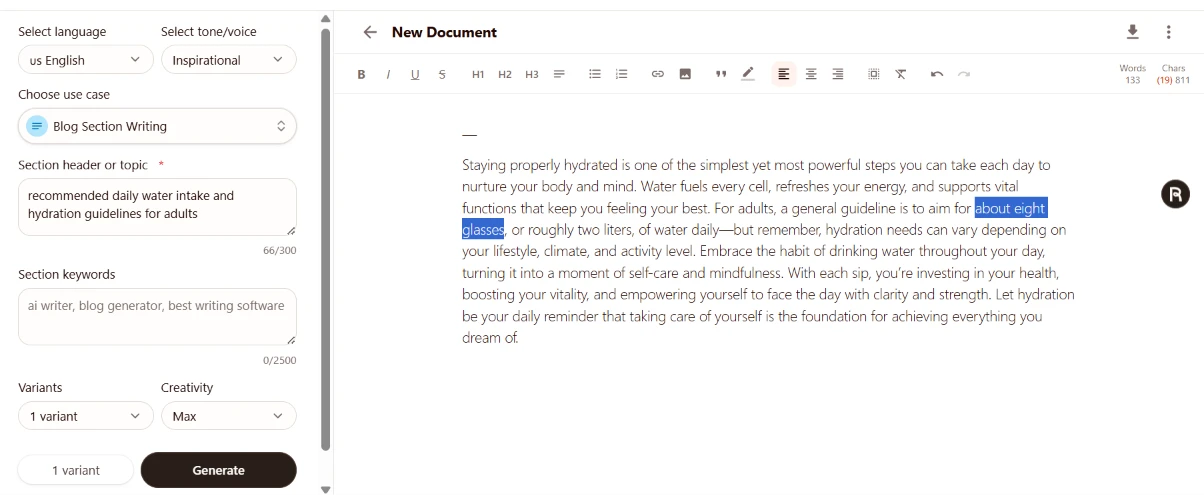
The answer: “For adults, a general guideline is to aim for about eight glasses, or roughly two liters, of water daily.”
I checked that against the Institute of Medicine’s Dietary Reference Intakes for Water, Potassium, Sodium, Chloride, and Sulfate, page 73.
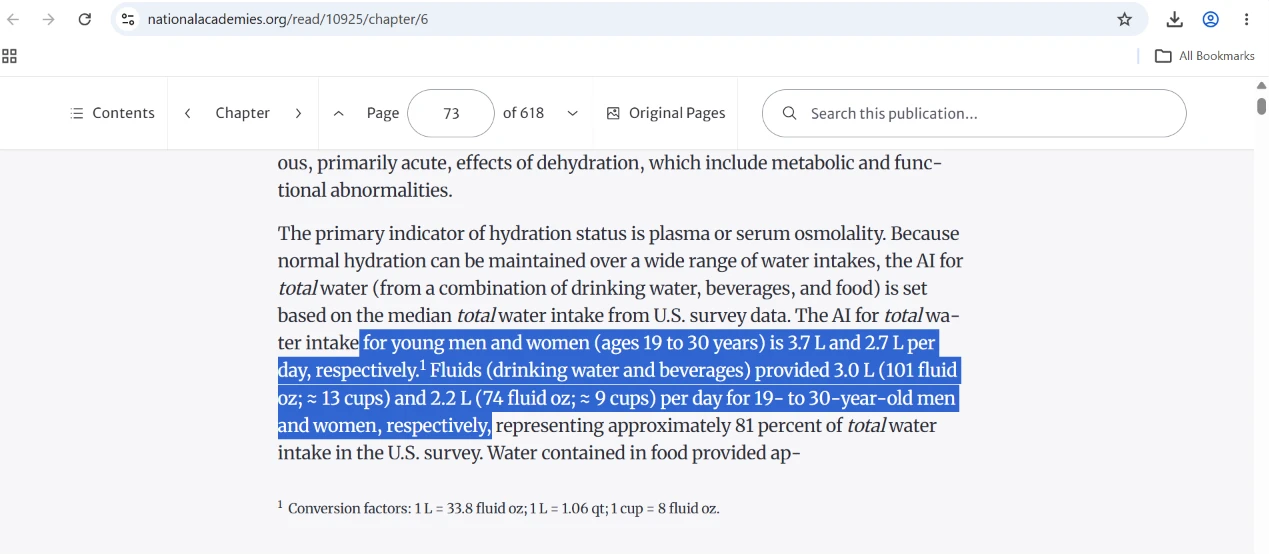
The Adequate Intake for total water sits at 3.7 litres a day for men and 2.7 litres for women, ages 19 to 30. Those figures cover water from food as well as from drinks. The comparable drinking-only number, given in the same paragraph, is about 13 cups a day for men and 9 cups for women. Eight glasses falls below both.
Two errors sit inside Rytr’s single sentence. It issued one figure for all adults where the source separates men from women. And it labelled the eight-glasses rule “a general guideline” when that number is folk wisdom with no published standard behind it.
Rytr deserves credit on two counts. It hedged that hydration needs vary with climate and activity level, and it attributed the claim to nobody, so there is no fabricated citation to correct. Its arithmetic held up as well. The report’s own conversion footnote confirms that eight 8-ounce glasses comes to 64 ounces, close enough to two litres.
Given a topic where an authoritative figure sits one search away, Rytr reproduced the most-repeated piece of internet folklore and gave it the weight of a guideline. Every factual claim it generates needs verification against a primary source before it reaches a published page.
| Dimension | Our test | User signal | Verdict | Composite |
|---|---|---|---|---|
| Output Quality Clarity, relevance, human likeness | 8.5 | 8.8 | Excellent | |
| Ease of Use Onboarding and daily workflow simplicity | 9.2 | 9.4 | Excellent | |
| Feature Depth Range of formats and controls | 7.8 | 8 | Good | |
| Value for Money Perceived worth versus pricing | 7.5 | 7.2 | Good | |
| Customer Support Responsiveness and problem resolution | 3 | 2.5 | Weak | |
| Billing Transparency Auto renewal and refund clarity | 2.5 | 2 | Weak |
Toolscopia uses cookies to keep you signed in, remember your preferences, and understand how our reviews get read. Analytics are anonymous. See our privacy policy for the full detail.



Comments 0
Join the discussion and share your perspective.
Sign in to post a comment and reply to other readers.
No comments yet
Be the first to share your perspective on this tool.