1
AI content detection
Frequently praised for strict, high sensitivity, though several users report problematic false positives.
Originality.ai is a strict AI detection and plagiarism platform for academics, educators, agencies, and publishers who need fast scanning, clear reports, and responsive support to safeguard content integrity across large writing workloads.
Independent review — we test tools ourselves and analyze public user reviews. How we test.
Originality.ai earns strong praise for accurate AI and plagiarism detection, clear reports, and very fast, friendly live chat support. Reviewers highlight its strictness as useful for catching subtle AI use in academic, agency, and publishing workflows. The same strictness, however, produces false positives for some technical, structured, or creative writing, and a few users question reliability and credit policies. It suits environments where conservative, reviewable AI flags are acceptable and human judgment is part of the process, rather than contexts that demand definitive authorship proof.
Originality AI is a Canadian content-integrity platform built for people who need to verify writing before it goes out the door. Its core is an AI-content detector that claims to spot text from ChatGPT, Claude, Gemini, and other models, but the paid product bundles a plagiarism checker, a fact checker with cited sources, grammar and readability scoring, and a Chrome extension that records a document being typed to prove a human wrote it. The target user is not a casual student checking one essay. It is editors vetting freelancers, agencies scanning content at scale, and educators running submissions through a Moodle plugin.
What sets it apart is its stance. Originality AI sells only detection and refuses to build a humanizer that disguises AI text, since that would sabotage its own customers. It also states plainly that scores are probabilities, not proof, which shapes how much weight you should give any single result.
Frequently praised for strict, high sensitivity, though several users report problematic false positives.
Often mentioned alongside AI detection as useful for academic and agency workflows.
Highlighted by some reviewers as a helpful complement to AI and plagiarism scans.
Unified view and shareable, detailed breakdowns earn strong approval from educators and teams.
Chrome extension with real time feedback in Google Docs receives specific positive mentions.
Site wide scanning helps teams manage large content volumes efficiently.
Fair pricing is noted, but expiring subscription credits draw criticism from some users.
Repeatedly acclaimed as fast, kind, and solution oriented across many interactions.
Shareable links and visual AI breakdowns assist professors and collaborators.
Marketing pages tell you what a tool wants you to believe. To see what Originality.ai actually does, I ran it through a small set of my own tests using the free web checker, which allows three scans a day without an account. I fed it text I generated myself, historical writing that predates any language model, and a couple of edge cases the tool is bound to meet in real use. Here is what came back.
My first test was the easy one. I asked ChatGPT for a plain 200-word paragraph on photosynthesis and pasted it straight in with no edits. The result was decisive: the detector reported that AI use appeared to exceed 15 percent at 100 percent confidence, and it painted almost every sentence in the passage to show where the machine fingerprints sat.
The sentence highlighting is the part worth dwelling on. Plenty of detectors hand you a single number and leave you to argue with it. This one shows its work, which matters if you ever have to justify a decision to a writer or a student.
A detector that flags everything is useless, so the harder question is whether it leaves real human writing alone. I pasted the opening of the United States Declaration of Independence, a document written in 1776 that cannot possibly be AI. The gauge swung green and reported that AI use appeared to be 15 percent or less.
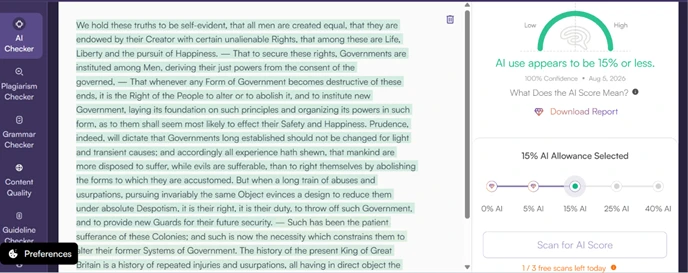
This is the tool getting it right. Formal, archaic, heavily structured prose is exactly the kind of writing that trips lesser detectors into a false positive, and it passed clean.
Short passages are a known weak spot for every AI detector, and Originality.ai handles this by refusing to guess. When I dropped a short excerpt into the Fact Checker, it stopped me at 83 words with a note that the minimum is 100.
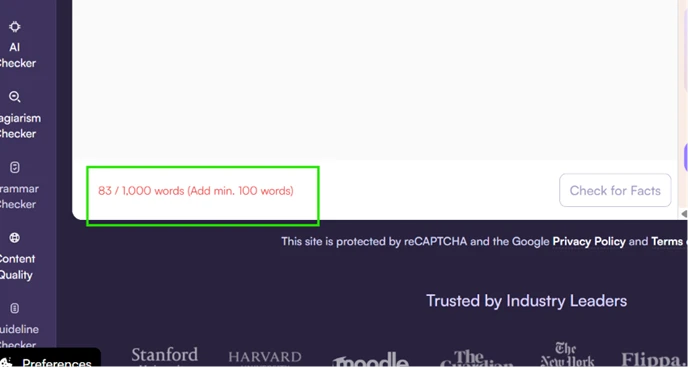
I read this less as a flaw and more as an honest limit. A tool that admits it needs enough text to work is safer than one that returns a confident verdict on two sentences.
The Fact Checker went a step past detection. Running the same Declaration text, it marked a claim as 100 percent potentially true, then explained why and linked two external sources backing the call.
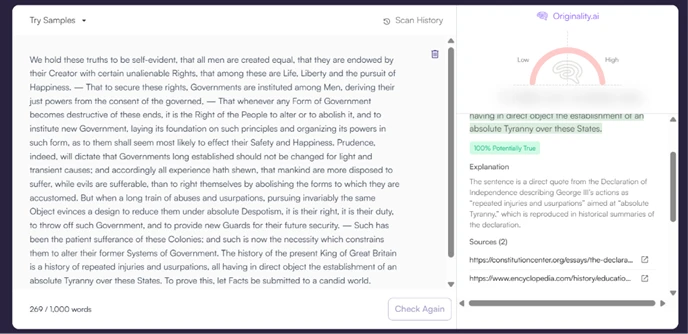
Citations turn a yes-or-no answer into something a reader can verify. For an editor checking a draft before publishing, that traceability is the feature that earns its keep.
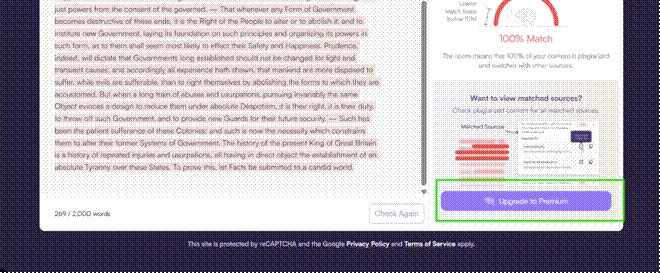
The plagiarism check produced the sharpest split in the whole test. Fed the Declaration again, it returned a 100 percent match, correctly recognizing text that lives on thousands of web pages. Accuracy was not the problem.
The catch sits on the right side of that screen. The free tier tells you that content is plagiarized but blurs out where it came from, hiding the matched sources behind an Upgrade to Premium button. You get the verdict without the evidence, and the evidence is the part you actually need.
Originality.ai offers no humanizer, meaning no feature that rewrites AI text to slip past detection. Given that its whole business is selling detection to teachers, editors, and agencies, a built-in evasion tool would work against its own customers. The absence is a deliberate stance rather than a gap, though it does mean the product only ever points one direction.
| Dimension | Our test | User signal | Verdict | Composite |
|---|---|---|---|---|
| AI Detection Accuracy Reliability detecting AI patterns | 8 | 8.3 | Good | |
| False Positive Handling Fairness toward human writing | 6 | 6.2 | Moderate | |
| Ease of Use Learning curve and daily usability | 8.8 | 9.1 | Excellent | |
| Customer Support Speed and quality of assistance | 9.5 | 9.7 | Excellent | |
| Value for Money Perceived fairness of pricing | 7.8 | 7.5 | Good | |
| Workflow Integration Fit with academic and agency flows | 8.6 | 8.9 | Excellent |
Toolscopia uses cookies to keep you signed in, remember your preferences, and understand how our reviews get read. Analytics are anonymous. See our privacy policy for the full detail.


Comments 0
Join the discussion and share your perspective.
Sign in to post a comment and reply to other readers.
No comments yet
Be the first to share your perspective on this tool.