1
Multistyle citation generator
Supports APA, Turabian, MLA, and more, widely praised for accuracy and reliability.
Citation generator and academic editing platform focused on students and researchers who need accurate references, APA formatting, and language polishing under tight deadlines, with mostly free tools plus paid proofreading, formatting, and plagiarism checks.
Independent review — we test tools ourselves and analyze public user reviews. How we test.
Scribbr delivers highly accurate, easy to use citation tools and well regarded academic editing, particularly for APA and other formal styles. Most reviewers highlight fast turnaround, helpful feedback, and a clean, ad free workspace. Criticism clusters around paid services, especially formatting scope, unclear pricing for some checks, occasional technical issues, and billing confusion. Best suited to students and researchers who rely heavily on citations and want professional editing support, while being careful to confirm service scope and costs in advance.
Scribbr began as a proofreading and plagiarism service for students, and "Scribbr AI" is the newer layer of automated tools stacked on top of that business: an AI detector, a paraphraser, a grammar checker, and an AI proofreader. The detail most reviews skip is that its main AI tools are not built in-house. Scribbr is owned by Learneo, formerly Course Hero, and its AI detector and paraphraser both run on QuillBot's engine, a sibling product under the same parent. The tools you are testing share their core with QuillBot instead of standing alone.
That ownership shapes how much weight the scores deserve. Passing Scribbr's detector is close to passing QuillBot's, so it works as a first-pass screen rather than an independent second opinion. The Citation Generator sits outside the AI label: it fills references from fixed style rules, not a language model, and belongs to Scribbr's older toolkit. Sorting the genuinely AI-driven tools from the rule-based ones shows you which outputs are probabilistic guesses and which are fixed, and where a wrong answer is most likely to hide.
Supports APA, Turabian, MLA, and more, widely praised for accuracy and reliability.
Groups and stores citations per project, helping students manage multiple assignments efficiently.
Lets users manually enter details when automatic detection fails, viewed as handy backup.
Human editors improve grammar, style, clarity, and tone, often described as detailed and constructive.
Applies APA 7 rules, but expectations around custom university templates sometimes misaligned.
Flags similarity percentages and sources, criticized for inconsistent reports and unclear free tier.
Browser extension aids quick citing from webpages, frequently called convenient for everyday tasks.
Interface highlighted as fast and distraction free compared with other citation tools.
Offers AI based checks, with some complaints about per word pricing and expectations.
I tested four of Scribbr's free tools by feeding each one text where I already knew the correct answer, so every result could be checked against the truth rather than guessed at. The runs covered the AI Detector, the Paraphraser, the Grammar Checker, and the Citation Generator. Every screenshot below is an actual output.
I started with the easiest possible case. I generated a formal, five-sentence paragraph about time management using ChatGPT and pasted it into the detector. Scribbr flagged it as 100% AI-generated and highlighted nearly every sentence.
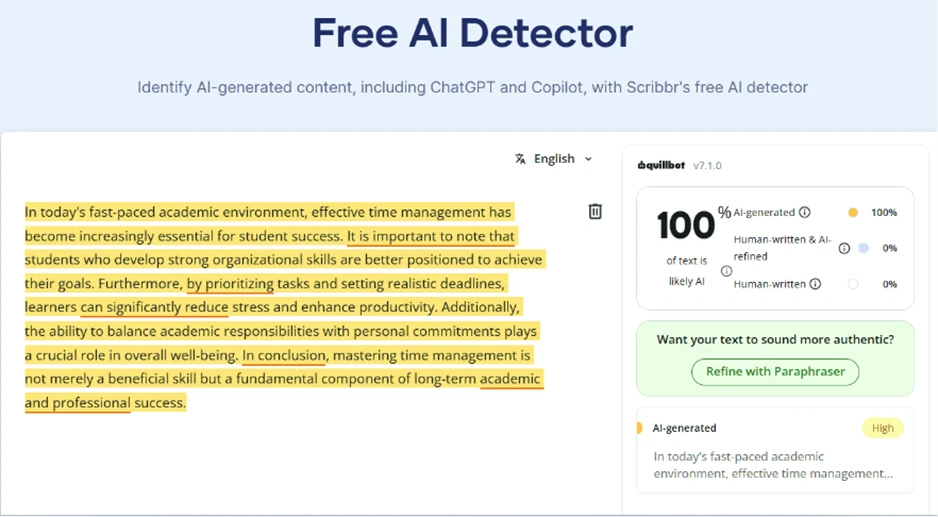
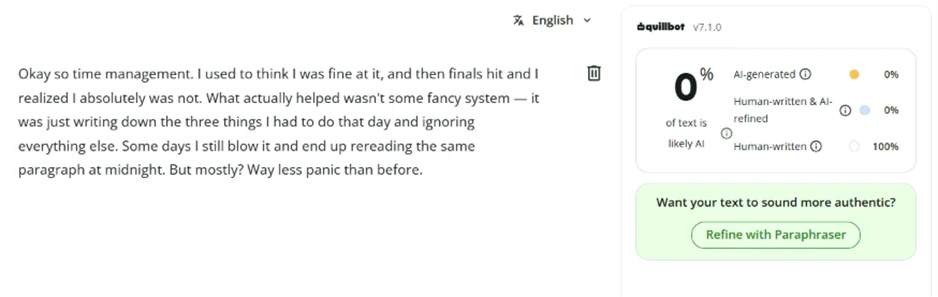
So the tool catches obvious, textbook AI writing. My next sample was also machine-written, but in a loose, conversational voice: a short first-person paragraph about a café where someone likes to work. The score dropped to 0% AI, and the passage was marked 100% human.
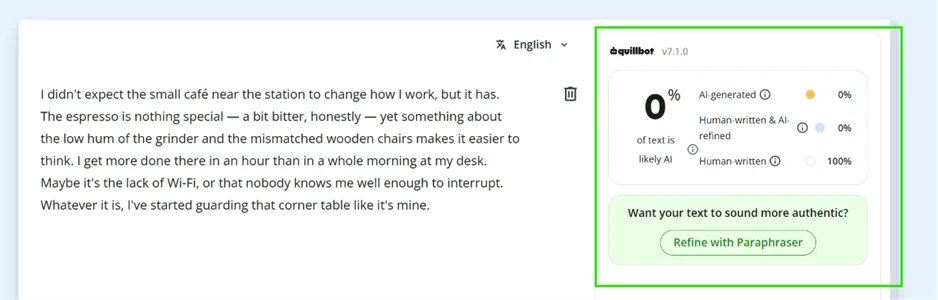
Two AI paragraphs, one author, opposite verdicts. The single thing that changed between them was the writing style.
Human text is where the results turned strange. I pasted a paragraph from a published 2005 article about the Civil Rights Act of 1960, written years before ChatGPT existed. Scribbr labelled it 100% AI-generated.
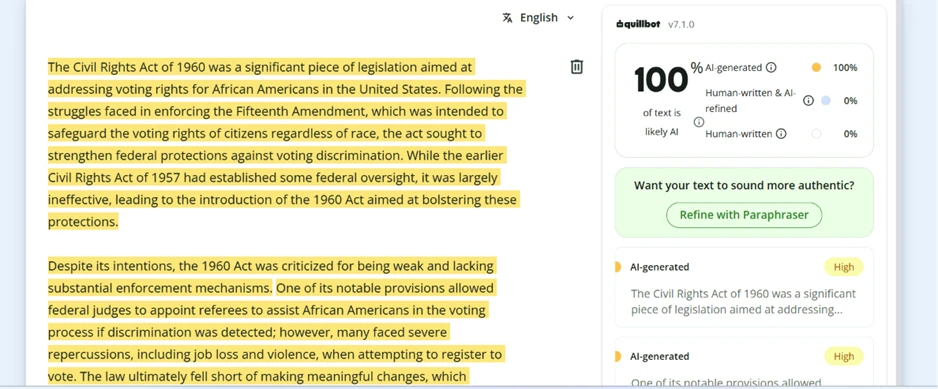
For a student submitting honest work, that is the result that stings the most.
For balance, I ran a narrative passage from a 1959 article through the same detector. Here it got the answer right, scoring the text 100% human.
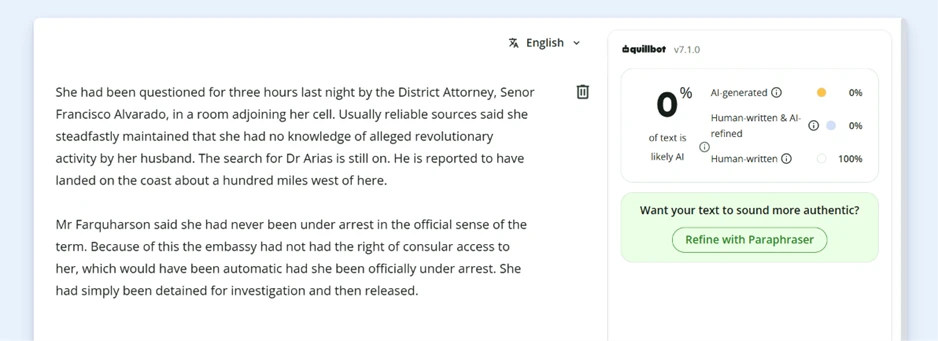
Lining up the four results exposes the pattern.
| Formal, academic prose | Casual, narrative prose | |
| Written by AI | 100% AI (Figure 1) | 0% AI (Figure 2) |
| Written by a human | 100% AI (Figure 3) | 100% human (Figure 4) |
Table 1. Detector verdicts by writing style and true author.
The verdict tracks the column, not the row. Formal academic prose gets read as AI whether a person or a model wrote it, and casual narrative prose gets read as human in both cases. The free detector is measuring register, not authorship.
I wanted to test that directly, so I ran the original formal essay through Scribbr's own Paraphraser. It changed individual words, swapping "effective" for "good" and "students" for "pupils", while leaving the sentence structure untouched.
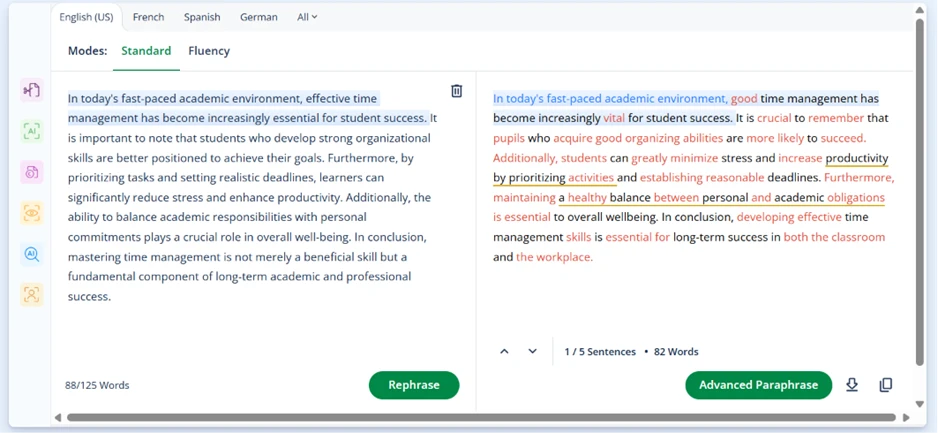
I pasted the reworded paragraph back into the detector. The score held at 100% AI-generated.
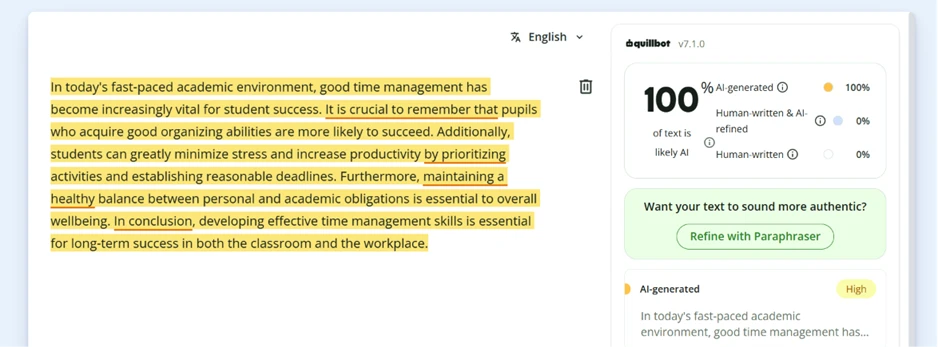
Swapping vocabulary changed nothing, because the formal shape of the writing stayed intact.
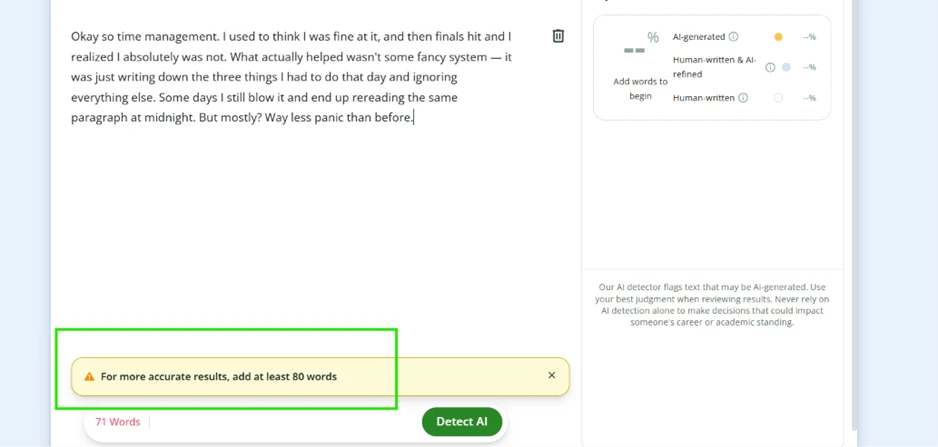
One more limitation surfaced during testing. The detector will not score short passages at all: a 71-word paragraph produced a warning asking for at least 80 words before it would give an accurate reading.
When the detector did score that same casual paragraph, it came back at 0% AI, another machine-written sample it read as human.
The Grammar Checker held up better. I gave it a single 26-word sentence packed with spelling and punctuation mistakes, and it caught 7 errors.
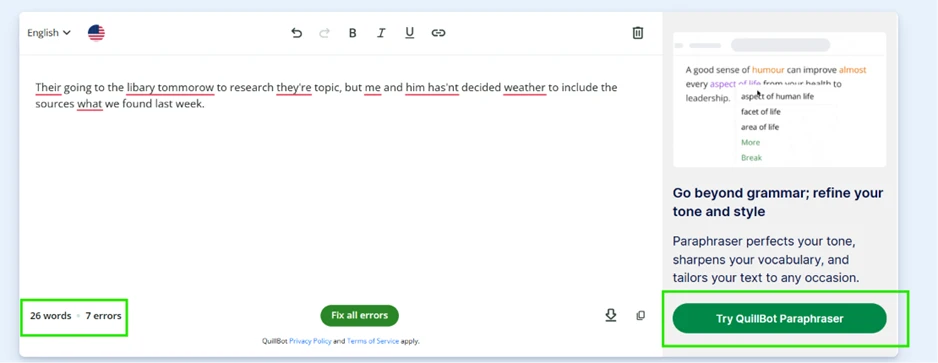
On plain proofreading, the tool does its job.
The Citation Generator runs on a separate rule-based engine, and it was the strongest tool I tested. I searched by DOI for the 1953 Watson and Crick paper on the structure of DNA.
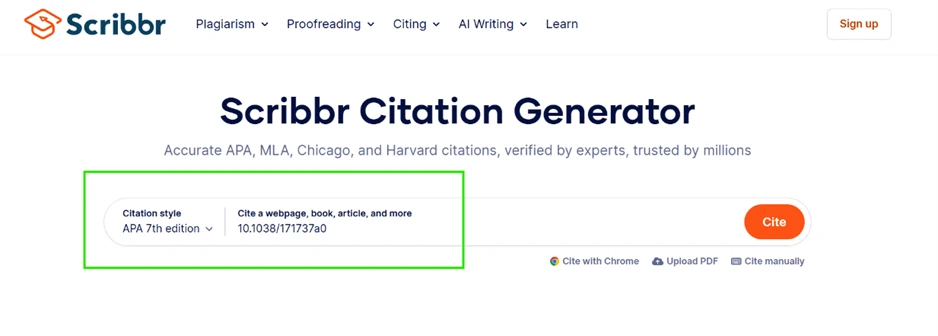
It returned a correctly formatted APA 7th edition reference, with the authors, article title, journal name, year, volume, and DOI all filled in.
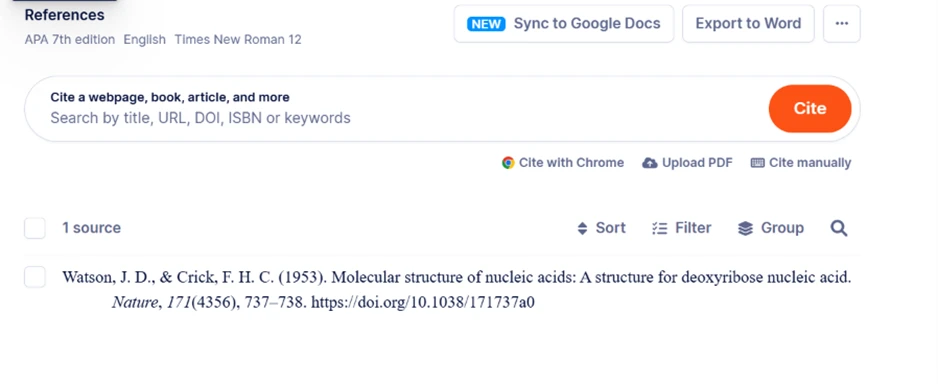
On a well-indexed source, the output needed no manual correction.
| Dimension | Our test | User signal | Verdict | Composite |
|---|---|---|---|---|
| Citation Accuracy Correctness of generated references | 9.2 | 9.5 | Excellent | |
| Editing Quality Depth of language and style edits | 8.6 | 8.9 | Excellent | |
| Formatting Reliability Consistency with style and templates | 7.4 | 7 | Good | |
| Tool Usability Ease of use and navigation | 9 | 9.2 | Excellent | |
| Support and Transparency Responsiveness and clarity of terms | 7.2 | 6.5 | Moderate | |
| Plagiarism Check Performance Stability and clarity of reports | 6.8 | 6 | Moderate |
Toolscopia uses cookies to keep you signed in, remember your preferences, and understand how our reviews get read. Analytics are anonymous. See our privacy policy for the full detail.


Comments 0
Join the discussion and share your perspective.
Sign in to post a comment and reply to other readers.
No comments yet
Be the first to share your perspective on this tool.