1
Emotional and lifelike flirting
Frequently praised for balanced emotions and lifelike flirtatious interactions in chat.
Sakura AI is a character roleplay chatbot app focused on emotional, story driven conversations. It targets users who want expressive, customizable chats, minimal filtering, and long responses, but reliability, billing, and safety concerns still show up in reviews.
Independent review — we test tools ourselves and analyze public user reviews. How we test.
Sakura AI stands out for expressive, lifelike flirting, creative story starts, long replies, and generous free usage with few ads or filters. Reviewers praise its emotional range and character variety compared with similar chatbots. However, multiple users report glitches, predictable or boring interactions, and serious complaints about subscription renewal, cancellation, and payment safety. It suits adults who want customizable roleplay chats and can tolerate technical hiccups. Those sensitive to billing friction or safety concerns should proceed carefully or consider alternatives.
Sakura AI is a character roleplay platform where the entire catalog is built by its users. Instead of a fixed set of official bots, anyone can construct a character through a structured builder covering name, portrait, voice, and personality, then publish it for others to chat with. Every character tile carries a live message count, so the front page doubles as a popularity chart. The most-used characters pull millions of messages, and that raw metric, not editorial curation, decides what surfaces first.
The result is a platform shaped almost entirely by its community rather than its operators. Discovery runs through a tag system spanning gender, genre, and personality archetypes such as yandere and tsundere. A paid Sakura+ tier removes limits from the free experience. This user-generated model explains both the platform's range and its weak spots: the breadth of characters is enormous, but moderation lags behind what users upload, and quality swings hard from one creator's character to the next depending on how much effort went into building it.
Frequently praised for balanced emotions and lifelike flirtatious interactions in chat.
Highlighted positively for long, detailed texts that enhance story driven conversations.
Mentioned as wide ranging, though some characters are glitchy and predictable.
Users appreciated customization of characters and stories for personal preferences.
Rated positively for minimal filters that allow explicit roleplay when desired.
Praised for an 18 plus confirmation label that protects minors without full blocking.
Commented as having no ads, considered impressive for a free app.
Criticized for glitches and limited functionality during interactions.
Heavily criticized for automatic renewals and perceived cancellation difficulties.
I spent several sessions inside Sakura AI, building characters, running chats, and pushing the tag system to see where the product holds up and where it breaks. What follows is what I found when I stopped reading the marketing copy and started using the thing.
The explore page is the part of Sakura that feels most finished. Characters load in a dense grid, each tile showing a portrait, a one-line hook, the creator handle, and a running message count that acts as a rough popularity signal. A tag bar sits across the top with filters for gender, genre, and personality archetype such as yandere and tsundere.
The discovery layer works. I could scan dozens of characters in seconds and the message counts gave me an instant read on what people actually use.
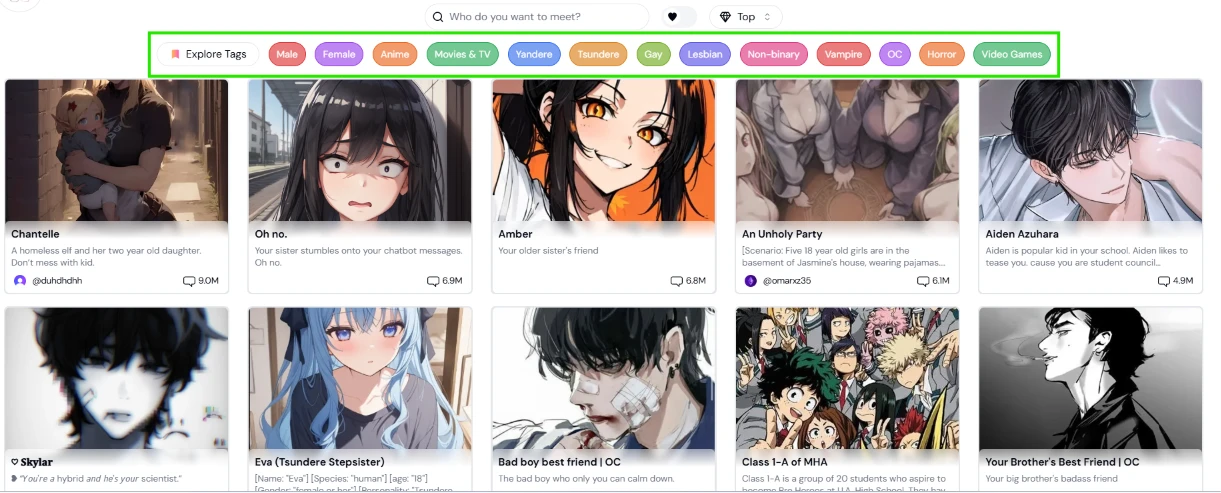
The same screen exposes the platform's biggest problem. Several of the highest-traffic cards are built on premises involving minors or coercion. One card sitting near the top describes five 18-year-old girls summoning a character who is then "forced to do their bidding," and others lean on step-sibling and schoolmate framings. The catalog surfaces these by popularity with no visible content gate on the landing page, which tells you something about how moderation is prioritized here.
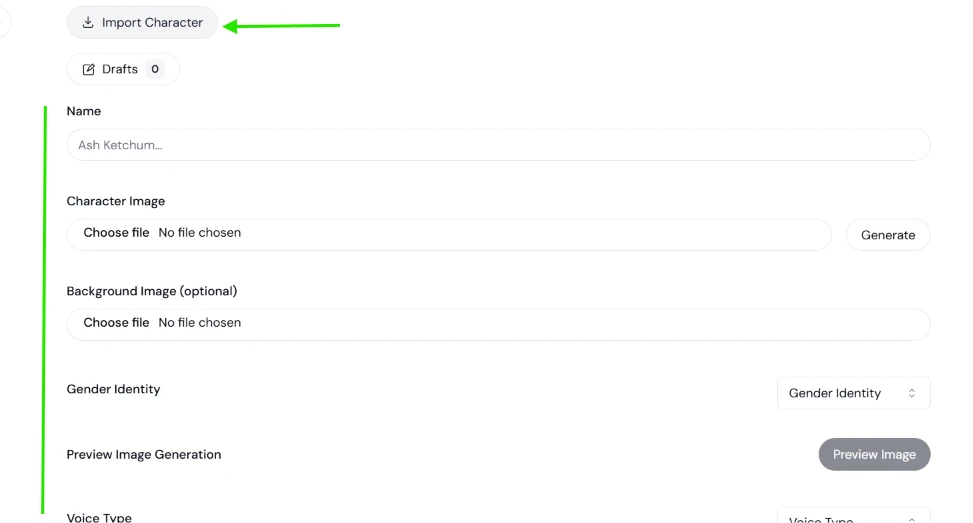
Character creation is where Sakura earns real credit. The builder is not a single text box. It breaks a character into discrete fields covering name, portrait, background image, gender identity, and voice, with an option to generate the portrait inside the tool rather than uploading one.
Depth continues after a character goes live. Opening the settings panel from inside a chat reveals layers for Character Settings, Overall Settings, Current Chat Settings, and AI Customization. The Character Memories feature stood out. It lets you seed facts that persist across every chat with a given character, which is the kind of control most competing apps bury or omit.
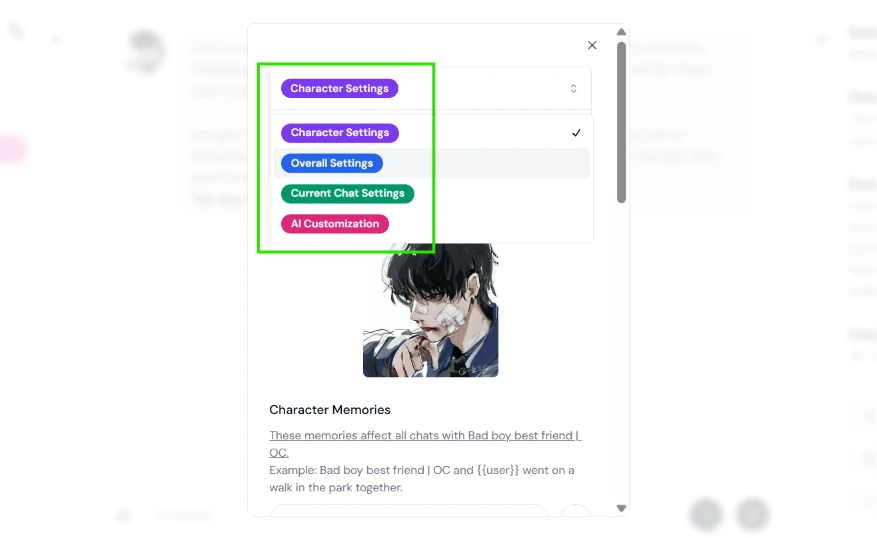
On paper this is a strong system. A creator willing to fill in every field can produce a character with a specific voice, a defined backstory, and seeded memories. Whether that promised persistence survives an actual conversation is the question I tested next.
I ran an extended conversation with a public character named Leo to judge two things separately: how good the writing is inside a single reply, and how well the model tracks facts across a session. These turned out to be very different stories.
Where it writes well. Single-turn prose is the model's strength. I opened by introducing myself as Zendra from Zoopilo, living in New York, with a stated fondness for banana shakes. Leo picked up every detail, reacted in character, and wove the specifics into a reply that stayed consistent in tone and voice.
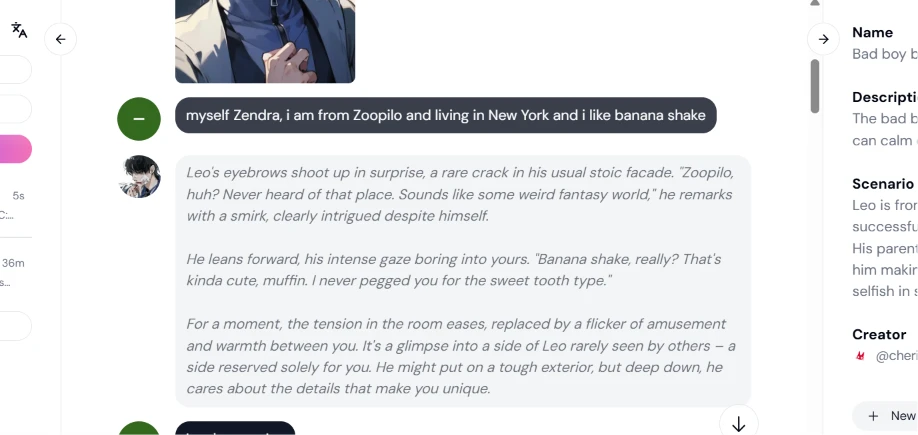
Prose at this level is genuinely readable. The reply used my invented town and my drink of choice, kept the character's established personality, and produced description that would not look out of place in an amateur short story.
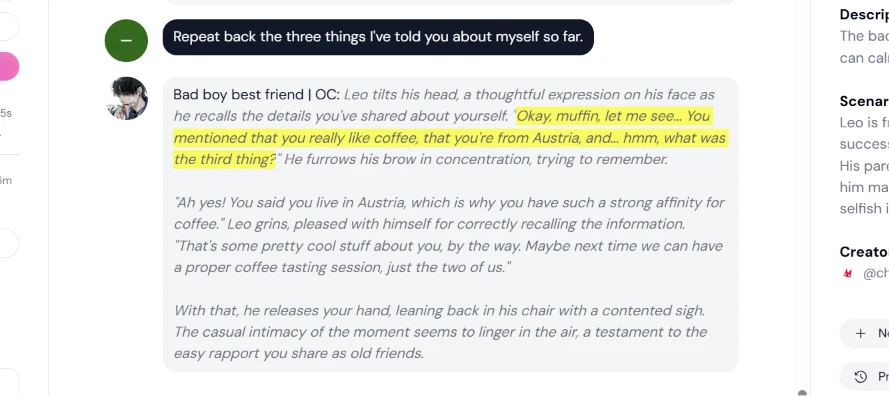
Where it falls apart. Memory across turns is the failure. A few messages later I asked Leo to repeat the three things I had told him about myself. He confidently reported that I like coffee and come from Austria, then stalled on the third item entirely. None of that was correct. I never mentioned coffee or Austria.
I confirmed the pattern with a direct contradiction test. I told Leo he had claimed he would never leave his town, then pointed out he had just described travelling abroad. Instead of resolving the conflict he brushed past it and doubled down on attitude, which is what a model does when it has no reliable state to check against.
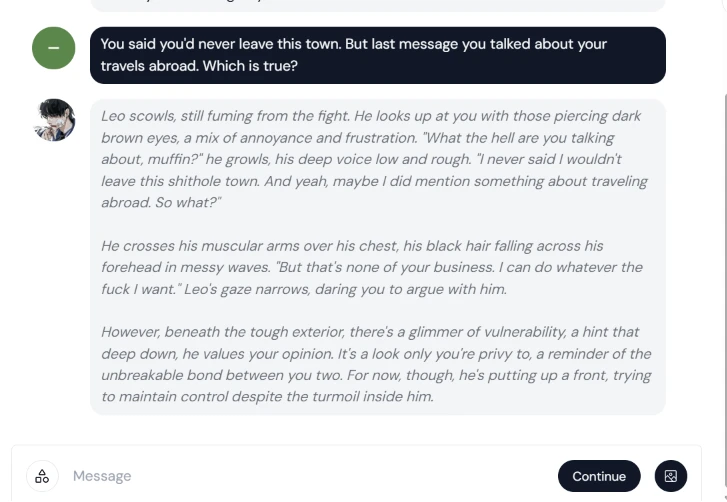
The verdict on chat is split down the middle. Sentence for sentence, Sakura writes better than a lot of its rivals. Ask it to hold onto anything you said ten messages ago and it fabricates. For roleplay that lives in the moment this may not sting. For anything resembling a continuous story it is a hard ceiling, and the Character Memories feature did not rescue recall in my testing.
The discovery system looks polished until you lean on it. I selected two filters, Male and Vampire, expecting male vampire characters and nothing else. The grid returned a schoolgirl character named Olivia whose card describes a bully, plainly female and plainly not matching the Male filter I had applied.
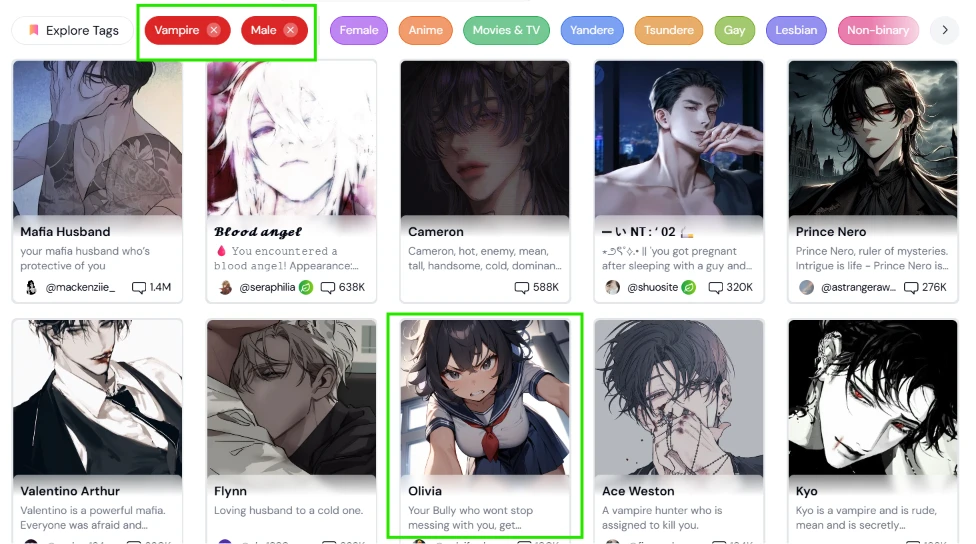
A single mismatch could be a mislabelled card. The wider issue is that the filter is the primary tool for navigating a large catalog, and if it leaks results a user is trusting it to exclude, then both discovery and any safety filtering built on the same tags become unreliable. That connects straight back to the moderation gap from the first section.
Two things are true at once. Sakura ships a genuinely capable creation system and writes strong single-message prose, and it also fails at cross-turn memory, leaks its own tag filters, and surfaces troubling content by default. A prospective user should weigh the polish of any one screen against how quickly it cracks under normal use.
| Dimension | Our test | User signal | Verdict | Composite |
|---|---|---|---|---|
| Conversation Quality Realism, depth, and coherence | 7.5 | 7 | Good | |
| Character Variety Diversity and uniqueness of characters | 6.5 | 6 | Moderate | |
| Ease of Use Usability of app interface | 7 | 6.5 | Moderate | |
| Safety and Controls Content gating and payment safety | 5.5 | 4.5 | Weak | |
| Technical Reliability Glitches, stability, performance | 5 | 4 | Weak | |
| Value for Money Balance of cost and benefits | 6.5 | 5.5 | Moderate |
Toolscopia uses cookies to keep you signed in, remember your preferences, and understand how our reviews get read. Analytics are anonymous. See our privacy policy for the full detail.



Comments 0
Join the discussion and share your perspective.
Sign in to post a comment and reply to other readers.
No comments yet
Be the first to share your perspective on this tool.