1
Unified multi model dashboard
Combines text, image, video, and audio tools, widely praised for simplifying workflows.
SYNTX.AI is a multi model AI workspace that combines text, image, video, and audio tools in one interface, aimed largely at creators and teams wanting faster, centralized content workflows.
Independent review — we test tools ourselves and analyze public user reviews. How we test.
SYNTX.AI delivers strong value for creators who want text, image, video, and audio models in a single dashboard, with many praising ease of use and workflow speed. Output quality and fast generations for creative work are consistent positives, and pricing is often described as fair for the breadth of tools. However, some users report very slow performance, limited depth for text answers, model version confusion, and unresponsive support in higher demand scenarios. There are also complaints about refund handling and dissatisfaction with hiring practices, which may influence trust. Overall, it suits creators and small teams prioritizing integrated AI tooling over absolute reliability and model transparency.
SYNTX AI is an aggregator that sits on top of other companies' AI models and resells access to them through a single account. Rather than holding separate ChatGPT, Midjourney, Runway or Suno subscriptions, you pay SYNTX once and spend tokens on whichever model you call. The catalog runs past 90 models covering text, images, video, audio and music, reached through a web dashboard or a Telegram bot. Familiar names sit inside it: Nano Banana and Flux for images, Kling and Veo for video, ElevenLabs and Suno for voice, with Claude and GPT handling the writing.
The appeal is consolidation and cost. One bill replaces four or five, and an agency juggling several tools can save around 80 dollars per seat each month. The trade-off is that you work through a middle layer instead of the source. You depend on SYNTX to keep model versions current and to price tokens fairly. You also trust it to pass your prompts through without watermarks or gates the native apps would never impose. That gap between the label on the menu and the model running your request is the thing worth testing, and the rest of this review does exactly that.
Combines text, image, video, and audio tools, widely praised for simplifying workflows.
Supports low resolution tests then 4K upscaling, praised as included in plans.
Provides text models, but criticized by some for shallow answers and slow responses.
Allows frequent script and prompt tweaking without heavy cost tracking, valued by experiment driven users.
Frequently adds new AI models, appreciated by users working in rapidly changing spaces.
Support praised as responsive by some, yet others report no replies after payment.
Seen as fair value for included services, though refund denials frustrate dissatisfied customers.
API usage and Seedance model criticized for extreme slowness and doubts about model authenticity.
Interface often described as clean and intuitive, though some mention an initial learning curve.
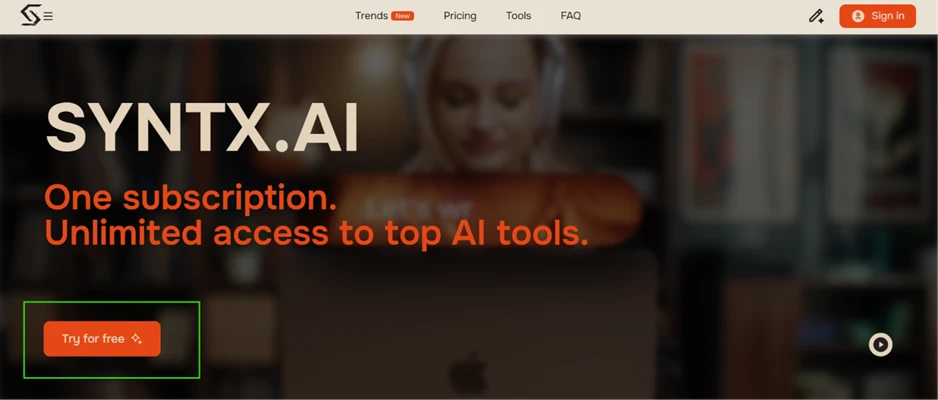
I set up a fresh free account on SYNTX.AI to find out how far it goes before it asks for payment. The homepage frames the pitch plainly, promising one subscription and unlimited access to top AI tools, with a bright orange Try for free button as the way in. I took that promise at face value and started generating.
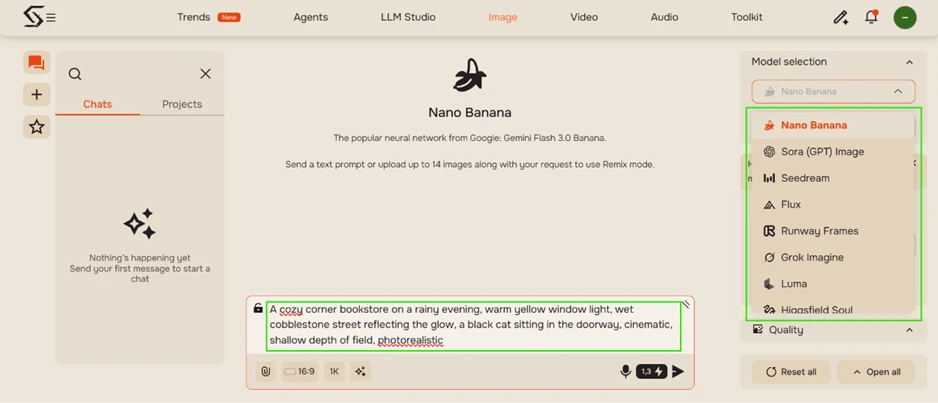
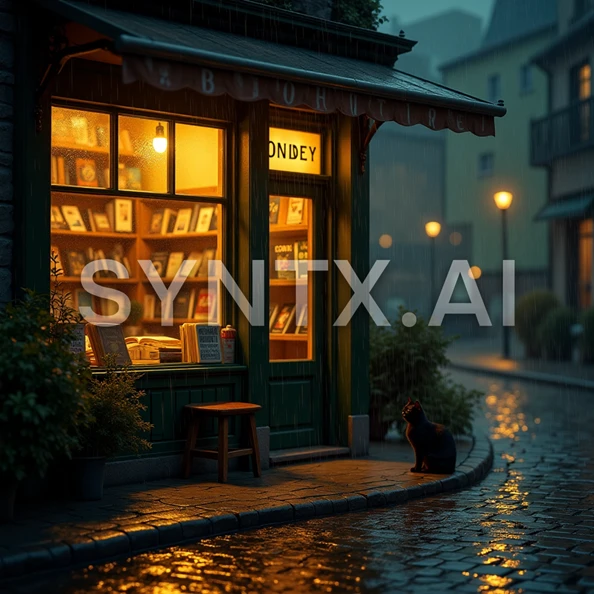
Inside the Image section I picked Nano Banana, the Google Gemini Flash model listed in their menu, and wrote a plain prompt: a cozy corner bookstore on a rainy evening with a black cat in the doorway.
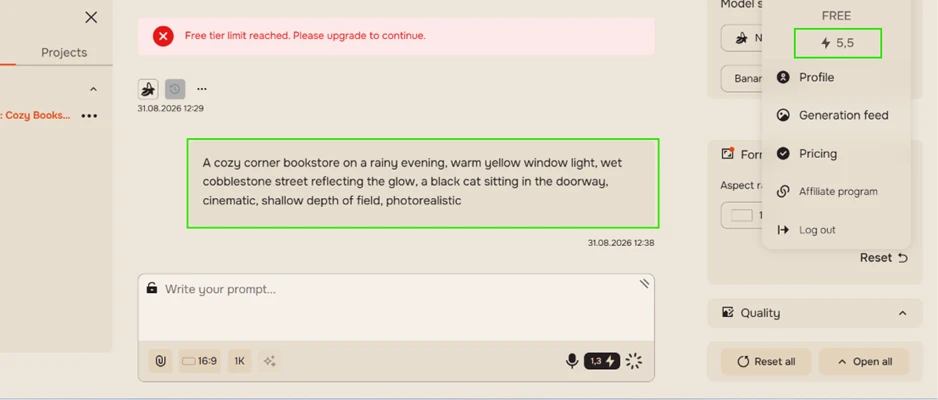
The response was a block.
A red banner read Free tier limit reached, please upgrade to continue, and it repeated every time I retried over the next nine minutes. The number sitting beside it made the block strange. My account showed 5.5 free credits against a generation cost of 1.3, so this was never about running low on balance. Nano Banana is walled off on the free tier regardless of what the counter says.
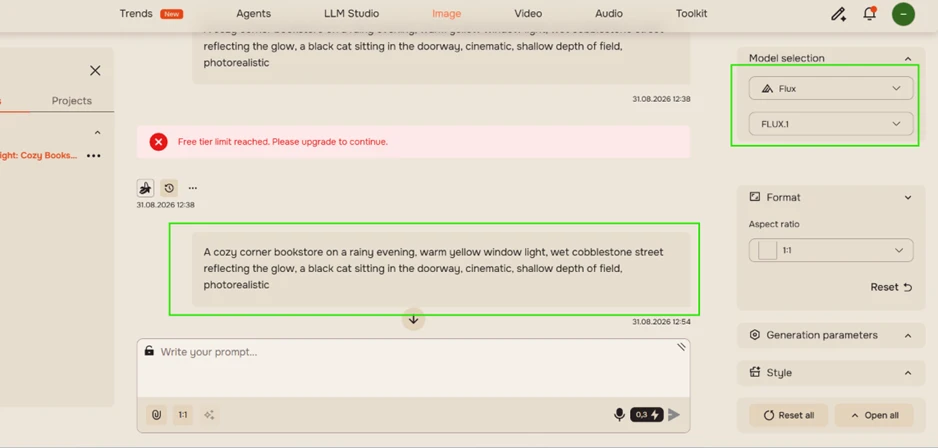
Switching to Flux, priced at 0.3 tokens per image, changed the result. The same prompt finally produced a picture.
The output came with two problems. A large SYNTX.AI watermark sits across the middle of the frame rather than tucked discreetly into a corner. The shop signage also renders as garbled lettering, with the awning and window text reading as nonsense instead of real words. Free images are possible, then, but only from the basic models and only with a watermark stamped over the subject.
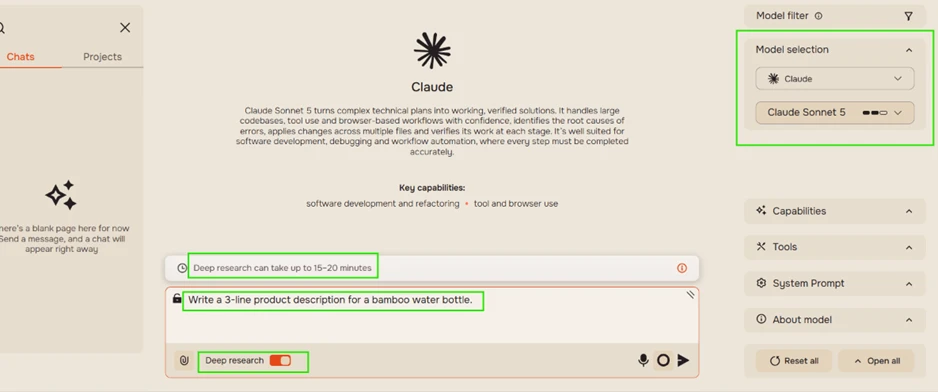
LLM Studio behaved better. I chose Claude Sonnet 5 and asked for a three-line product description for a bamboo water bottle, leaving Deep Research switched off after it warned of a 15 to 20 minute wait.
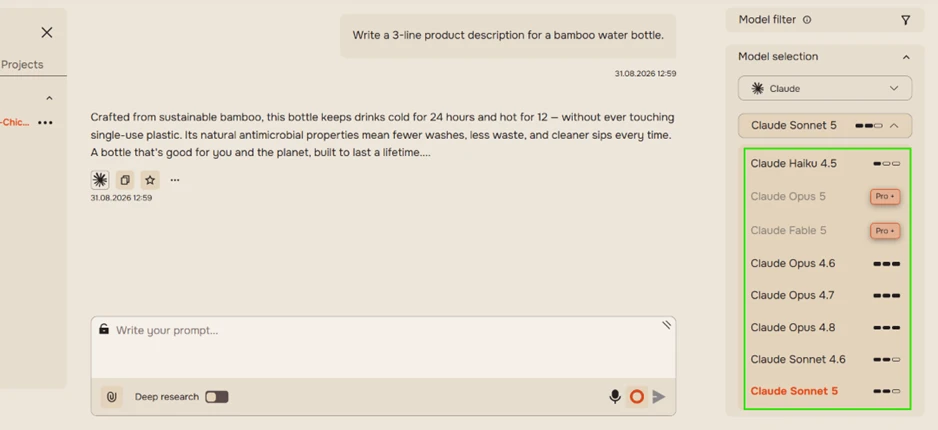
The copy came back in seconds, clean and ready to paste, carrying no watermark and no gate on that model. The model list did expose the upsell structure, with Claude Opus 5 and Fable 5 both locked behind a Pro+ badge while the standard models stayed open.
The Audio section carried ElevenLabs and Suno, along with a video-to-audio mode, plus a voice library I could filter by gender, age, use case, language and accent. Attempting a voice generation threw a fresh popup titled Subscribe to continue, telling me my free tokens had run out and laying out the plans.
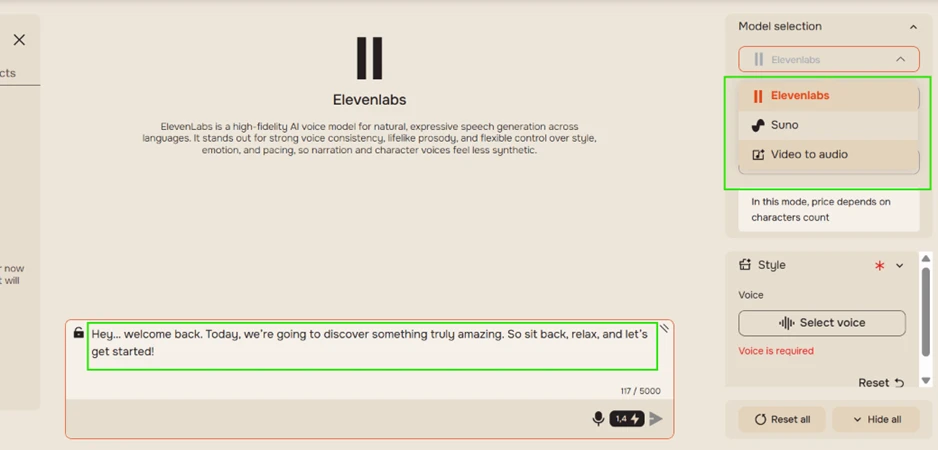
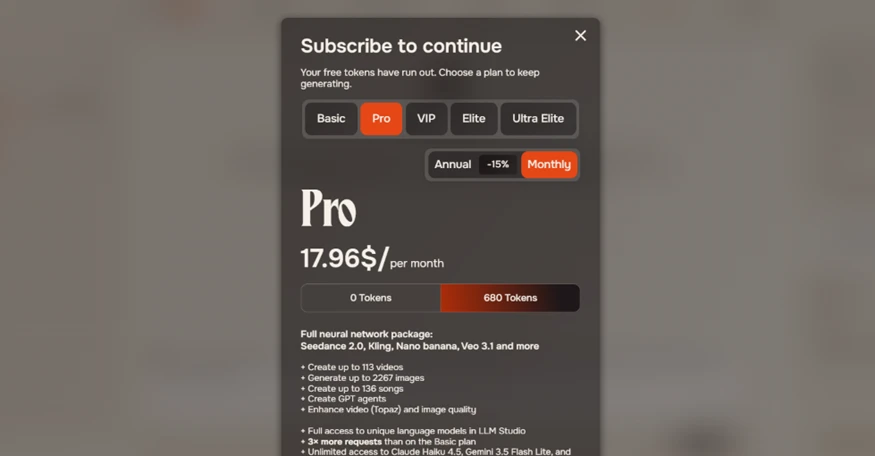
That message did not match reality.
The token history showed I still held 5.2 tokens at that moment. The same ledger also exposed the real billing logic behind every earlier block. Each failed Nano Banana attempt charged 1.3 and then refunded it moments later, while the one successful Flux run charged 0.3 and kept it. So the wall was a model restriction dressed up as an empty wallet.
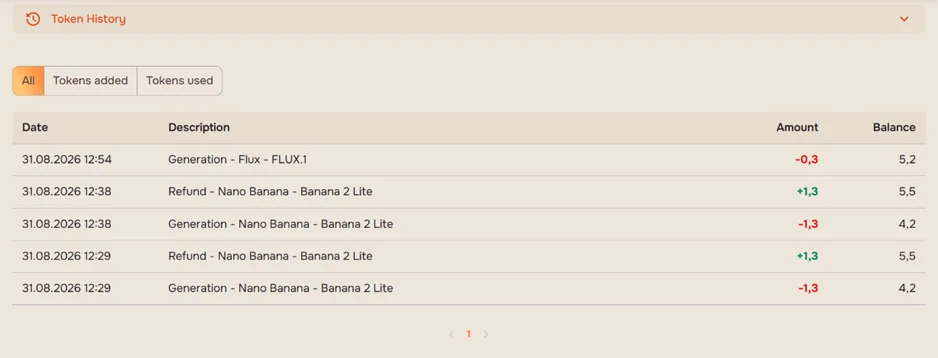
Two conclusions come straight off that ledger. The automatic refund on failed generations is fair, since I paid nothing for output that never arrived. The out-of-tokens messaging is not, because it fired while 5.2 tokens still sat in the account.
For reference, the Pro plan opens at 17.96 dollars a month for 680 tokens, with an annual toggle dangling a 15 percent cut against the monthly rate.
| Dimension | Our test | User signal | Verdict | Composite |
|---|---|---|---|---|
| Ease of Use Navigation and learning curve | 8.5 | 8.8 | Excellent | |
| Creative Output Quality Media and text generation quality | 8 | 8.2 | Good | |
| Performance and Speed Generation speed and uptime | 6 | 5.5 | Weak | |
| Value for Money Perceived value versus pricing | 8 | 8.3 | Good | |
| Customer Support Helpfulness and responsiveness | 6.5 | 6 | Moderate | |
| Model Transparency Clarity on models and versions | 5.5 | 5 | Weak |
Toolscopia uses cookies to keep you signed in, remember your preferences, and understand how our reviews get read. Analytics are anonymous. See our privacy policy for the full detail.









Comments 0
Join the discussion and share your perspective.
Sign in to post a comment and reply to other readers.
No comments yet
Be the first to share your perspective on this tool.